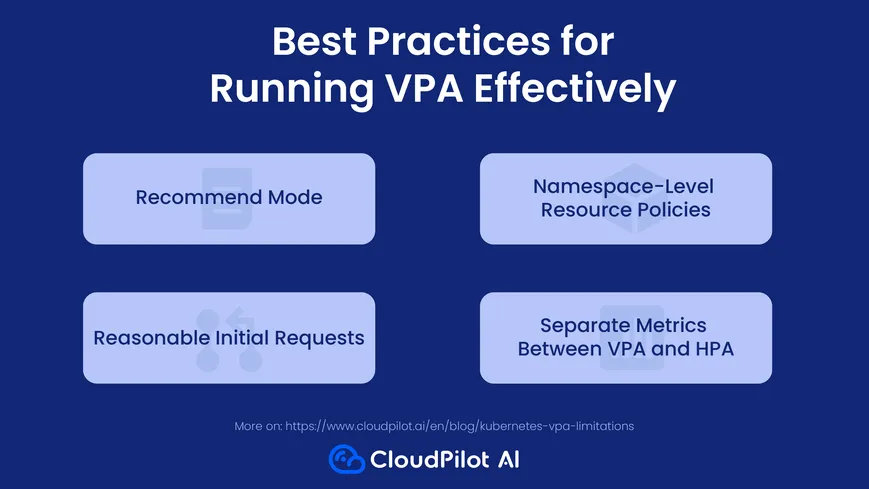
Kubernetes' Vertical Pod Autoscaler (VPA) tries to be helpful by tweaking CPU and memory requests on the fly. Problem is, it needs to bounce your pods to do it. And if you're also running Horizontal Pod Autoscaler (HPA) on the same metrics? Now they're fighting over control.
VPA sees a narrow slice of the world. No awareness of cluster topology. No big-picture view of workload patterns. It leans on short-term signals and brute-force restarts—not great if you're running critical, multi-region systems or trying to scale cleanly.
Let's keep in touch!
Stay updated with my latest posts and news. I share insights, updates, and exclusive content.
Unsubscribe anytime. By subscribing, you share your email with @faun and accept our Terms & Privacy.
Give a Pawfive to this post!
Only registered users can post comments. Please, login or signup.
Start writing about what excites you in tech — connect with developers, grow your voice, and get rewarded.
Join other developers and claim your FAUN.dev() account now!

The FAUN watches over the forest of developers. It roams between Kubernetes clusters, code caves, AI trails, and cloud canopies, gathering the signals that matter and clearing out the noise.
Developer Influence
3k
Influence
302k
Total Hits
3711
Posts
Hey, sign up or sign in to add a reaction to my post.
Join thousands of other developers, 100% free, leave anytime.
Hey there! 👋 I created FAUN.dev(), an effortless, straightforward way for busy developers to keep up with the technologies they love 🚀
Aymen @eon01
Founder of FAUN.dev()
Join thousands of developers and engineering teams who use FAUN.dev() to stay up-to-date with the technologies they love, without the overwhelm.