Building a SaaS startup is all about speed. Teams launch MVPs quickly, push updates daily, and continuously experiment with new features to stay ahead of competitors. But while moving fast helps startups grow, it also creates one major problem: bugs reach users faster than ever.
A broken signup flow, failed payment gateway, or crashing dashboard can instantly damage user trust. For early stage SaaS companies, even small failures can lead to customer churn and negative reviews. That is exactly why startups need end to end testing from the beginning instead of treating it as something only large enterprises need.
What Is End to End Testing?
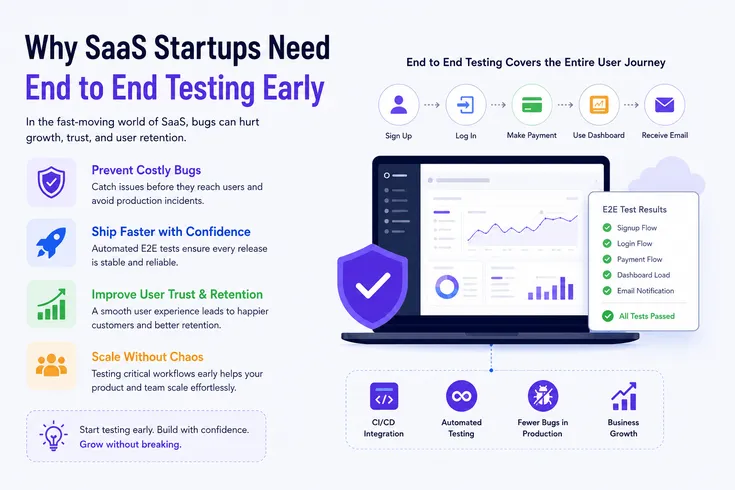
End to end testing is a software testing method that validates complete user workflows from start to finish. Instead of testing isolated components, it checks whether the entire application behaves correctly in real world scenarios.
For example, a SaaS platform might test:
- User registration
- Login authentication
- Payment processing
- Dashboard functionality
- Email notifications
- API integrations
The goal is to ensure every connected system works together smoothly.
Why SaaS Startups Face More Testing Risks
Unlike traditional software products, SaaS applications are constantly evolving. Developers deploy updates frequently, integrate multiple third party services, and support users across devices and browsers.
This creates several challenges:
Rapid Feature Releases
Startups often prioritize shipping speed over stability. New features are added quickly, but every change introduces the risk of breaking existing workflows.
For example:
- A frontend update may break authentication
- API changes may affect dashboards
- Database migrations may impact reports
Without proper end to end testing, these issues are usually discovered by customers first.
Heavy Dependence on Integrations
Modern SaaS products rely on external systems for payments, emails, analytics, authentication, and cloud infrastructure.
Even if your application code works perfectly, failures in third party integrations can still break the user experience.
A payment API timeout or email delivery issue might completely stop a critical workflow. End to end testing helps validate these real world interactions before deployment.
Small Teams Managing Large Systems
Most startups operate with limited engineering resources. Developers often handle coding, deployment, debugging, and infrastructure simultaneously.
Manual testing becomes difficult as the application grows. Teams cannot repeatedly test every feature after each deployment. Automated end to end testing reduces this burden and improves release confidence.
The Real Cost of Skipping Testing Early
Many founders believe testing can wait until the product scales. Unfortunately, fixing bugs in production is far more expensive than preventing them during development.
Here is what usually happens when startups delay testing:
- Users encounter broken workflows
- Customer trust decreases
- Support tickets increase
- Engineering teams spend more time firefighting
- Releases become slower and riskier
Over time, technical debt builds up and product stability becomes harder to maintain.
Startups that invest in testing early avoid these problems and create more reliable user experiences.
How End to End Testing Improves SaaS Growth
Testing is not only about preventing bugs. It directly impacts business growth.
Better User Retention
Users expect SaaS platforms to work smoothly from the first interaction. If onboarding or payments fail, many customers never return.
Reliable workflows improve customer satisfaction and retention.
Faster Deployments
Automated tests allow teams to release updates confidently without manually checking every feature.
This speeds up development while reducing deployment anxiety.
Improved Team Productivity
Instead of spending hours debugging production issues, engineers can focus on building features and improving the product.
Stronger Product Reputation
Reliable software builds trust. Startups known for stability often gain a competitive advantage in crowded markets.
Why Modern Startups Use Automation Tools
Traditional testing setups are often complex and time consuming. Writing and maintaining test cases manually can slow down development.
This is why many engineering teams are adopting automated testing tools like Keploy.
Keploy helps generate tests from real API traffic, making it easier to create realistic testing workflows without extensive manual setup. It also simplifies mocks and replay testing, which is especially useful for fast moving SaaS teams.
Instead of building everything from scratch, startups can automate large parts of the testing process and integrate it directly into CI/CD pipelines.
End to End Testing Is a Long Term Investment
Some startups see testing as an extra engineering task. In reality, it is an investment in product reliability, customer trust, and scalable growth.
The earlier a team adopts end to end testing, the easier it becomes to maintain quality as the product grows.
SaaS companies that ignore testing often struggle later with unstable deployments, frustrated users, and increasing maintenance costs.
But teams that prioritize reliability early can move faster with confidence.
Final Thoughts
SaaS startups operate in highly competitive environments where user experience matters more than ever. A single broken workflow can push customers toward competitors.
End to end testing helps startups catch failures before users experience them. It improves release confidence, reduces production bugs, and supports faster product growth.
As applications become more dependent on APIs, integrations, and distributed systems, testing complete user journeys is no longer optional. It is a necessity.