Frequently Asked Questions
What is the best architecture pattern for Android development?
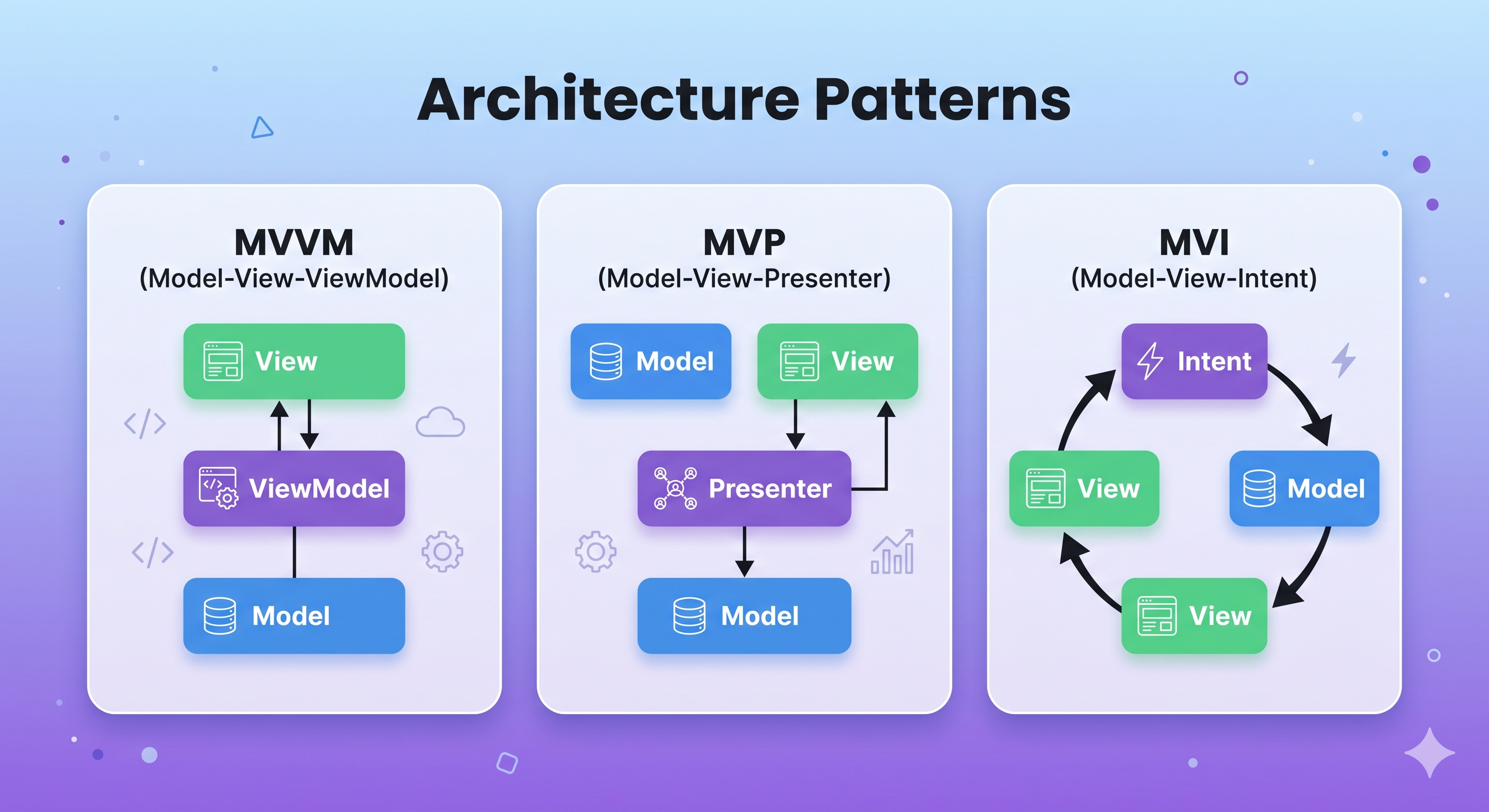
MVVM (Model-View-ViewModel) is the most widely recommended pattern for Android, as it integrates well with Google's Jetpack libraries like ViewModel, LiveData, and Room. For apps with complex business logic, combining MVVM with Clean Architecture, which adds a domain layer with Use Cases is considered the best approach. MVI is a strong alternative for highly reactive UIs built with Jetpack Compose.
What is the difference between MVVM and MVI in Android?
Both MVVM and MVI separate UI from business logic, but they manage state differently. In MVVM, the ViewModel exposes multiple observable state variables that the View observes independently. In MVI, the entire screen state is represented as a single immutable object, and user interactions are modeled as "intents" that trigger state changes. MVI is stricter and more predictable, but it requires more boilerplate, making it better for complex, event-driven UIs.
What are the main components of Android app architecture?
The core components include Activities and Fragments (UI hosts), ViewModel (manages UI state), LiveData or StateFlow (observable data holders), Repository (single source of truth for data), Room Database (stores data locally), and Retrofit or Ktor (makes remote API calls). When using Clean Architecture, Use Cases serve as a domain layer that encapsulates individual business operations.
Why is Clean Architecture recommended for Android apps?
Clean Architecture enforces a clear separation between UI, business logic, and data concerns. Each layer can be developed, tested, and changed independently. Use Cases, which are the core of Clean Architecture, are plain Kotlin classes with no Android dependencies, making them highly testable. This structure is especially useful in larger projects or long-term apps where requirements change frequently and multiple developers work on the same codebase.
How does Jetpack Compose affect Android architecture?
Jetpack Compose supports modern architecture patterns rather than replacing them. Composable functions are designed to be pure functions of state; they take state as input and render UI. This works seamlessly with MVVM (where the ViewModel provides state via StateFlow) and MVI (where a single UiState object drives the entire screen). Compose also reduces the need for Fragments in many cases, greatly simplifying the UI layer.