Join us

Artificial Intelligence vs Machine Learning: What's the Difference?

Artificial Intelligence vs Machine Learning

TL;DR:

Confused by AI vs machine learning? This guide breaks down what sets them apart, how they work together, and what it means for you.


You've probably searched for "AI vs machine learning" on Google at least once, maybe right before a meeting where someone used both terms interchangeably. You nodded along, hoping nobody would ask you to explain the difference. You're not alone. Even people in tech often mix up these terms, and it's not your fault. The two ideas are so intertwined in everyday talk, marketing materials, and news that sorting them out feels like a task no one has time for. But here’s the thing: knowing this difference isn’t just for tech enthusiasts. It actually changes how you think about technology, how you assess tools for your business, and how you understand a world where "AI-powered" is attached to everything from toothbrushes to tax software.

Let's clear this up properly, without the jargon overload.

What Is Artificial Intelligence, Really?

Artificial intelligence is a broad term. It describes the idea of machines performing tasks that usually need human intelligence. That’s the main point. Tasks like recognizing a face in a photo, understanding spoken language, playing chess, driving a car, and recommending what show to watch next all fall under AI.

AI isn't just one technology. It's a goal, a destination. Researchers have pursued this goal since the 1950s, long before computers were strong enough to achieve anything remarkable. Early AI systems relied on rules. Programmers wrote clear instructions: if this happens, do that. These systems could play basic games or solve logic puzzles, but they didn't learn or adjust. They simply followed the rules.

That rigidity was a problem. The real world doesn't always follow rules. Researchers began searching for ways to help machines learn from experience rather than being instructed on what to do every time, a challenge that would eventually become the driving force behind modern AI development services and the intelligent systems we rely on today.

That's where machine learning enters the picture.

What Is Machine Learning, Then?

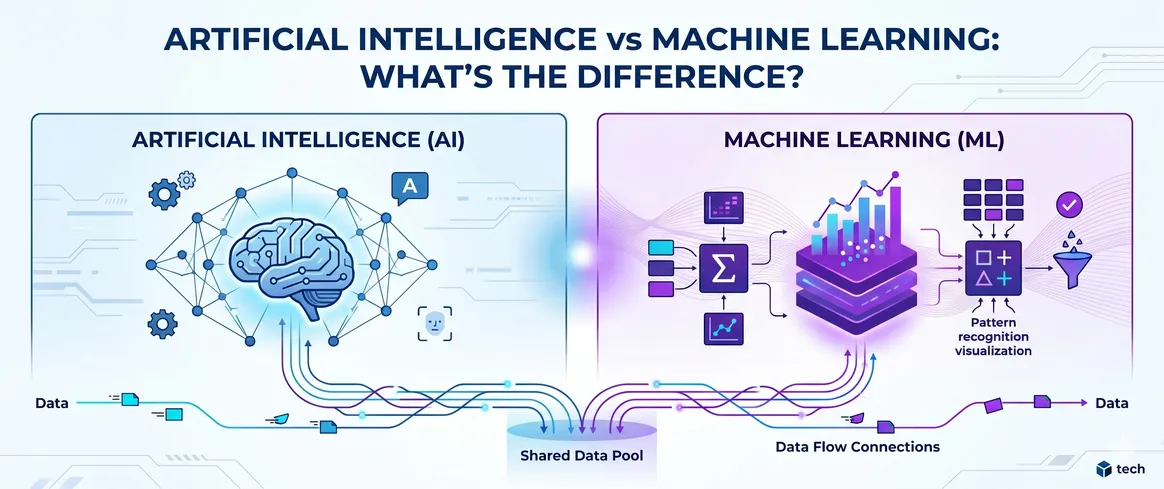
Machine learning is a subset of AI. It's a specific approach to achieving artificial intelligence, and it's the one driving most of the AI breakthroughs we hear about today.

Instead of programming explicit rules, machine learning lets systems learn patterns from data. You feed an algorithm thousands or millions of examples, and it figures out the patterns on its own. Show a machine learning model enough pictures labeled "cat" and "not cat," and it learns to recognize cats without anyone writing a rule like "if it has whiskers and pointy ears, it's probably a cat."

This is a fundamentally different way of building intelligent systems. Rather than hand-coding behavior, you're essentially teaching a system through exposure and feedback, similar to how a child learns to recognize animals by seeing many examples rather than memorizing a textbook definition.

Machine learning itself branches into several types: supervised learning, where models learn from labeled data; unsupervised learning, where models find patterns without labels; and reinforcement learning, where models learn through trial and error and rewards, like training a dog with treats. Deep learning, which powers most of today's flashy AI applications, is a further specialization within machine learning that uses layered neural networks to handle highly complex patterns, such as understanding language or recognizing objects in cluttered scenes.

So AI Is the Goal, ML Is the Method

Here's a simple way to keep this straight in your head. Artificial intelligence is the broad ambition of making machines smart. Machine learning is one major strategy for achieving that ambition, specifically through learning from data rather than following pre-written rules.

Every machine learning system is a form of AI. But not every AI system uses machine learning. Some older or simpler AI systems still rely on rule-based logic, especially in situations where the rules are clear-cut and don't need to be learned from data, such as a thermostat that turns on heating when the temperature falls below a certain threshold.

Think of it like baking. "Cooking" is the broad category, similar to AI. "Baking" is a specific method within cooking, similar to machine learning. You can cook without baking (grilling, frying, boiling), just like you can build AI without machine learning. But baking is, without question, a form of cooking.

AI vs. Machine Learning vs. Generative AI: A Quick Side-by-Side

Now that you've got AI and machine learning sorted, there's one more term worth pinning down since it's probably the reason you ended up Googling any of this in the first place. Generative AI services like chatbots and image generators have become part of daily life, so here's a quick side-by-side to keep all three concepts straight.

Artificial Intelligence (AI)

AI is the broad goal of making machines act intelligently. Think of it as the umbrella everything else sits under. It doesn't always require data to function; a rule-based chess program from the 1980s counts as AI without learning a single thing from experience. The output can be decisions, actions, or responses depending on what the system is built to do. You'll find it working quietly inside voice assistants, navigation apps, and fraud detection systems. The core evaluation question is simple: does it behave intelligently?

Machine Learning (ML)

Machine learning is a method within AI where systems learn from data rather than following fixed, hand-coded rules. It almost always needs data and lots of it to identify patterns and improve over time. A spam filter that gets sharper the more emails it processes is a textbook example. The output tends to be predictions, classifications, or recommendations rather than direct actions. It powers applications such as sales forecasting, predictive maintenance, and recommendation engines. For businesses exploring machine learning development services, the key question is always: how accurate are its predictions?

Generative AI

Generative AI is a specialized branch of machine learning focused specifically on creating new content rather than just analyzing or classifying existing data. It typically requires massive datasets to learn patterns well enough to produce something original. A tool that writes product descriptions, designs visuals, or holds a natural conversation is generative AI in action. The output is brand-new text, images, audio, or code, not just a prediction or recommendation. Generative AI services are increasingly used for personalized marketing copy, image generation, and conversational chatbots. The evaluation focus shifts entirely to how coherent, original, and relevant the output actually is.

Why People Mix These Terms Up So Often

Part of the confusion comes from how the tech industry talks about these tools. Marketing teams often use "AI" because it sounds more impressive and far-reaching than "machine learning," even when the underlying technology is, technically, just machine learning. It's not dishonest exactly, since ML is genuinely a type of AI, but it does blur the lines for people trying to understand what's actually happening under the hood.

Another reason for the mix-up is that recent AI advancements, especially generative AI tools that write text or create images, are entirely powered by machine learning, specifically deep learning. So in everyday conversation, when people say "AI," they usually mean machine learning, because that's the technology actually doing the heavy lifting right now.

Why This Distinction Actually Matters

You might be wondering if this is just semantic nitpicking. It's not, especially if you're a business owner, a student choosing a career path, or someone trying to invest in the right technology.

If your company is exploring AI development services, understanding this difference helps you ask better questions. Are you looking for a rule-based automation system that follows clear logic, or one that learns and improves from your data over time? These are very different projects with different timelines, costs, and outcomes.

Similarly, if you're specifically looking into machine learning development services, you're signaling that you want a system built around data, patterns, and continuous learning, something that gets smarter as it processes more information, like a fraud detection system that adapts to new scam tactics or a recommendation engine that improves as it learns user preferences.

Knowing the difference helps you communicate more clearly with developers, set realistic expectations, and avoid paying for complexity you don't actually need. Sometimes a simple rule-based AI system solves your problem perfectly well, and you don't need a complex machine learning model chewing through data and requiring ongoing training.

Real-World Examples to Make This Click

Let's ground this in everyday scenarios.

A spam filter that blocks emails containing certain banned words is a basic form of AI, built on fixed rules. A spam filter that learns from your behavior, noticing which emails you mark as spam and which you don't, then adjusting its filtering criteria over time, is machine learning in action.

A GPS system that calculates the shortest route based on programmed road data is an AI system. A navigation app that learns your typical driving patterns, predicts traffic based on historical data, and adjusts routes dynamically uses machine learning.

Voice assistants like Siri or Alexa rely heavily on machine learning, particularly natural language processing, to understand your speech, learn your preferences, and improve responses over time. The whole system is AI, but the learning component is what makes it genuinely useful and adaptable rather than clunky and robotic.

The Bigger Picture: Why This Knowledge Empowers You

Once this distinction clicks, a lot of confusing tech conversations suddenly make more sense. News articles about AI replacing jobs, ethical concerns about AI bias, or debates about regulating AI almost always boil down to discussions of machine learning systems specifically, since those are the systems that learn from real-world data and make decisions with real consequences.

This understanding also helps you evaluate tools and services with a more critical eye. When someone pitches an "AI solution," you can ask the right follow-up questions. Is this rule-based or does it learn from data? How is it trained? What happens when it encounters something it hasn't seen before? These questions separate informed decision-makers from people who just nod along, hoping nobody asks them to explain things further.

Wrapping It Up

Artificial intelligence and machine learning aren't competing concepts; they're related, with machine learning as one of the most powerful and widely used approaches within the larger world of AI. AI is the destination: machines that can think, reason, and act intelligently. Machine learning is one of the main vehicles getting us there by teaching systems to learn from data rather than follow fixed instructions.

Understanding this difference isn't about winning trivia nights. It's about making smarter decisions, whether you're choosing technology for your business, exploring a career in tech, or simply trying to keep up with conversations that increasingly shape how we live and work. The next time someone uses these terms interchangeably, you'll know exactly what's actually being discussed, and you might even be the one clearing up the confusion for someone else.

Frequently Asked Questions

Is machine learning the same thing as AI?

No, machine learning is a subset of AI, not a synonym for it. AI is the broader concept of machines simulating human intelligence, while machine learning is a specific technique within that field, focusing on learning from data rather than following explicitly programmed rules.

Can you have AI without machine learning?

Yes. Early AI systems and many simple AI applications today rely on rule-based logic rather than learning from data. A basic chatbot that follows scripted responses, for example, is AI but doesn't necessarily use machine learning.

Which came first, AI or machine learning?

Artificial intelligence, as a field of study, dates back to the 1950s. Machine learning emerged later as researchers searched for better ways to achieve AI's goals, eventually becoming the dominant approach due to advances in computing power and data availability.

Is deep learning the same as machine learning?

Not exactly. Deep learning is a specialized subset of machine learning that uses layered neural networks to process highly complex data, such as images, audio, and natural language. All deep learning is machine learning, but not all machine learning involves deep learning.

How do I know if my business needs AI or specifically machine learning?

It depends on your problem. If your task involves consistent, well-defined rules, a basic AI system might suffice. If your task involves recognizing patterns in large volumes of changing data, such as customer behavior or fraud detection, a learning-based approach is usually more effective and adaptable over time.


Let's keep in touch!

Stay updated with my latest posts and news. I share insights, updates, and exclusive content.

Unsubscribe anytime. By subscribing, you share your email with @elsie-rainee and accept our Terms & Privacy.

Give a Pawfive to this post!


Only registered users can post comments. Please, login or signup.

Start writing about what excites you in tech — connect with developers, grow your voice, and get rewarded.

Join other developers and claim your FAUN.dev() account now!

Avatar

Elsie Raine

Full Stack Engineer, WPWeb Infotech

@elsie-rainee
An aspiring full stack developer with a QA background. I am exploring modern front-end and back-end technologies. I build scalable web applications and improve my skills in APIs, databases, and system design. I actively engage with the developer comm
Developer Influence
1

Influence

1

Total Hits

2

Posts