Join us

Why product data quality breaks at scale

fixing-product-data-at-scale-5-issues-that-hurt-retail-listings

TL;DR:

Weaknesses in product data expose themselves quickly in a multi-channel retail environment. Define a master schema, maintain control of your inventory and pricing via rules, continuously monitor for compliance, and connect performance metrics to the precise changes made for each SKU.


Why product data quality breaks at scale

In multi-channel retail, product data management is a simple problem but with a messy outcome; as every single product needs to be functional within multiple catalogue systems each with their own rules and validations. Small product data inaccuracies across channels and SKUs get added to multi-retail channel data quality.

Salsify's 2025 Consumer Research Report indicated 54% of shoppers will abandon a purchase due to inconsistencies of product details on various websites, and 71% will return items purchased online as a result of the item being different than the product description provided. According to GS1 US, 86% of consumers will not purchase an item if they experience inaccuracies in product information.

The article discusses five product data quality issues and provides solutions based upon centralized listing management, mapping rules, and ongoing validation.

Top 5 product quality issues in multi-channel retail

Multi-channel retail faces a lot of product quality issues that impacts its sales negatively. Here are the top 5 issues:
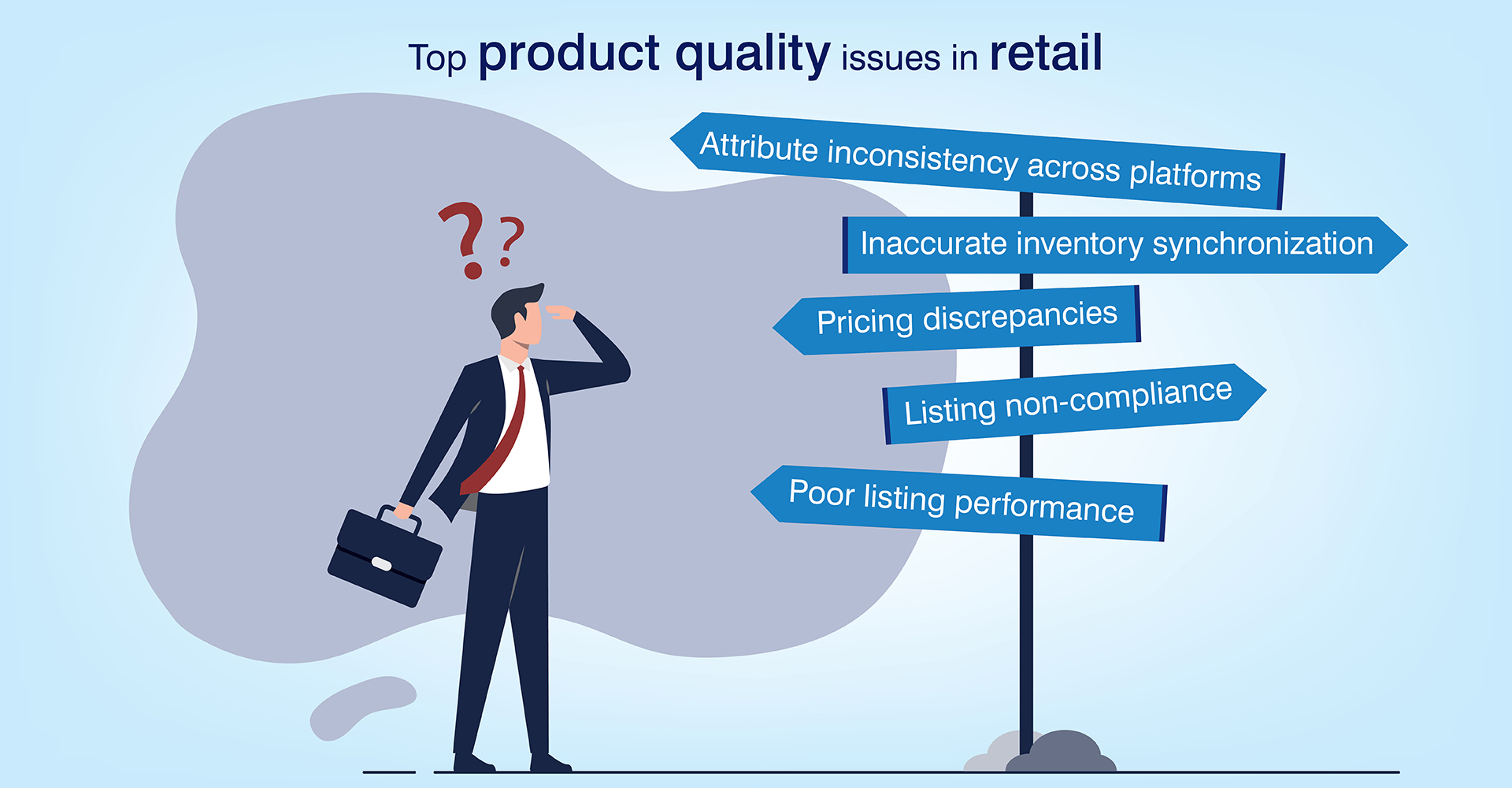
Issue 1: Attribute inconsistency across platforms

A. Problem overview

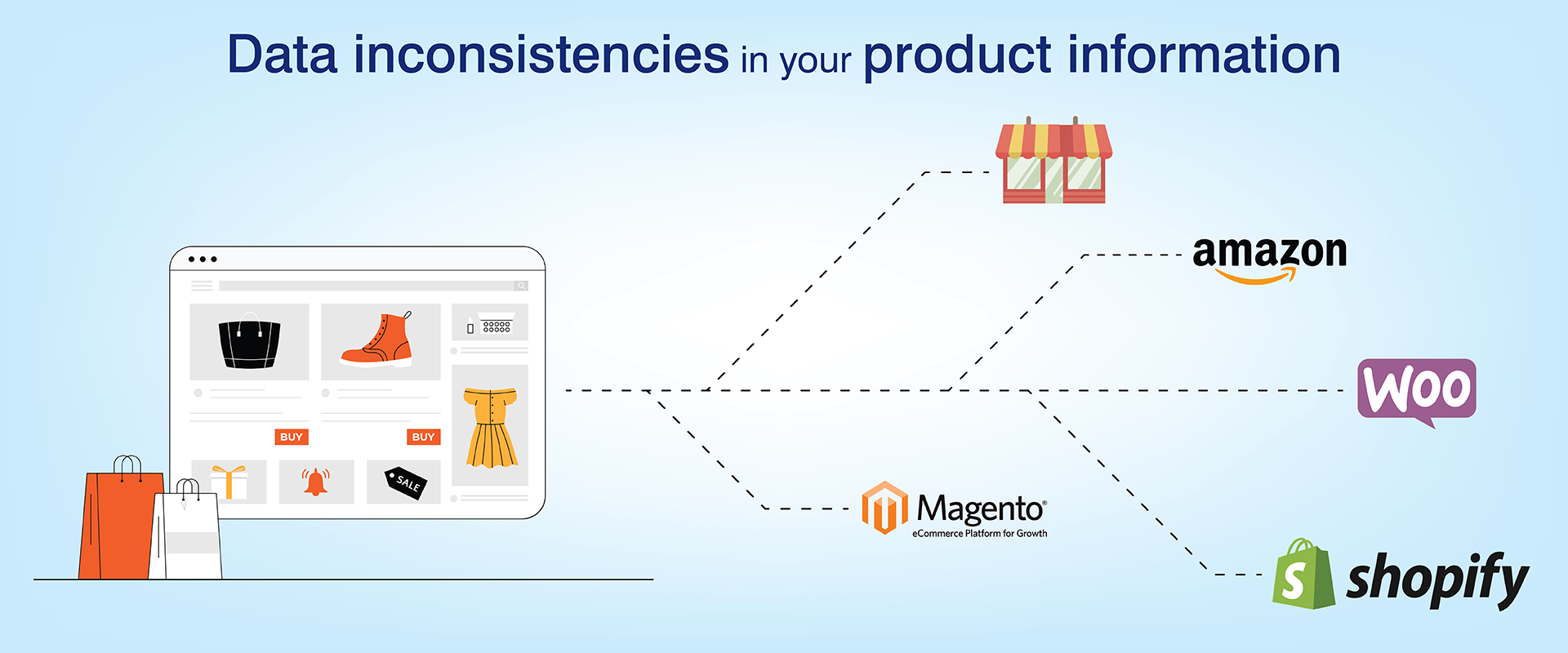
Amazon, Shopify and Walmart do not treat product attributes similarly. Although some fields may appear similar (e.g., title), different requirements may exist such as format, allowable values, or category logic. Adding suppliers who have data feeds or PIM exports that are not aligned with the marketplaces' taxonomies will lead to attribute "drift" and can cause missing specifications, broken variations, non-consistent titles and non-working facets.

B. Business impact

When the product cannot be categorized consistently across all channels search relevance decreases. Facets and search functionality deteriorates. Rates of rejection and suppression increase. Shoppers are able to find different answers to the same question dependent on the channel.

C. How to fix it

Utilize a master product schema that is organized by category and utilize controlled values, units and rules for creating variations. Create a transformation for each channel to map the master schema to each channel. Validate mandatory, conditionally required and variation level attributes prior to publishing the new content and again after the content has been updated.

Issue 2: Inaccurate or lagging inventory synchronization

A. Problem overview

Inventory does not synchronize when update processes occur at a slower rate than order placement. This occurs most commonly with batch feeds, delayed feeds, and siloed systems, particularly during promotional periods and for high-velocity SKUs. Manually reconciling inventory levels cannot keep pace and leads to duplicate product listings.

B. Business impact

Outdated inventory synchronisation leads to overstocking/overselling, order cancellations, and increased customer service workload. Retail product data challenges also indicate that seller performance metrics decrease, potentially resulting in reduced visibility for sellers. Consumers primarily recall the cancelled order.

C. How to fix it

Use APIs and event-driven updates to synchronize inventory in real-time or nearly in real-time. Utilize a single, central inventory ledger with well-defined states, i.e., on hand, reserved and available to sell. Add channel allocations and safety buffers to minimize risk of overselling.

Issue 3: Pricing discrepancies and rule violations

A. Problem overview

Static pricing models fail in multi-channel retail because fees, discounts, taxes and shipping rules vary between platforms and geographies. Expectations for parity and MAP (Minimum Advertised Price) rules add increased pressure. Currency conversions can result in data entry errors. Teams usually identify pricing discrepancies only after a platform identifies a violation.

B. Business impact

Violating pricing rules can result in suspension or de-listing of the seller. Unchecked price competition can reduce profit margins. Additionally, inconsistent pricing can further weaken trust with customers.

C. How to fix it

Utilize rule-based pricing with floor prices, ceiling prices, MAP price limits and promo limits by channel. Use data on fees and fulfilment costs to fix channel-specific pricing. And be sure to provide clear audit logs of parity issues and unusual price movements so you know what was modified and why.

Issue 4: Listing non-compliance and policy drift

A. Problem overview

Changes to marketplace policies occur much faster than changes to a retailer's internal catalogs. Old listings will quietly begin to lose compliance until a retailer is notified that a listing was removed due to policy violations. Common violations include usage of prohibited terms, failure to meet image specification requirements, missing required disclosure statements and unsubstantiated claims.

B. Business impact

Removal of listings due to policy violations can disrupt sales and affect account health. You need immediate manual intervention to retain listings that have lost compliant status.

C. How to fix it

Create continuous compliance scanning using platform-specific rule engines. Create notification workflows that alert teams to take corrective actions prior to enforcement of policies that change.

Issue 5: Poor listing performance visibility and feedback loops

A. Problem overview

Visibility to performance metrics for listings are split among multiple platforms, making it difficult for retailers to identify specific SKU-related issues or connect changes to content, price or inventory to the corresponding performance outcomes. Retailers end up optimizing separately.

B. Business impact

Retailers continue to optimize listing content without addressing the root cause of poor listing performance. Retailer teams invest significant resources in low-ROI optimization activities. Revenue continues to leak from retailers due to prioritization of less impactful changes.

C. How to fix it

Create centralized dashboard views for impressions, conversion, suppression reasons, returns and sales. Establish a change history view for performance trends to tie changes to content, price and availability together. Implement a closed loop process where data dictates what should be optimized next and measure the effectiveness of the optimization.

Conclusion: Build a resilient multi-channel product data framework

While these product data quality issues may include isolated listing issues, they actually stem from structural gaps. Such may include disparate schemas, delayed inventory, uncontrolled pricing, changing policies and fractured performance reporting. You won't be able to meet scalability needs with just a point solution.

For a framework that can handle product data across multiple channels without hiccups, use centralized listing management, a defined master schema, real-time synchronization of inventory and automated governance for pricing and compliance. Your teams can gain process visibility and be more resilient with continuous validation and feedback loop setups.


Let's keep in touch!

Stay updated with my latest posts and news. I share insights, updates, and exclusive content.

Unsubscribe anytime. By subscribing, you share your email with @habiledata and accept our Terms & Privacy.

Give a Pawfive to this post!


Only registered users can post comments. Please, login or signup.

Start writing about what excites you in tech — connect with developers, grow your voice, and get rewarded.

Join other developers and claim your FAUN.dev() account now!

Avatar

Habile Data

HabileData

@habiledata
HabileData is a global data services and BPO company that transforms raw data into accurate, actionable insights for enterprises and AI-driven businesses.
Developer Influence
15

Influence

1

Total Hits

1

Posts