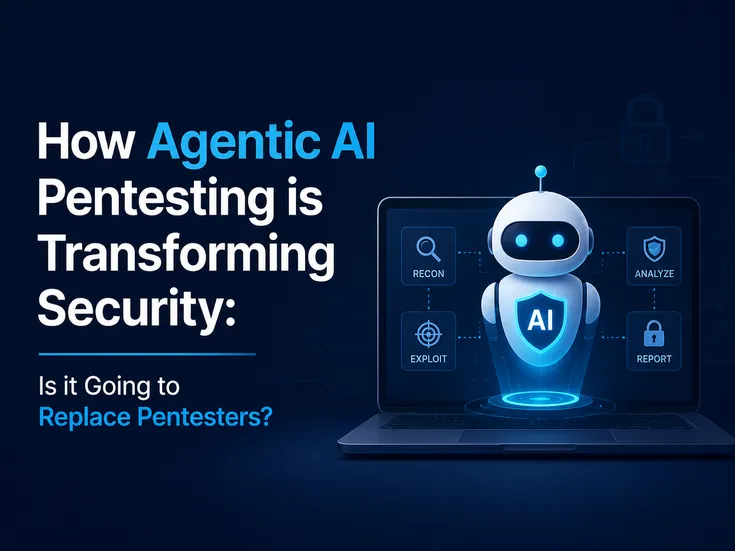
I’ve seen how quickly security challenges are evolving, and honestly, traditional pentesting often struggles to keep pace. What caught my attention is how advanced approaches can reduce incident response time by up to 96%, making security far more proactive.
At the same time, the financial impact is hard to ignore. These same approaches reduced the cost of a data breach by an average of $2.22 million. That’s exactly why I started paying attention to agentic AI pentesting.
What is Agentic AI Pentesting, Really?
Pentesting has always been about thinking like an attacker. Agentic AI does exactly that, but autonomously. Unlike traditional scanners that follow fixed rules, agentic AI can plan, adapt, and make decisions on its own. It doesn't just find vulnerabilities. It chains them together, pivots across systems, and mimics how a real attacker moves through an environment.
Here's what makes it different:
- It sets its own objectives during a test
- It learns from what it discovers in real time
- It doesn't need constant human prompting to keep going
In simple terms, I look at agentic AI pentesting as continuous, intelligent attack simulation. It helps me move from just finding issues to actually understanding how they can be used in a real attack.
The Limitations of Traditional Pentesting Approaches
Traditional pentesting is valuable, but it was built for a different era. Today's attack surfaces are bigger, faster-moving, and far more complex than what annual; manual assessments were ever designed to handle.
Here are the core limitations I've seen hold teams back:
- Point-in-Time Testing: A pentest done in January tells you nothing about your security posture in June. Threat actors begin scanning for new vulnerabilities within 15 minutes of public disclosure, a yearly test simply can't keep up.
- Narrow Scope Coverage: Too many providers focus on limited test targets rather than the entire attack surface. Attackers don't respect scope boundaries. Your security assessment shouldn't either.
- High Cost and Resource Dependency: External pentest engagements can range from a few hundred to over $100,000, with the average sitting around $18,000. That's a serious budget hit, and it doesn't even guarantee full coverage.
- Production Environment Disruption: Manual pentests often interfere with production environments and require coordination across teams. This forces tests outside business hours, missing how attacks actually unfold in real conditions.
- Shortage of Skilled Pentesters: The acute shortage of expert human resources is a greater challenge faced in conducting effective penetration testing. Demand is growing faster than talent supply.
- Scale Simply Doesn't Work Manually: It simply isn't feasible to manually test every web app, API, cloud resource, and third-party integration on a continuous basis. The attack surface has outgrown the manual model.
5 Core Ways Agentic AI is Transforming Security
Security testing used to be a scheduled event. Agentic AI is turning it into a continuous process, one that thinks, adapts, and acts without waiting for human instruction. Here's exactly how it's changing the game.
Continuous Testing Instead of Point-in-Time Snapshots
Traditional pentests cover maybe two weeks out of the year. That leaves 50 weeks of untested exposure. Agentic AI runs repeatable test vectors across assets continuously, detecting drift and misconfigurations that annual or quarterly assessments completely miss.
I've seen environments change drastically between test cycles. With agentic AI running 24/7, those gaps close in real time, not months later.
Autonomous Attack Surface Mapping
Manually mapping every API, endpoint, and authentication flow is exhausting. It's also incomplete. Modern agentic pentesting solutions can map your entire attack surface, including APIs, endpoints, authentication flows, and data handling processes without a human directing every move. This means nothing hides in blind spots anymore. The AI finds what manual recon routinely misses.
Intelligent Vulnerability Chaining
A scanner finds vulnerabilities. Agentic AI connects them. It reasons through how one weakness leads to another, just like a real attacker would.
Agentic AI can generate a payload, send it to a target, analyze the error response, refine the payload based on an error database, and retry until successful, it has a feedback loop. That's not automation. That's autonomous offensive reasoning.
Dramatically Faster Incident Response
Speed matters when attackers are already inside. Studies show agentic AI can reduce incident response time by up to half, shrinking the window attackers have to cause damage. The average breach dwell time in 2025 is 161 days, and every extra day undetected increases breach costs by $1.9M. Faster detection isn't just efficient, it's financially critical.
Scalable Testing Without Scaling Your Team
One of the biggest frustrations I hear from security teams is bandwidth. Common scenarios include having 1,500 applications to pentest with a team of 12, or only 15 minutes to manually test each new feature release.
Agentic AI solves this without hiring more people. AI agents in recent studies operated between $18 and $60 per hour, making continuous, higher-frequency offensive testing far more practical than traditional models that rely solely on human experts.
Is Agentic AI Going to Replace Human Penetration Testers?
No, but it will change what the job looks like. I get why people ask this. When a tool can autonomously map attack surfaces, chain vulnerabilities, and run 24/7, it's natural to wonder where humans fit in.
Here's the breakdown in two simple points:
- AI handles the volume, repetitive scans, continuous monitoring, large-scale coverage. Humans handle the judgment, creative attack paths, social engineering, and business logic flaws
- When AI generates the findings, humans interpret what actually matters in context. Penetration testers’ own accountability, legal, ethical, and strategic decisions stay with people.
Agentic AI isn't a replacement. It's a force multiplier. The penetration testers who will struggle are those who refuse to adapt. The ones who lean into these tools will cover more ground, deliver sharper findings, and frankly, become a lot more valuable.
Final Thoughts: Future of Pentesting with Agentic AI
Agentic AI isn't a trend; it's a fundamental shift in how security testing works. It's faster, broader, and smarter than anything traditional pentesting could deliver alone.
But I don't see it as a solo solution. The teams getting the best results are combining AI's speed and scale with human judgment and expertise. That hybrid approach is where real security lives.
The future of pentesting isn't human vs. machines; it's both working together. And the sooner security teams adapt to it, the stronger their defenses become.