Join us

Angular vs React: Which Framework Is Better for Web Development?

Angular vs React

TL;DR:

Angular vs React: discover the main differences, performance, and use cases to choose the best framework for modern web development projects in 2026.


You're about to start a new web project, or maybe you've just gotten your first developer job. Someone asks, "Are we going with Angular or React?" Suddenly, the room feels tense.

If you've ever felt stuck by this decision, you're not the only one. It's one of the most searched debates in the front-end world, and for good reason. Both tools support some of the biggest products on the internet. Choosing the wrong one can slow your team down for months. Picking the right one can greatly improve your workflow.

This guide cuts through the noise. There’s no hype and no brand loyalty, just a straightforward look at what each tool offers, where each excels, and how to choose the one that fits your needs.

What Are Angular and React, Really?

Before we compare them, we need to clarify what they are, because they are not quite the same type of tool.

Angular — The Full Framework

Angular is a complete, opinionated framework built and maintained by Google. It comes with everything included: routing, state management, form handling, HTTP clients, and a powerful CLI. You don't have to make many architectural decisions; Angular has already taken care of that for you. It uses TypeScript by default and follows a component-based, MVC-style structure.

React — The UI Library

React, on the other hand, is a JavaScript library, not a full framework. Created by Meta (Facebook), React only handles the view layer of your application. Everything else, such as routing, state, and data fetching, you set up yourself using additional libraries like React Router, Redux, or TanStack Query. This makes React very flexible, but it requires more decision-making from the start.

Quick Mental Model:

Think of Angular as a fully furnished apartment; everything's in place, and you just move in. React is like a studio with an open floor plan; you choose exactly how to set it up.

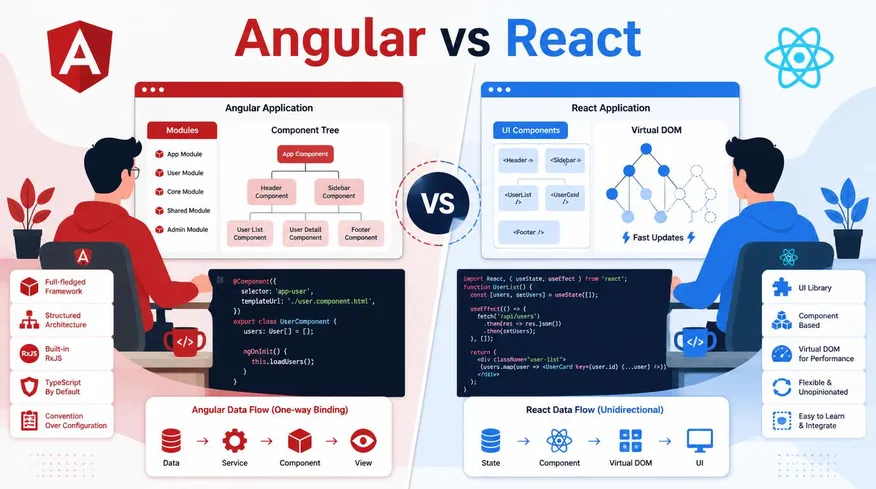
Angular vs React: Side-by-Side Comparison

Type: Angular is a complete framework. It provides everything you need to build an application right out of the box. React, on the other hand, is a UI library that focuses solely on creating the view layer of your app.

Maintained By: Angular is developed and maintained by Google, while React is supported by Meta (Facebook). Both have strong backing, so neither is vanishing anytime soon.

Language: Angular uses TypeScript by default. This offers built-in type safety and structured code from day one. React is written in JavaScript with JSX, which allows you to write HTML-like code inside JavaScript, although you can manually add TypeScript if you want.

Learning Curve: Angular has a steeper learning curve. You need to be familiar with TypeScript, decorators, modules, and dependency injection before you can feel productive. React's core concepts, such as components, props, state, and hooks, are quicker to learn, making it more friendly for beginners.

Architecture: Angular follows a specific MVC (Model-View-Controller) pattern, meaning the structure is mostly decided for you. React, however, takes a flexible, component-based approach where you make the architectural choices yourself.

Data Binding: Angular supports two-way data binding out of the box. Changes in the UI automatically reflect in the data model and vice versa. React uses one-way data binding, where data flows in a single direction. You manually handle updates, giving you more control but needing more code.

Performance: Both are excellent in 2026. Angular uses the Ivy rendering engine, which creates smaller bundles and faster compile times. React relies on a Virtual DOM to reduce expensive real DOM updates. In practice, performance differences are small; both tools can handle high-traffic, complex applications easily.

Ecosystem: Angular includes many features such as routing, forms, HTTP, animations, and testing utilities. They all come with the framework. React's ecosystem is rich and modular, allowing you to pick and combine the best tools for your needs, but it requires more initial decision-making.

Best For: Angular is best for enterprise applications and large teams where consistency and structure are important. React works well for startups, product teams, and projects where speed of development and flexibility are priorities.

npm Downloads (2026): React leads in adoption, getting over 25 million downloads per week on npm. Angular has around 3 million downloads per week, which is healthy but shows React's wider mainstream usage in the industry.
When Angular Makes More Sense

Angular truly deserves its place in specific environments. If your project meets any of these criteria, it's worth serious consideration:

  • Large enterprise applications with multiple teams working at the same time. Angular's strict structure keeps codebases consistent.
  • TypeScript-first teams. You get type safety, dependency injection, and decorators right away, with no extra setup.
  • Complex forms and data-heavy dashboards. Angular's built-in reactive forms module is very effective for this purpose.
  • Projects that need long-term stability. Google's support and clear structure mean Angular projects remain reliable and have predictable upgrade paths.

Real World Example:

Companies like Deutsche Bank, Forbes, and Samsung have used Angular to drive large-scale internal tools and customer-facing platforms. This is due to its structured and team-friendly architecture.

When React Is the Smarter Pick

React's flexibility and large ecosystem make it the first choice for many modern teams, and there are very good reasons for that.

  • Startups and fast-moving products — React allows you to ship quickly and change direction without struggling with a rigid framework.
  • Teams are comfortable making architectural decisions — The ability to choose your stack, like Next.js, Vite, or Remix, is a real advantage.
  • UI-heavy or interactive applications — React's component model is excellent for building rich, stateful interfaces.
  • Cross-platform ambitions — React Native enables you to extend your web codebase to mobile apps with a familiar mindset.

Real World Example:

Airbnb, Netflix, WhatsApp Web, and Instagram all use React. Its capacity to manage dynamic, high-traffic user interfaces at scale has been demonstrated across various industries.

Performance & Learning Curve

Performance

Both Angular and React are fast in 2025. Angular's Ivy rendering engine has greatly reduced bundle sizes and improved compile times in recent years. React's virtual DOM reconciliation remains efficient for dynamic UIs. In benchmarks, the difference is often hard to notice for end users. Performance depends on how well your code is written, not which tool you choose.

Learning Curve

This is where they truly differ. React's core concepts, such as components, props, state, and hooks, can be learned in just a few days. Angular requires more upfront work. You need to be comfortable with TypeScript, understand decorators, modules, dependency injection, and RxJS observables. This investment is worthwhile for complex projects, but it can seem daunting at first.

Honest Take:

If you are a solo developer or a small team launching your first product, React's easier learning curve is a real advantage. If you are managing a large engineering team with senior developers, Angular's structure can save more headaches in the long run.

Job Market & Community in 2025

From a career perspective, React has many more job postings around the world. Its adoption rate among startups and mid-sized tech companies is much higher. The 2024 Stack Overflow Developer Survey ranked React as the most widely used web framework for the third year in a row.

Angular remains strong in the enterprise world, especially in financial services, healthcare, and government tech, where structured frameworks are preferred. If you aim for those industries, Angular skills are valuable and less saturated.

In terms of community, React's ecosystem is larger and evolves quickly. Angular's community is smaller but has deep technical knowledge and strong support from Google's developer relations team.

So, Which Should You Pick?

Here's a practical shortcut. Map your situation to one of these two profiles:

Choose Angular If…

  • Building a large-scale enterprise app
  • Your team already knows TypeScript.
  • You want structure over flexibility.
  • Long-term maintainability is critical.
  • Complex forms and data flows are involved.

Choose React If…

  • Moving fast with a small team
  • You want maximum ecosystem flexibility.
  • Building a consumer-facing UI product
  • Mobile expansion (React Native) is planned.
  • Hiring talent from a wide pool

Conclusion

The Angular vs. React debate doesn't have a clear winner, nor did it ever. What matters is context. React excels in flexibility, ecosystem size, and developer momentum. Angular shines in structure, built-in tools, and enterprise scalability.

The best choice depends on your team size, project complexity, and timeline. A startup racing to a minimum viable product doesn't need Angular's overhead. A 50-person engineering team developing a regulated financial platform probably wouldn't want React's architectural ambiguity.

Whichever option you choose, both are mature and proven tools that will serve you well, provided you decide thoughtfully. Now that you understand the real trade-offs, you can make that choice with confidence.

Frequently Asked Questions

Is Angular better than React for large applications?

For large enterprise applications with multiple teams, Angular's structured architecture, built-in TypeScript support, and rigid project layout help maintain code consistency over time. It is often the top choice in regulated industries like finance and healthcare. React can also handle large apps, but it needs more careful architectural planning and extra tools.

Which is easier to learn — Angular or React?

React has a gentler learning curve. Its core API, which includes components, props, state, and hooks, is smaller and more beginner-friendly. Angular demands knowledge of TypeScript, decorators, dependency injection, and RxJS, which adds considerable upfront learning. Most bootcamps and junior developer pathways begin with React for this reason.

Which has better job opportunities in 2026 — Angular or React?

React has the edge in job volume, especially in startups and product companies. However, Angular skills are in high demand in enterprise environments, including banking, insurance, government, and large corporate IT departments. Both are valuable; React offers more variety, while Angular provides depth in specific high-value sectors.

Can I use Angular and React together in the same project?

Technically, yes, through a microfrontend architecture, but it is generally not recommended. Running two major frameworks at the same time significantly increases bundle size, complexity, and maintenance. In practice, teams tend to choose one framework and stick with it. If you are considering microfrontends, standardizing on a single framework is a cleaner approach.

Is React a framework or a library?

React is officially a JavaScript library specifically for building user interfaces. It only manages the view layer of an application. Unlike Angular, it doesn’t include routing, state management, or HTTP utilities out of the box. Developers usually pair React with other tools like React Router, Redux, or Next.js to create a complete application stack.


Let's keep in touch!

Stay updated with my latest posts and news. I share insights, updates, and exclusive content.

Unsubscribe anytime. By subscribing, you share your email with @rafidbottler and accept our Terms & Privacy.

Give a Pawfive to this post!


Only registered users can post comments. Please, login or signup.

Start writing about what excites you in tech — connect with developers, grow your voice, and get rewarded.

Join other developers and claim your FAUN.dev() account now!

WPWeb Infotech
WPWeb Infotech

WPWeb Infotech provides expert web and mobile app development services, delivering innovative, scal…

Avatar

Rafid Bottler

Full Stack Engineer, WPWeb Infotech

@rafidbottler
Full Stack Engineer | Building scalable web apps | Passionate about clean code, system design, and modern web technologies.
Developer Influence
25

Influence

1

Total Hits

1

Posts