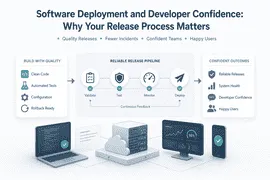
There is a question that distinguishes teams that ship frequently from teams that ship rarely. Not a question about technical capability or codebase quality, but a question that reveals something deeper about how they work. When a developer pushes a change to production, do they feel confident that it will work? Or do they feel a knot in their stomach, checking logs obsessively for the first ten minutes, hoping nothing breaks?
That feeling, confidence or fear, is not incidental to how software deployment works. It shapes how often teams release, how carefully developers write code, how much mentoring senior engineers do for junior ones, and ultimately how fast the organization can move. The software deployment process is not just a technical pipeline. It is a statement about what the organization believes about code quality, about whether problems get caught before they matter, about whether developers can trust their own work.
This article covers the relationship between software deployment practices and developer confidence, and why the way teams deploy software directly determines their ability to ship frequently, maintain quality, and keep talented developers engaged.
The Confidence Gap
A gulf exists between how fast teams technically could ship and how fast they actually do. A typical service might have fully automated tests, a solid CI/CD pipeline, and the technical capacity to deploy dozens of times a day. Yet the team ships once a week, or once every two weeks. When asked why, the answer is often some version of "we want to make sure nothing breaks," or "we need more testing," or "we like to batch changes." Those are not wrong answers, but they mask the deeper reason: developers do not feel fully confident in their deployments.
Confidence is not binary. It exists on a spectrum. A team with complete confidence deploys whenever code is ready, knowing the process will catch problems. A team with low confidence batches changes, tests manually, has deployment checklists, and feels a sense of relief when a release completes without incident. Most teams fall somewhere in between, and their position on that spectrum directly determines how much they ship.
Why does this gap exist? For most teams, it is not because the software deployment pipeline is broken, but because there are categories of problems the pipeline does not catch. The integration failures that only appear when services interact in specific ways. The performance regressions that do not affect correctness but affect user experience. The edge cases that unit tests miss. The configurations that work in staging but not in production. The data issues that only surface under real load.
Developers know about these gaps. They have experienced the release that passed all tests and broke in production. They have debugged the incident that required rolling back a change they were confident in. That experience creates caution. The caution manifests as reluctance to deploy frequently, pressure for more testing before release, and conservative deployment windows.
What Kills Deployment Confidence
Deployment confidence lives or dies on one metric that matters more than any other: does the software deployment process catch problems before users experience them? If the answer is consistently yes, confidence grows. If the answer is sometimes no, confidence erodes.
The problems that undermine confidence most are not the obvious ones. A failing unit test is caught immediately. A syntax error is impossible to deploy. The dangerous problems are the ones that pass all tests but fail in production. A code change that works perfectly in isolation but breaks when it interacts with other services. A performance optimization that passes performance tests but fails when deployed to the real service load. A database migration that works in staging but causes a production outage. These failures are dangerous precisely because they bypass the tests everyone relies on.
When a deployment fails in production, the damage to team confidence is profound and lasting. A single incident where a developer deployed confident code that broke production for an hour creates skepticism in the entire team. That skepticism does not disappear when the incident is fixed. It persists, shaping how the team approaches future deployments. More manual verification happens. Releases get batched. Deployments move to specific windows where senior engineers are on call. The team becomes more conservative, and shipping velocity drops.
This is not irrational conservatism. It is a rational response to evidence that the software deployment process does not catch all the problems it should. The team is protecting themselves from future incidents by slowing down.
The Cost of Fear
Developer fear around software deployment has costs that go well beyond slower shipping. When developers are anxious about deployments, the quality of their work changes. They become more defensive, writing code that is conservative and less ambitious. They avoid refactoring because the risk feels real. They avoid trying new approaches because the deployment risk feels too high. Over time, this produces code that is more defensive but less clean, more repetitive but less innovative.
There is also a quality-of-life cost that matters. Developers who dread releases experience stress that extends beyond the deployment window. Anxiety starts days before a release, peaks during the deployment, and lingers through the monitoring phase afterward. That stress affects job satisfaction directly. Teams with frequent, confident deployments report significantly higher satisfaction than teams with fearful releases.
The turnover cost is substantial. Developers with options leave teams where deployments feel risky and stressful. Junior developers in particular need to work in environments where they can build confidence in their own work, and that requires deployments that reliably work. A team that cannot offer that environment loses junior talent to teams that can.
Beyond the individual level, there is a cultural cost. When deployments are scary, senior engineers spend significant time mentoring junior engineers on "how to deploy safely." That knowledge transfer is necessary but indicates that the software deployment process itself is not trustworthy. The team is compensating for process weakness with experienced judgment. That works for a time, but it does not scale. As the team grows, it cannot scale the amount of careful mentoring needed for every engineer to gain deployment confidence.
Building Systems That Inspire Confidence
What distinguishes teams with high deployment confidence from teams with low confidence is usually not the tooling but the completeness of the testing and observability infrastructure. Teams with high confidence have automated tests that catch the problems that would otherwise reach production. They have integration tests that capture how services interact. They have staging environments that allow realistic validation before production. They have monitoring that makes problems visible immediately when they do slip through.
More importantly, teams with high confidence treat those systems as first-class priorities. When a test fails to catch a production problem, they do not just fix the problem, they fix the gap in the testing. When monitoring fails to alert, they do not just debug the incident, they improve the monitoring. When a deployment causes an issue, they do not just revert the change, they understand why the testing did not catch it and address the root cause.
This approach creates a virtuous cycle. Each incident drives improvements to the deployment process. Each improvement increases confidence. Increased confidence leads to more frequent deployments. More frequent deployments mean more opportunities to catch process weaknesses early, in smaller changes, rather than in large batches where the root cause is harder to trace. The system becomes more trustworthy over time.
The technical elements matter. Comprehensive unit tests, integration tests, and staging environment validation catch many problems. But there is a category of problems that traditional testing misses: the integration failures that only appear when real services interact with real data under real load. Capturing these failure modes requires testing approaches that go beyond prediction and assertion. Tools that record actual system interactions in production and replay them as regression tests catch these realistic failure modes. This approach, used by tools like Keploy, significantly expands the set of problems the software deployment process catches before they reach users.
The Feedback Loop Between Deployment and Code Quality
A less obvious consequence of confident deployment practices is the effect on code quality over time. Developers who feel confident deploying frequently refactor code more often. They clean up technical debt incrementally rather than letting it accumulate. They try improvements and validate them quickly rather than building elaborate up-front designs. This leads to codebases that stay more maintainable and productive as they age.
In contrast, teams with fearful deployments refactor less frequently, so code quality degrades over time. Technical debt accumulates because the risk of touching existing code feels too high. This creates a downward spiral. As code becomes harder to understand, developers touch it less, so it degrades further. The only way out of that spiral is a rewrite or a major refactoring effort that happens during a dedicated window.
The relationship between deployment confidence and code quality is bidirectional. Better testing and observability practices increase deployment confidence, which leads to more frequent refactoring, which produces higher quality code. Higher quality code is easier to test and deploy with confidence. Each element reinforces the others.
Teams that build this virtuous cycle report significant improvements in both shipping velocity and code quality over time. The initial investment in testing and observability infrastructure pays off as the team becomes able to move faster without sacrificing quality.
Developer Confidence as a Leading Indicator
Software deployment confidence functions as a leading indicator for team health and velocity. Teams where developers feel confident deploying ship more frequently, innovate more freely, and report higher satisfaction. Teams where developers fear deployments ship slowly, change conservatively, and eventually lose talented people.
This is why measuring deployment confidence matters more than measuring deployment speed. Speed without confidence is brittle. A team can force fast deployments through automation, but if developers do not trust the process, the quality costs are substantial. Confidence with slower deployment is healthier than speed with constant incidents. A team that ships weekly with full confidence will outperform a team that ships daily with 20 percent incident rate over the long term.
The signal of low confidence is visible in multiple ways. Deployment windows that are restricted to specific times when senior engineers are on call. Long manual checklists that appear before releases. Batching of changes to reduce deployment frequency. Reluctance from developers to deploy their own code. Extended staging testing before production releases. Any of these patterns indicates that developers do not fully trust the software deployment process.
The Compounding Returns of Confidence
The strongest case for investing in deployment practices that build confidence is the compounding effect over time. In the short term, better testing and observability takes time and resources. Over months and years, that investment returns manifold.
A team that ships weekly with high confidence, enabled by comprehensive testing and observability, accumulates learning faster than a team that ships monthly with manual verification. The weekly team learns from real user feedback every week. The monthly team learns every month. Over a year, that is a 52-week learning advantage. In competitive markets, that advantage compounds into substantial capability differences.
A team with high deployment confidence refactors code regularly, so the codebase improves over time. A team with low confidence refactors rarely, so the codebase degrades. Over five years, the difference in code quality between these trajectories is dramatic. The team with high confidence can build new features faster because the codebase is maintainable. The team with low confidence spends increasing time fighting technical debt.
A team with high deployment confidence retains talented developers because the work is engaging and the environment is psychologically safe. A team with fearful deployments loses people and spends time recruiting and onboarding replacements. The institutional knowledge that departs with those people is irreplaceable.
Creating the Conditions for Confidence
Building high deployment confidence requires attention to multiple elements. Comprehensive automated testing that catches realistic failure modes. Staging environments that allow validation before production. Monitoring and alerting that make problems visible immediately. Observability that allows quick diagnosis of issues. A culture where responding to deployment problems is prioritized over defending the deployment.
It also requires a mindset shift. The software deployment process is not something that should be feared or treated as a specialized skill. It should be something that every developer on the team can do with confidence. That requires investment in the systems and practices that make deployment safe, but it also requires a commitment to treating deployment as part of normal development rather than a special event that requires preparation and ritual.
Teams that make this shift report significant changes in how they work. Deployments become routine rather than high-stakes events. Developers experiment more freely because the cost of a failed experiment is low. Release planning becomes simpler because the constraint of manual verification is gone. The organization becomes more responsive to market changes because getting new capabilities to users is fast and reliable.
Software Deployment as Organizational Choice
The software deployment practices a team adopts are not forced by technical constraints but chosen based on what the organization prioritizes. Teams could choose to invest in comprehensive testing and monitoring that build deployment confidence. Instead, some teams choose to invest in manual verification processes that feel safer in the moment. Teams could choose to create staging environments that closely mirror production. Instead, some teams choose to validate primarily in production.
These are organizational choices with profound consequences. They reflect what the organization believes about quality, about trust, about developer capability. They shape how fast the organization can move, how much developers enjoy their work, and how long talented people stay.
The organizations that build the greatest shipping velocity and maintain the highest code quality over time are those that choose to invest in the systems and practices that create deployment confidence. They treat the software deployment process as a strategic asset rather than a necessary evil. They understand that developer confidence is not a luxury but a prerequisite for sustainable velocity.
When teams make that choice consciously, the results are transformative. Shipping velocity increases. Code quality improves. Developer satisfaction rises. Technical debt decreases. The ability to respond to market opportunities accelerates. The organization becomes more competitive not because the team is working harder but because the systems they work within enable them to work faster and safer.
The software deployment process matters not because of the technical pipeline itself but because of what it enables and what it prevents. When the process builds confidence, it enables developers to work at their best. When it fails to build confidence, it prevents the organization from moving at the speed the market demands. The choice about what kind of deployment process to build is ultimately a choice about what kind of organization to be.