Join us

ContentUpdates and recent posts about BigQuery..
Story
@laura_garcia shared a post, 2 months, 3 weeks ago
Software Developer, RELIANOID

🚨 𝗡𝗜𝗦𝟮 𝗶𝘀 𝗰𝗵𝗮𝗻𝗴𝗶𝗻𝗴 𝘁𝗵𝗲 𝗰𝘆𝗯𝗲𝗿𝘀𝗲𝗰𝘂𝗿𝗶𝘁𝘆 𝗴𝗮𝗺𝗲 𝗶𝗻 𝗘𝘂𝗿𝗼𝗽𝗲

It’s no longer just about protection — it’s about 𝗮𝗰𝗰𝗼𝘂𝗻𝘁𝗮𝗯𝗶𝗹𝗶𝘁𝘆, 𝗰𝗼𝗺𝗽𝗹𝗶𝗮𝗻𝗰𝗲, 𝗮𝗻𝗱 𝗯𝘂𝘀𝗶𝗻𝗲𝘀𝘀 𝗿𝗲𝘀𝗶𝗹𝗶𝗲𝗻𝗰𝗲. ⚠️ Fines up to €10M 🔍 Supplier & partner scrutiny 🛡️ Mandatory risk management The question is: 𝗮𝗿𝗲 𝘆𝗼𝘂 𝗿𝗲𝗮𝗱𝘆? 📖 Read our latest blog to understand the impact and how to prepare: NIS2 Directive and..

Link Xygeni Team
@mashka shared a link, 2 months, 3 weeks ago
Paid Acquisition and Growth Marketing, xygeni

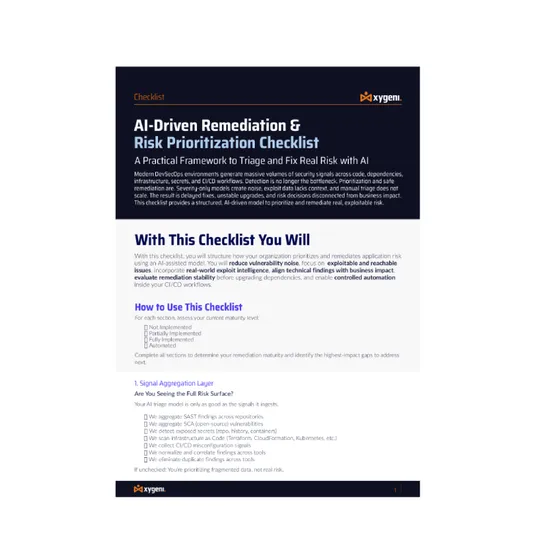
You don’t have a vulnerability problem. You have a prioritization problem.

Most teams today don’t struggle to find vulnerabilities; they struggle to decide what to fix first. With SAST, SCA, secrets, and CI/CD checks all generating signals, the real challenge is prioritization: what’s actually exploitable, what’s reachable, and what can be fixed without breaking things. Instead of relying only on severity, modern teams are shifting toward risk-based remediation, combining exploitability, context, and stability, while reducing noise across tools and automating safe fixes through PRs. If you’re dealing with alert fatigue or slow remediation cycles, this checklist is a practical starting point → https://go.xygeni.io/ai-driven-remediation-risk-prioritization-checklist

Ai-Driven Checklist
Link
@varbear shared a link, 2 months, 3 weeks ago
FAUN.dev()

I built a programming language using Claude Code

Cutlet usesClaude Code. The LLM emits every line. Source, build steps, and examples live on GitHub. It runs on macOS and Linux and ships aREPL. It supports arrays, strings, double numbers, a vectorizingmeta-operator, zip/filter indexing, prototypal inheritance, and a mark-and-sweepGC. Development ra.. read more  

Link
@varbear shared a link, 2 months, 3 weeks ago
FAUN.dev()

Why value streams and capability maps are your new governance control plane

The piece flips enterprise AI fromgenerativetoagentic. Agents getstructured autonomyto perceive, plan, and execute across systems. It turnsvalue streammaps into a control plane withautonomy zones,halt-on-exceptiongates, cryptographicflight recorders, andpolicy-as-code. Result: less hallucination and.. read more  

Why value streams and capability maps are your new governance control plane
Link
@varbear shared a link, 2 months, 3 weeks ago
FAUN.dev()

Cracking the Python Monorepo

Outlines a Python monorepo setup that pairsuvworkspaces withDaggerandBuildKitcaching. Builds container stages programmatically. Keeps things cache-friendly and predictable. Parsespyproject.tomland extracts the workspace graph. Copies required local packages into intermediate stages. Installs them in.. read more  

Link
@varbear shared a link, 2 months, 3 weeks ago
FAUN.dev()

A new chapter for the Nix language, courtesy of WebAssembly

Determinate Nix introduces experimental WebAssembly host calls. It lets Nix invoke Wasm modules, pass and return complex Nix values, and support Rust, C++, and Zig toolchains. It runs on Wasmtime/Cranelift and slashes runtime and memory: Fibonacci test 0.33s vs 79.33s, 30MB vs 4.5GB. Per-call instan.. read more  

A new chapter for the Nix language, courtesy of WebAssembly
Link
@varbear shared a link, 2 months, 3 weeks ago
FAUN.dev()

Using Rust and Postgres for everything: patterns learned over the years

Rust and PostgreSQL are considered the best tools in the software world due to their performance and reliability. Rewriting a backend service from Go to Rust led to significant improvements in processing speed and memory usage. Using sqlx for database operations and leveraging PostgreSQL features li.. read more  

Link
@kaptain shared a link, 2 months, 3 weeks ago
FAUN.dev()

Running Agents on Kubernetes with Agent Sandbox

Agent Sandbox unveils the Sandbox CRD to map long-lived, singleton AI agents onto Kubernetes. It adds stable identity and lifecycle primitives. It supports runtimes like gVisor and Kata Containers. It enables zero-scale resume. It includes SandboxWarmPool with SandboxClaim and SandboxTemplate to kil.. read more  

Link
@kaptain shared a link, 2 months, 3 weeks ago
FAUN.dev()

Securing Production Debugging in Kubernetes

The post prescribes an on-demand SSH gateway pod. It usesshort-lived, identity-bound credentialsandKubernetes RBACto grant scoped, auditable debug sessions. It recommends anaccess brokerthat binds Roles to groups, issues ephemeral certs and OpenSSH user certificates, rotates CAs, enforces command-le.. read more  

Link
@kaptain shared a link, 2 months, 3 weeks ago
FAUN.dev()

The Invisible Rewrite: Modernizing the Image Promoter

SIG Release rewrote theimage promotercore. It cut 20% of the code. It added apipeline engine,cosignsigning, andSLSAattestations. Signing now sits separate fromsignature replication. Registry reads run in parallel - plan time dropped ~20m → ~2m. Per-request timeouts, retries, and HTTP connection reus.. read more  

BigQuery is a cloud-native, serverless analytics platform designed to store, query, and analyze massive volumes of structured and semi-structured data using standard SQL. It separates storage from compute, automatically scales resources, and eliminates the need for infrastructure management, indexing, or capacity planning.

BigQuery is optimized for analytical workloads such as business intelligence, log analysis, data science, and machine learning. It supports real-time data ingestion via streaming, batch loading from cloud storage, and federated queries across external data sources like Cloud Storage, Bigtable, and Google Drive.

Query execution is distributed and highly parallel, enabling interactive performance even on petabyte-scale datasets. The platform integrates deeply with the Google Cloud ecosystem, including Looker for BI, Vertex AI for ML workflows, Dataflow for streaming pipelines, and BigQuery ML, which allows users to train and run machine learning models directly using SQL.

Built-in security features include fine-grained IAM controls, column- and row-level security, encryption by default, and audit logging. BigQuery follows a consumption-based pricing model, charging for storage and queries (on-demand or reserved capacity).