Join us

ContentUpdates and recent posts about Flask..
Story
@laura_garcia shared a post, 2ย months, 4ย weeks ago
Software Developer, RELIANOID

Discover why Cloud Security Posture Management (CSPM) is a game-changer for companies in today's digital landscape!

Discover why Cloud Security Posture Management (CSPM) is a game-changer for companies in today's digital landscape! In our latest article, we take you on a narrative journey exploring the vital role CSPM plays in maintaining robust cloud securityโ€”from continuously monitoring digital infrastructures ..

Story
@viktoriiagolovtseva shared a post, 2ย months, 4ย weeks ago

Data Center Migration to Cloud: Step-by-Step Guide

Teams are migrating away fromJira Data Centerdue to its impending end-of-life, and staying put increases risks over time.Atlassian recently announced the end of life for Data Centerand is focusing its investments onJira Cloud, where new features, automation, and improvements to roadmaps and dashboar..

Zrzut ekranu 2026-03-23 180645
Story
@laura_garcia shared a post, 2ย months, 4ย weeks ago
Software Developer, RELIANOID

๐Ÿšจ ๐—ก๐—œ๐—ฆ๐Ÿฎ ๐—ถ๐˜€ ๐—ฐ๐—ต๐—ฎ๐—ป๐—ด๐—ถ๐—ป๐—ด ๐˜๐—ต๐—ฒ ๐—ฐ๐˜†๐—ฏ๐—ฒ๐—ฟ๐˜€๐—ฒ๐—ฐ๐˜‚๐—ฟ๐—ถ๐˜๐˜† ๐—ด๐—ฎ๐—บ๐—ฒ ๐—ถ๐—ป ๐—˜๐˜‚๐—ฟ๐—ผ๐—ฝ๐—ฒ

Itโ€™s no longer just about protection โ€” itโ€™s about ๐—ฎ๐—ฐ๐—ฐ๐—ผ๐˜‚๐—ป๐˜๐—ฎ๐—ฏ๐—ถ๐—น๐—ถ๐˜๐˜†, ๐—ฐ๐—ผ๐—บ๐—ฝ๐—น๐—ถ๐—ฎ๐—ป๐—ฐ๐—ฒ, ๐—ฎ๐—ป๐—ฑ ๐—ฏ๐˜‚๐˜€๐—ถ๐—ป๐—ฒ๐˜€๐˜€ ๐—ฟ๐—ฒ๐˜€๐—ถ๐—น๐—ถ๐—ฒ๐—ป๐—ฐ๐—ฒ. โš ๏ธ Fines up to โ‚ฌ10M ๐Ÿ” Supplier & partner scrutiny ๐Ÿ›ก๏ธ Mandatory risk management The question is: ๐—ฎ๐—ฟ๐—ฒ ๐˜†๐—ผ๐˜‚ ๐—ฟ๐—ฒ๐—ฎ๐—ฑ๐˜†? ๐Ÿ“– Read our latest blog to understand the impact and how to prepare: NIS2 Directive and..

Link Xygeni Team
@mashka shared a link, 2ย months, 4ย weeks ago
Paid Acquisition and Growth Marketing, xygeni

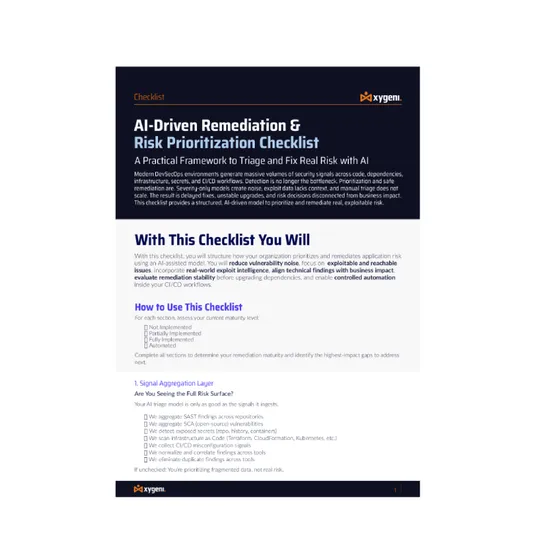
You donโ€™t have a vulnerability problem. You have a prioritization problem.

Most teams today donโ€™t struggle to find vulnerabilities; they struggle to decide what to fix first. With SAST, SCA, secrets, and CI/CD checks all generating signals, the real challenge is prioritization: whatโ€™s actually exploitable, whatโ€™s reachable, and what can be fixed without breaking things. Instead of relying only on severity, modern teams are shifting toward risk-based remediation, combining exploitability, context, and stability, while reducing noise across tools and automating safe fixes through PRs. If youโ€™re dealing with alert fatigue or slow remediation cycles, this checklist is a practical starting point โ†’ https://go.xygeni.io/ai-driven-remediation-risk-prioritization-checklist

Ai-Driven Checklist
Link
@varbear shared a link, 3ย months ago
FAUN.dev()

Why value streams and capability maps are your new governance control plane

The piece flips enterprise AI fromgenerativetoagentic. Agents getstructured autonomyto perceive, plan, and execute across systems. It turnsvalue streammaps into a control plane withautonomy zones,halt-on-exceptiongates, cryptographicflight recorders, andpolicy-as-code. Result: less hallucination and.. read more ย 

Why value streams and capability maps are your new governance control plane
Link
@varbear shared a link, 3ย months ago
FAUN.dev()

Using Rust and Postgres for everything: patterns learned over the years

Rust and PostgreSQL are considered the best tools in the software world due to their performance and reliability. Rewriting a backend service from Go to Rust led to significant improvements in processing speed and memory usage. Using sqlx for database operations and leveraging PostgreSQL features li.. read more ย 

Link
@varbear shared a link, 3ย months ago
FAUN.dev()

I built a programming language using Claude Code

Cutlet usesClaude Code. The LLM emits every line. Source, build steps, and examples live on GitHub. It runs on macOS and Linux and ships aREPL. It supports arrays, strings, double numbers, a vectorizingmeta-operator, zip/filter indexing, prototypal inheritance, and a mark-and-sweepGC. Development ra.. read more ย 

Link
@varbear shared a link, 3ย months ago
FAUN.dev()

Cracking the Python Monorepo

Outlines a Python monorepo setup that pairsuvworkspaces withDaggerandBuildKitcaching. Builds container stages programmatically. Keeps things cache-friendly and predictable. Parsespyproject.tomland extracts the workspace graph. Copies required local packages into intermediate stages. Installs them in.. read more ย 

Link
@varbear shared a link, 3ย months ago
FAUN.dev()

A new chapter for the Nix language, courtesy of WebAssembly

Determinate Nix introduces experimental WebAssembly host calls. It lets Nix invoke Wasm modules, pass and return complex Nix values, and support Rust, C++, and Zig toolchains. It runs on Wasmtime/Cranelift and slashes runtime and memory: Fibonacci test 0.33s vs 79.33s, 30MB vs 4.5GB. Per-call instan.. read more ย 

A new chapter for the Nix language, courtesy of WebAssembly
Link
@kaptain shared a link, 3ย months ago
FAUN.dev()

Running Agents on Kubernetes with Agent Sandbox

Agent Sandbox unveils the Sandbox CRD to map long-lived, singleton AI agents onto Kubernetes. It adds stable identity and lifecycle primitives. It supports runtimes like gVisor and Kata Containers. It enables zero-scale resume. It includes SandboxWarmPool with SandboxClaim and SandboxTemplate to kil.. read more ย 

Flask is an open-source web framework written in Python and created by Armin Ronacher in 2010. It is known as a microframework, not because it is weak or incomplete, but because it provides only the essential building blocks for developing web applications. Its core focuses on handling HTTP requests, defining routes, and rendering templates, while leaving decisions about databases, authentication, form handling, and other components to the developer. This minimalistic design makes Flask lightweight, flexible, and easy to learn, but also powerful enough to support complex systems when extended with the right tools.

At the heart of Flask are two libraries: Werkzeug, which is a WSGI utility library that handles the low-level details of communication between web servers and applications, and Jinja2, a templating engine that allows developers to write dynamic HTML pages with embedded Python logic. By combining these two, Flask provides a clean and pythonic way to create web applications without imposing strict architectural patterns.

One of the defining characteristics of Flask is its explicitness. Unlike larger frameworks such as Django, Flask does not try to hide complexity behind layers of abstraction or dictate how a project should be structured. Instead, it gives developers complete control over how they organize their code and which tools they integrate. This explicit nature makes applications easier to reason about and gives teams the freedom to design solutions that match their exact needs. At the same time, Flask benefits from a vast ecosystem of extensions contributed by the community. These extensions cover areas such as database integration through SQLAlchemy, user session and authentication management, form validation with CSRF protection, and database migration handling. This modular approach means a developer can start with a very simple application and gradually add only the pieces they require, avoiding the overhead of unused components.

Flask is also widely appreciated for its simplicity and approachability. Many developers write their first web application in Flask because the learning curve is gentle, the documentation is clear, and the framework itself avoids unnecessary complexity. It is particularly well suited for building prototypes, REST APIs, microservices, or small to medium-sized web applications. At the same time, production-grade deployments are supported by running Flask applications on WSGI servers such as Gunicorn or uWSGI, since the development server included with Flask is intended only for testing and debugging.

The strengths of Flask lie in its minimalism, flexibility, and extensibility. It gives developers the freedom to assemble their application architecture, choose their own libraries, and maintain tight control over how things work under the hood. This is attractive to experienced engineers who dislike being boxed in by heavy frameworks. However, the same freedom can become a limitation. Flask does not include features like an ORM, admin interface, or built-in authentication system, which means teams working on very large applications must take on more responsibility for enforcing patterns and maintaining consistency. In situations where a project requires an opinionated, all-in-one solution, Django or another full-stack framework may be a better fit.

In practice, Flask has grown far beyond its initial positioning as a lightweight tool. It has been used by startups for rapid prototypes and by large companies for production systems. Its design philosophyโ€”keep the core simple, make extensions easy, and let developers decideโ€”continues to attract both beginners and professionals. This balance between simplicity and power has made Flask one of the most enduring and widely used Python web frameworks.