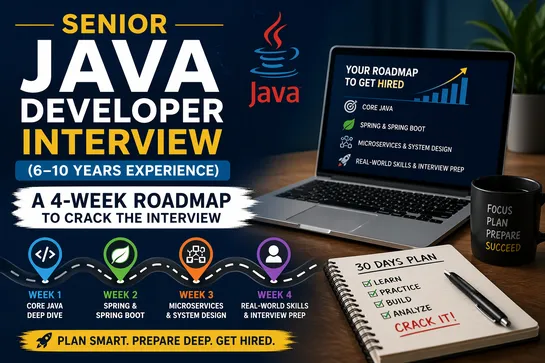
How To Crack Senior Java Interviews (6–10 YOE) In 4 Weeks
A practical 4-week roadmap to crack Senior Java Developer interviews (6–10 YOE), covering Core Java, Spring Boot internals, Microservices, System Design, and real-world interview strategies.

Java 26 (March 2026) is out, and while it’s not a headline-heavy release, it brings meaningful improvements where it counts — performance, networking, and concurrency.
Some notable updates:
🌐 HTTP/3 support (QUIC-based, lower latency, better reliability)
🧵 Structured Concurrency (Preview) for safer multithreading
⚡ JVM & GC optimizations improving startup and runtime performance
🧠 Continued evolution of pattern matching
🧪 Vector API (Incubator) for high-performance workloads
This release is less about flashy features and more about incremental improvements that impact real-world systems.

Most Spring Boot applications run perfectly in development.
The APIs respond quickly, tests pass, and everything seems stable.
But once the application reaches production, things can change dramatically — slow responses, memory issues, and unexpected failures start appearing.
In many cases, the problem isn't Spring Boot itself.
It's a set of common mistakes developers unknowingly introduce into their applications.
In this article, we'll explore 7 critical mistakes that cause many Spring Boot apps to fail in production — and how to avoid them.

A practical breakdown of the most common Spring Boot performance bottlenecks — and how we optimized our API from 3 seconds to 200 ms.