TL;DR
Anthropic's global AI study surveyed 80,508 participants across 159 countries, revealing desires for more personal time and concerns about AI's unreliability and job displacement. Sentiments vary regionally, with lower-income countries seeing AI as an equalizer, while Western Europe and North America focus on governance issues. The study highlights a complex mix of hope and fear regarding AI's impact.
Key Points
Highlight key points with color coding based on sentiment (positive, neutral, negative).19% of 80,000+ respondents want AI to handle routine tasks so they can focus on higher-value work - but the real ask behind it is almost always more time with family, not better output.
The top three fears: hallucinations (27%), job displacement (22%), and loss of human autonomy (22%). On average, each respondent voiced 2.3 distinct concerns.
67% of respondents globally express net positive sentiment toward AI - but that number shifts sharply by region. Africa, Latin America, and South Asia skew significantly more optimistic than Western Europe and North America.
Hope and fear aren't opposites here - they live in the same person. Someone excited about AI for emotional support is 3x more likely to also fear becoming dependent on it.
Economic anxiety is the one tension that actually divides people into camps: independent workers report real gains (47% of entrepreneurs vs 14% of institutional employees), while freelance creatives sit at 23% benefit and 17% precarity - AI is both their tool and their competitor.
Anthropic just published what it claims is the largest qualitative AI study ever conducted - and the results are more nuanced than the usual optimist/pessimist split you see in tech media.
The study
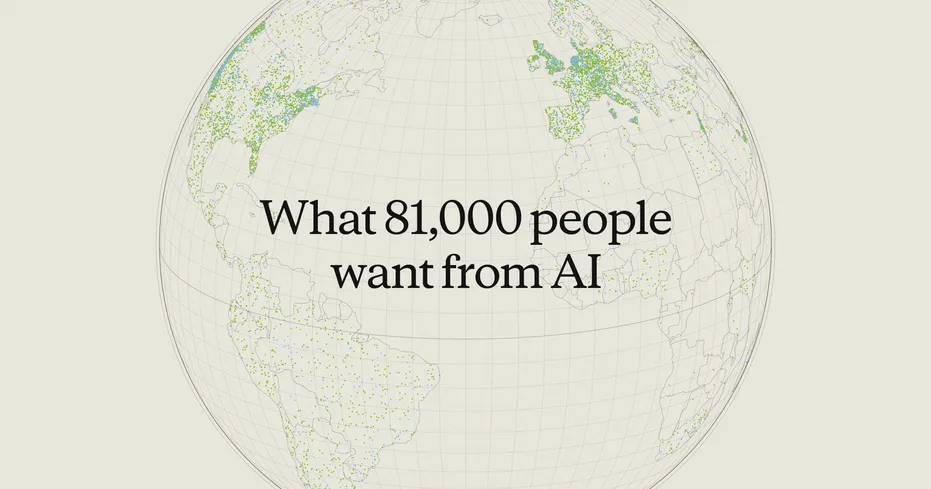
Between December 2024 and January 2025, Anthropic used a version of Claude as an interviewer, inviting all Claude.ai users to share how they use AI, what they hope for, and what scares them. 80,508 people across 159 countries and 70 languages responded. That's not a survey with checkboxes - it's open-ended interviews, analyzed at scale using Claude-powered classifiers.
What people actually want
The #1 ask wasn't "help me be more productive." The dominant theme was simpler: more time back for the things that matter outside of work.
- 19% want AI to help them achieve professional excellence - less busywork, more meaningful work
- 14% want personal transformation - emotional growth, mental health support, companionship
- 11% explicitly want AI to free up time for family, hobbies, and rest
- 10% are chasing financial independence through AI
A common pattern: people said they wanted AI for email automation or documentation - but when asked why, the real answer was "so I can pick up my kids on time."
The fears
Concerns were more varied than hopes, and most people voiced 2.3 distinct worries on average. The top concern was unreliability and hallucinations (27%), followed closely by job displacement and loss of human autonomy, both at 22%. Cognitive atrophy came next at 16%, then governance gaps at 15%, and misinformation at 14%.
Only 11% said they had no concerns at all.
The most interesting finding
Hope and fear don't divide people into separate camps - they coexist in the same person. Someone excited about AI for emotional support is 3x more likely to also fear becoming dependent on it. The people most enthusiastic about AI-powered learning are among the most worried about cognitive atrophy.
The exception: economic anxiety. The people excited about AI-driven entrepreneurship and the people worried about displacement are largely different groups - not the same person holding both at once.
The geography gap
Sentiment toward AI skews heavily by region. Lower and middle income countries are consistently more optimistic - not because they're naive, but because AI registers more as an equalizer than a threat.
"I'm in a tech-disadvantaged country, and I can't afford many failures. With AI, I've reached professional level in cybersecurity, UX design, marketing, and project management simultaneously." - Entrepreneur, Cameroon
Western Europe and North America cluster on the opposite end: higher concern about governance, surveillance, and job displacement. 67% of all respondents expressed net positive sentiment toward AI - but that number shifts significantly depending on where you live.
Bottom line
This is a rare piece of qualitative research that cuts through the usual AI discourse. The findings aren't about abstract risk projections, they're grounded in what 80,000 actual users are experiencing day to day. For anyone building or governing AI products, it's required reading.
Key Numbers
Present key numerics and statistics in a minimalist format.The total number of participants in Anthropic's AI study.
The total number of countries from which participants were included in the study.
The total number of languages in which participants responded.
The percentage of participants who wanted AI to help them achieve professional excellence.
The percentage of participants who sought personal transformation through AI.
The percentage of participants who wanted AI to free up time for family, hobbies, and rest.
The percentage of participants interested in achieving financial independence through AI.
The average number of distinct worries about AI expressed by participants.
Stakeholder Relationships
An interactive diagram mapping entities directly or indirectly involved in this news. Drag nodes to rearrange them and see relationship details.People
Key entities and stakeholders, categorized for clarity: people, organizations, tools, events, regulatory bodies, and industries.Led the 81k study, designed and ran the analysis, and authored the report.
Led data visualization and prototyped the interactive article.
Organizations
Key entities and stakeholders, categorized for clarity: people, organizations, tools, events, regulatory bodies, and industries.Conducted the largest qualitative AI study ever, interviewing 80,508 Claude users across 159 countries to understand global hopes and concerns around AI.
Tools
Key entities and stakeholders, categorized for clarity: people, organizations, tools, events, regulatory bodies, and industries.A version of Claude specifically prompted to conduct open-ended conversational interviews, used to collect all 80,508 responses in the study.
Used to build the classifiers that categorized responses across dimensions including visions, concerns, sentiment, and job categories.
Timeline of Events
Timeline of key events and milestones.Anthropic used Anthropic Interviewer to conduct open-ended interviews with 80,508 Claude.ai users across 159 countries and 70 languages, over one week.
Anthropic published the full report - 'What 81,000 People Want from AI' - including findings, regional breakdowns, and interactive data visualizations.
Anthropic announced a second Anthropic Interviewer study, launching to a small subset of Claude users, focused specifically on Claude's effects on user wellbeing over time.
Additional Resources
Enjoyed it?
Get weekly updates delivered straight to your inbox, it only takes 3 seconds!Subscribe to our weekly newsletter Kala to receive similar updates for free!
Give a Pawfive to this post!
Share with your friends and followers
Start writing about what excites you in tech — connect with developers, grow your voice, and get rewarded.
Join other developers and claim your FAUN.dev() account now!

FAUN.dev()
FAUN.dev() is a developer-first platform built with a simple goal: help engineers stay sharp withou…



Kala #GenAI
FAUN.dev()
@kalaDeveloper Influence
30
Influence
1
Total Hits
155
Posts