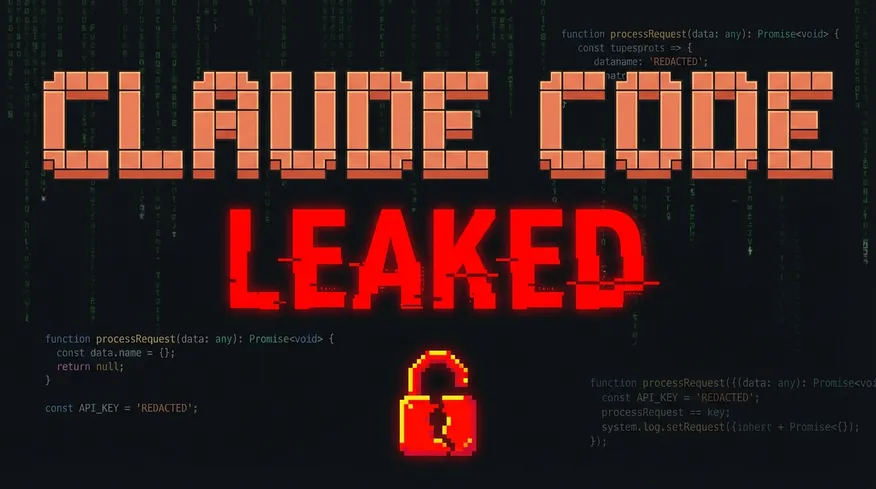
What actually leaked: Claude Code already has a public GitHub repo (anthropics/claude-code, 65,200+ stars) with installation scripts, plugin examples, and community resources. That's the packaging. What leaked today is the engine: the full internal TypeScript implementation - tool registry, system prompts, permission classifiers, pricing constants, feature flags, employee-only tooling. None of that was ever in the public repo. Reverse-engineering efforts like ccleaks.com had reconstructed fragments from the minified bundle before, but the source map delivered everything unobfuscated - internal comments, file paths, and all.
Read a more detailed report here: Anthropic Accidentally Leaks Claude Code's Entire Source Code via npm
1. Anthropic employees hide AI involvement in public code
The source contains "Undercover Mode" (src/utils/undercover.ts).
Undercover Mode is a system built into Claude Code that activates when Anthropic employees use Claude to write code for public or open-source repositories. Its job is to make sure nobody can tell that an AI was involved. When it's active, it automatically removes anything that would reveal Claude's involvement - things like "Co-Authored-By: Claude" in git commits, model names in PR descriptions, or any mention that the code was AI-generated. The system prompt injected into Claude literally tells it: "You are operating UNDERCOVER... Do not blow your cover."
How much open-source code credited to Anthropic engineers was actually written by Claude? The system is designed to make it impossible to tell.
2. Undercover Mode has no off switch
This isn't a toggle. If the system can't confirm that the current repository is private, stealth stays on as "defense-in-depth." Concealment is the default, not the exception.
3. AI-written code is tracked to the character - then erased
Claude Code tracks the exact percentage of AI-authored code per PR using character-level matching. The leaked code references examples like "93% 3-shotted by claude-opus-4-6" (src/utils/commitAttribution.ts). This data exists for internal metrics - then gets stripped entirely when Undercover Mode is active.
4. Next-gen models are already in the code
The Undercover Mode prompt warns employees to never leak opus-4-7 and sonnet-4-8 - model identifiers that don't exist publicly. The active internal model is codenamed "Capybara", encoded character-by-character as String.fromCharCode(99,97,112,121,98,97,114,97) to avoid tripping their own leak detector.
5. Fast Mode is 6x the price for the same model
Opus 4.6 Fast Mode: $30/$150 per million tokens (input/output). Normal Opus 4.6: $5/$25. Same weights, same architecture. The only difference is priority inference.
6. The auto-permission system is called "YOLO"
The function deciding whether Claude can run a tool without asking is named classifyYoloAction(). It uses Claude to evaluate the risk of its own tool calls: LOW, MEDIUM, or HIGH. An AI deciding whether its own actions are safe enough to skip human review.
7. Telemetry tracks 1,000+ event types
Every action is logged under the "Tengu" prefix and sent to Anthropic's servers: tool grants, denials, YOLO decisions, session performance, subscription tier, environment details. The analytics service spans src/services/analytics/ and covers over a thousand distinct event types.
8. Environment variables disable all safety features
CLAUDE_CODE_ABLATION_BASELINE disables all safety features. DISABLE_COMMAND_INJECTION_CHECK skips the injection guard. Both are flagged as dangerous in the code itself. Presumably for internal research - but compiled into the distributed binary.
9. Computer Use is codenamed "Chicago"
Full GUI automation (mouse, clicks, screenshots) is gated behind tengu_malort_pedway (Malort is a notoriously bitter Chicago liquor, the Pedway is the city's underground walkway). Anthropic employees bypass the gate with ALLOW_ANT_COMPUTER_USE_MCP.
10. Web search costs $0.01 per query
Flat one cent per request, tracked separately from token costs. Hardcoded in the source. Not controversial, but useful for cost-sensitive workflows.
11. 22 private Anthropic repos were exposed
The Undercover Mode allowlist reveals 22 private repository names: anthropics/casino, anthropics/trellis, anthropics/forge-web, anthropics/mycro_manifests, anthropics/feldspar-testing, and more. Never meant to be public.
12. The 1M context window is disabled for healthcare
The extended 1M token context (vs 200K default) can be force-disabled with CLAUDE_CODE_DISABLE_1M_CONTEXT. This appears to be a HIPAA compliance measure, suggesting extended context raises data retention concerns in regulated environments.
13. Voice Mode has a kill-switch called "Amber Quartz"
Voice input is built into Claude Code with OAuth authentication. It has a remote kill-switch gated behind tengu_amber_quartz_disabled, suggesting active testing with the ability to shut down instantly.
14. A full virtual pet system is ready to ship
A complete Tamagotchi-style companion called "Buddy" lives in the codebase: 18 species (duck, ghost, axolotl, capybara, dragon, mushroom, chonk...), five rarity tiers (Common 60%, Uncommon 25%, Rare 10%, Epic 4%, Legendary 1%) plus an independent 1% Shiny chance on top of any rarity, procedurally generated stats (DEBUGGING, PATIENCE, CHAOS, WISDOM, SNARK), cosmetic hats and eye styles, and a "soul description" written by Claude on first hatch. Species determined by a Mulberry32 PRNG seeded from your user ID, every user gets a unique, deterministic pet. The code references April 1-7 as a teaser window and May 2026 for full launch.
15. An autonomous background agent called KAIROS is fully built
KAIROS (from the Greek "the right time") is a persistent, always-on mode that watches, logs, and acts without user input. It maintains append-only daily logs, sends push notifications, subscribes to PRs, and runs a "dream" phase while the user is idle, consolidating memories in four steps:
- Orient
- Gather
- Consolidate
- Prune
It has its own tool set, its own status modes, and is referenced over 150 times in the source (this isn't a prototype).
16. The irony
Anthropic built Undercover Mode to hide AI involvement when employees use Claude on public repos - and to prevent internal details like model codenames from leaking in the process. They hid secret model names like "Capybara" by spelling them out one letter at a time in code (e.g.: String.fromCharCode(99,97,112,...)) so that Anthropic's own build tools - which scan the codebase for forbidden strings before publishing - wouldn't catch it. They also kept a blocklist of sensitive words (scripts/excluded-strings.txt) that gets automatically stripped from the product before it ships to users.
Then they shipped the entire source code in a .map file because someone forgot *.map in .npmignore: The system designed to prevent AI leaks didn't fail but the humans did.
Data sourced from analysis at ccleaks.com.