Join us

ContentUpdates and recent posts about AIStor..
Link
@varbear shared a link, 3 weeks, 5 days ago
FAUN.dev()

GitHub backs down, kills Copilot PR ‘tips’ after backlash

GitHub revoked Copilot's ability to inject tips into other users' pull requests after reports that Copilot Review inserted aRaycastlink. They disabled agent tips in PR comments, blamed a programming-logic bug, and said they won't turn tips into ads... read more  

GitHub backs down, kills Copilot PR ‘tips’ after backlash
Link
@varbear shared a link, 3 weeks, 5 days ago
FAUN.dev()

SQLite Features You Didn’t Know It Had: JSON, text search, CTE, STRICT, generated columns, WAL

SQLite packsJSONextraction, expression indexes,FTS5full-text search,CTEs, window functions, andWALinto a single file. It enforcesstrict tables, supportsgenerated columns, and indexes JSON expressions for fast semi-structured queries... read more  

Link
@varbear shared a link, 3 weeks, 5 days ago
FAUN.dev()

Python 3.3: The Version That Quietly Rewired Everything

Python 3.3 introduced three key features that have had a lasting impact on Python development. Firstly, yield from simplified the composition of generators by allowing easy delegation between them. Secondly, venv standardized virtual environments in Python, improving isolation and reproducibility of.. read more  

Python 3.3: The Version That Quietly Rewired Everything
Link
@varbear shared a link, 3 weeks, 5 days ago
FAUN.dev()

I told Claude Code to build me an executive assistant. This is what my work as CTO looks like now

CTO at ZAR shares his experience managing 10 engineers, shipping code, and operating at the C-level with an AI assistant named Claude Code. The system allows him to maintain context across multiple workstreams, automate tasks, and scale his productivity. In just three weeks, he has documented 82 mee.. read more  

Link
@varbear shared a link, 3 weeks, 5 days ago
FAUN.dev()

Email address obfuscation: What works in 2026?

The article catalogs obfuscation methods:HTML entities,SVG in an object,display:none, JavaScript decoders, custom encodings, andAES‑256. It coversmailtoobfuscation, redirects (302/301,.htaccess), interaction-gated reveals, accessibility caveats, and ahoneypot-based spam-statistics system... read more  

Link
@kaptain shared a link, 3 weeks, 5 days ago
FAUN.dev()

How GitHub uses eBPF to improve deployment safety

GitHub hosts its own source code on github.com, creating a circular dependency. To mitigate this, GitHub maintains mirrors of its code and built assets. By using eBPF, GitHub can selectively monitor and block calls that create circular dependencies in their deployment system... read more  

How GitHub uses eBPF to improve deployment safety
Link
@kaptain shared a link, 3 weeks, 5 days ago
FAUN.dev()

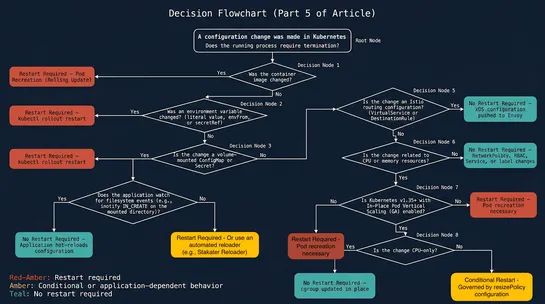
When Kubernetes restarts your pod - And when it doesn’t

Production internals guide verified against Kubernetes 1.35 GA. Engineers need to understand terminology differences to avoid flawed runbooks and bad on-call decisions. Kubelet watches the pod spec, not other resources like ConfigMaps or Secrets, to explain the majority of config update investigatio.. read more  

When Kubernetes restarts your pod - And when it doesn’t
Link
@kaptain shared a link, 3 weeks, 5 days ago
FAUN.dev()

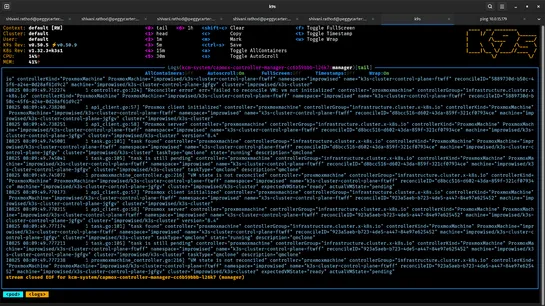
K3s on On-Prem Infrastructures the GitOps Way: Writing a Custom k0rdent Template from Scratch

Kubernetes, now 12 years old, has evolved into the universal operating system for modern infrastructure, running on various platforms like Proxmox. Using k0rdent, Proxmox, and K3s, users can provision and manage Kubernetes clusters on-premise in a declarative, repeatable, and clean manner. This appr.. read more  

K3s on On-Prem Infrastructures the GitOps Way: Writing a Custom k0rdent Template from Scratch
Link
@kaptain shared a link, 3 weeks, 5 days ago
FAUN.dev()

Kubernetes Monitoring Helm chart v4: Biggest update ever!

The Kubernetes Monitoring Helm chart version 4.0 is designed to solve real pain points that users have hit as their monitoring setups have grown. Destinations are now defined as a map instead of a list, making it easier to manage configurations for multiple clusters. Collectors are defined by the us.. read more  

Kubernetes Monitoring Helm chart v4: Biggest update ever!
Link
@kaptain shared a link, 3 weeks, 5 days ago
FAUN.dev()

Duolingo's Kubernetes Leap

Duolingo made a bold leap migrating 500+ services to Kubernetes, embracing Argo CD for blue-green deployments and leveraging GitOps for flexibility and control. This shift to a cellular architecture enabled them to isolate environments and manage developer trust while navigating AWS rate limits. Exc.. read more  

AIStor is an enterprise-grade, high-performance object storage platform built for modern data workloads such as AI, machine learning, analytics, and large-scale data lakes. It is designed to handle massive datasets with predictable performance, operational simplicity, and hyperscale efficiency, while remaining fully compatible with the Amazon S3 API. AIStor is offered under a commercial license as a subscription-based product.

At its core, AIStor is a software-defined, distributed object store that runs on commodity hardware or in containerized environments like Kubernetes. Rather than being limited to traditional file or block interfaces, it exposes object storage semantics that scale from petabytes to exabytes within a single namespace, enabling consistent, flat addressing of vast datasets. It is engineered to sustain very high throughput and concurrency, with examples of multi-TiB/s read performance on optimized clusters.

AIStor is optimized specifically for AI and data-intensive workloads, where throughput, low latency, and horizontal scalability are critical. It integrates broadly with modern AI and analytics tools, including frameworks such as TensorFlow, PyTorch, Spark, and Iceberg-style table engines, making it suitable as the foundational storage layer for pipelines that demand both performance and consistency.

Security and enterprise readiness are central to AIStor’s design. It includes capabilities like encryption, replication, erasure coding, identity and access controls, immutability, lifecycle management, and operational observability, which are important for mission-critical deployments that must meet compliance and data protection requirements.

AIStor is positioned as a platform that unifies diverse data workloads — from unstructured storage for application data to structured table storage for analytics, as well as AI training and inference datasets — within a consistent object-native architecture. It supports multi-tenant environments and can be deployed across on-premises, cloud, and hybrid infrastructure.