Join us

ContentUpdates and recent posts about AWX..
News FAUN.dev() Team
@kala shared an update, 3 months, 4 weeks ago
FAUN.dev()

FastMCP 3.0 Released: Community-Driven Enhancements Unveiled

FastMCP

FastMCP 3.0 is now generally available. It keeps the @mcp.tool() API but rebuilds the internals around components + providers + transforms, adds a CLI, and ships production features like component versioning, per-component auth + OAuth additions, OpenTelemetry tracing, background tasks, pagination, tool timeouts, and hot reload. The project moved from jlowin/fastmcp to PrefectHQ/fastmcp on GitHub, and upgrading is supported via dedicated guides for FastMCP 2 and MCP SDK users.
FastMCP 3.0 Released: Community-Driven Enhancements Unveiled
Story
@laura_garcia shared a post, 3 months, 4 weeks ago
Software Developer, RELIANOID

🚀 Ready to level up your #AppSec skills?

Join us at London OWASP Training Days 2026 – February 25–28 in London! Hands-on, instructor-led sessions covering: 🔹 API Security 🔹 Secure Development & Testing 🔹 Threat Modeling & Risk Analysis 🔹 AI & Security 🔹 Mobile & IoT Security 🔹 Offensive Security & Pentesting Learn from the global OWASP com..

London OWASP Training Days 2026
Story
@laura_garcia shared a post, 3 months, 4 weeks ago
Software Developer, RELIANOID

Finance: Resilience. Trust. Continuity

Downtime isn’t just costly—it’s a trust killer. 💸 In financial services, outages can cost millions, invite regulatory penalties, and damage customer confidence. Our latest blog dives into the true cost of downtime and why resilience, security, and compliance must be non-negotiable. #FinancialServic..

Blog_Why Financial Services Institutions Must Protect Themselves From Downtime_RELIANOID
Story
@dwisiswant0 shared a post, 4 months ago

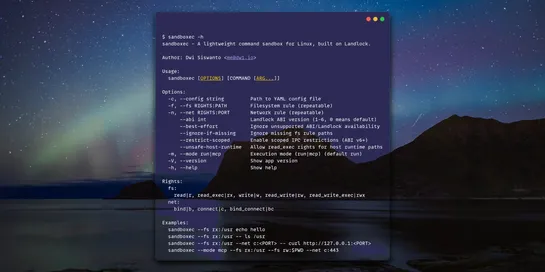
The most practical, fast, tiny command sandboxing for AI agents

Need to run one sketchy command without a full container? Here is the most practical, lightweight way to lock down one risky command in your AI pipeline. No daemon, no root, no image build.

sandboxec-social-preview
Story
@laura_garcia shared a post, 4 months ago
Software Developer, RELIANOID

🚀 Deploy RELIANOID Community Edition v7 on Microsoft Azure using Terraform.

⚡ Infrastructure ready in minutes ⚡ Official Terraform module ⚡ Fully automated Azure deployment Simple. Fast. Reproducible. #Terraform#Azure#DevOps#IaC#LoadBalancer#CloudInfrastructure#RELIANOID https://www.relianoid.com/resources/knowledge-base/community-edition-v7-administration-guide/deploy-reli..

terraform_relianoid_community_azure_img2
Story
@laura_garcia shared a post, 4 months ago
Software Developer, RELIANOID

🚀 See you at DeveloperWeek — February 18–20, 2026!

🚀 See you at DeveloperWeek — February 18–20, 2026! The world’s largest independent software development & AI engineering conference lands in San Jose, bringing together developers, architects, and tech leaders shaping the future of software. From AI & cloud-native to DevSecOps and developer experien..

developer-week-san-jose-california-2026
News FAUN.dev() Team
@kala shared an update, 4 months ago
FAUN.dev()

OpenAI Hires OpenClaw Creator Peter Steinberger; Project Moves to Independent Foundation

OpenClaw

Peter Steinberger, creator of OpenClaw, is joining OpenAI to work on bringing AI agents to a broader audience, while OpenClaw will move to an independent open-source foundation and continue development outside OpenAI’s direct control.

OpenAI Hires OpenClaw Creator Peter Steinberger; Project Moves to Independent Foundation
News FAUN.dev() Team Trending
@kala shared an update, 4 months ago
FAUN.dev()

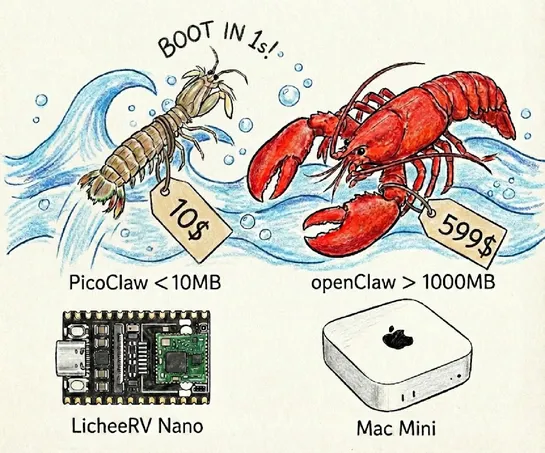
OpenClaw Lightweight Alternative Launches: A 10MB AI Assistant That Runs on $10 Hardware

PicoClaw Go OpenClaw

Sipeed has released PicoClaw an OpenClaw micro alternative that uses 99% less memory than . , an open-source AI assistant written in Go that runs in under 10MB of RAM and boots in about one second. Designed for low-cost Linux boards starting around $10, it supports multiple LLM providers, chat platform integrations, and automation workflows. The project is MIT-licensed and available on GitHub.

OpenClaw Alternative Launches: A 10MB AI Assistant That Runs on $10 Hardware
 Activity
@kala added a new tool PicoClaw , 4 months ago.
Link
@varbear shared a link, 4 months ago
FAUN.dev()

Why I’m not worried about AI job loss

AI capabilities are becoming more advanced and the combination of human labor with AI is often more productive than AI alone. Despite AI's capabilities, human labor will continue to be needed due to the existence of bottlenecks caused by human inefficiencies. The demand for goods and services create.. read more  

AWX is the open source, community supported upstream project for Red Hat Ansible Automation Platform, formerly known as Ansible Tower. It gives teams a web based interface, a full REST API, and a distributed task engine on top of Ansible, turning command line playbook runs into a managed, auditable automation service.

The project began at AnsibleWorks as the commercial Ansible Tower product, and after Red Hat acquired Ansible, it open sourced the codebase as AWX in September 2017, positioning it as the development ground where new features land before they are hardened into the supported Automation Platform controller. With AWX, you organize automation around projects (synced from Git or other source control), inventories (static or dynamically pulled from cloud providers), credentials (stored encrypted and injected at runtime), and job templates that tie a playbook to its inventory and credentials. On top of that, it adds role based access control, a visual dashboard, job scheduling, workflow chaining, webhooks, and real time job output, so multiple teams can run, track, and delegate automation without sharing SSH keys or sitting at a terminal.

Modern AWX runs on Kubernetes or OpenShift through the AWX Operator, which manages installation, upgrades, and scaling declaratively, reflecting its shift from a single host application to a cloud native, container based platform. Because it is the upstream of a paid product, AWX moves fast and ships frequently, which makes it ideal for labs, learning, and self managed deployments, though teams needing formal support and long term stability typically run the downstream Automation Platform instead.