Join us

ContentUpdates and recent posts about GPT-5.4..
Link
@kaptain shared a link, 3 weeks, 2 days ago
FAUN.dev()

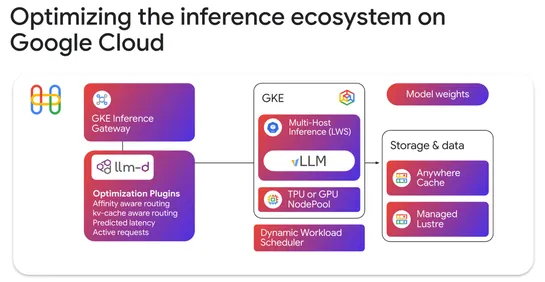
llm-d officially a CNCF Sandbox project

At Google Cloud, the llm-d project has been accepted as a Cloud Native Computing Foundation (CNCF) Sandbox project. This collaboration with industry leaders like Red Hat, IBM Research, CoreWeave, and NVIDIA aims to provide a framework for any model, accelerator, or cloud. The introduction of GKE Inf.. read more  
llm-d officially a CNCF Sandbox project
Link
@kala shared a link, 3 weeks, 2 days ago
FAUN.dev()

From zero to a RAG system: successes and failures

An engineer spun up an internal chat with a localLLaMAmodel viaOllama, a PythonFlaskAPI, and aStreamlitfrontend. They moved off in-memoryLlamaIndexto batch ingestion intoChromaDB(SQLite). Checkpoints and tolerant parsing went in to stop RAM disasters. Indexing produced 738,470 vectors (~54 GB). They.. read more  

From zero to a RAG system: successes and failures
Link
@kala shared a link, 3 weeks, 2 days ago
FAUN.dev()

Why we're rethinking cache for the AI era

Cloudflare data shows that 32% of network traffic originates from automated traffic, including AI assistants fetching data for responses. AI bots often issue high-volume requests and access rarely visited content, impacting cache efficiency. Cloudflare researchers propose AI-aware caching algorithms.. read more  

Why we're rethinking cache for the AI era
Link
@kala shared a link, 3 weeks, 2 days ago
FAUN.dev()

Our most intelligent open models, built from Gemini 3 research and technology to maximize intelligence-per-parameter

Built from Gemini 3 research and technology, Gemma 4 offers maximum compute and memory efficiency for mobile and IoT devices. Develop autonomous agents, multimodal applications, and multilingual experiences with Gemma 4's unprecedented intelligence-per-parameter... read more  

Our most intelligent open models, built from Gemini 3 research and technology to maximize intelligence-per-parameter
Link
@kala shared a link, 3 weeks, 2 days ago
FAUN.dev()

Qwen3.6-Plus: Towards Real World Agents

Qwen3.6-Plus, the latest release following Qwen3.5 series, offers enhanced agentic coding capabilities and sharper multimodal reasoning. The model excels in frontend web development and complex problem-solving, setting a new standard in the developer ecosystem. Qwen3.6-Plus is available via Alibaba .. read more  

Link
@kala shared a link, 3 weeks, 2 days ago
FAUN.dev()

State of Context Engineering in 2026

Context engineering has evolved in the AI engineering field since mid-2025 with the introduction of patterns for managing context effectively. These patterns include progressive disclosure, compression, routing, retrieval strategies, and tool management, each addressing a different dimension of the .. read more  

Link
@devopslinks shared a link, 3 weeks, 2 days ago
FAUN.dev()

RAM is getting expensive, so squeeze the most from it

The Register contrastszramandzswap. It flags a patch that claims up to 50% fasterzramops. It notes Fedora enableszramby default. It details thatzramprovides compressed in‑RAM swap (LZ4).zswapcompresses pages before writing to disk and requires on‑disk swap... read more  

RAM is getting expensive, so squeeze the most from it
Link
@devopslinks shared a link, 3 weeks, 2 days ago
FAUN.dev()

Scaling a Monolith to 1M LOC: 113 Pragmatic Lessons from Tech Lead to CTO

The post discusses performance issues related to page counts, long cron-job reads, RAM pressure, and offloading work to background jobs. It also touches on common sources of front-end performance issues, the importance of running EXPLAIN on DB queries, and the benefits of cultivating a culture of op.. read more  

Link
@devopslinks shared a link, 3 weeks, 2 days ago
FAUN.dev()

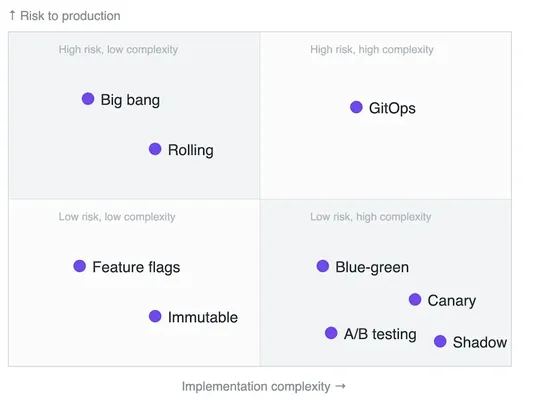
Deployment strategies: Types, trade-offs, and how to choose

Deployment strategies control traffic shifts, rollback speed, and release risk. Options:canary,blue‑green,rolling,feature flags,shadow,immutable, andGitOps. Strategies trade production risk for setup cost. They pair withArgo Rollouts,Kayenta,ArgoCD/Flux, service meshes, and flag platforms. Pipelines.. read more  

Deployment strategies: Types, trade-offs, and how to choose
Link
@devopslinks shared a link, 3 weeks, 2 days ago
FAUN.dev()

Supply Chain Attack on Axios Pulls Malicious Dependency from npm

A supply chain attack on Axios introduced a malicious dependency, plain-crypto-js@4.2.1, published minutes earlier and absent from the project’s GitHub releases... read more  

GPT-5.4 is OpenAI’s latest frontier AI model designed to perform complex professional and technical work more reliably. It combines advances in reasoning, coding, tool use, and long-context understanding into a single system capable of handling multi-step workflows across software environments. The model builds on earlier GPT-5 releases while integrating the strong coding capabilities previously introduced with GPT-5.3-Codex.

One of the defining features of GPT-5.4 is its ability to operate as part of agent-style workflows. The model can interact with tools, APIs, and external systems to complete tasks that extend beyond simple text generation. It also introduces native computer-use capabilities, allowing AI agents to operate applications using keyboard and mouse commands, screenshots, and browser automation frameworks such as Playwright.

GPT-5.4 supports context windows of up to one million tokens, enabling it to process and reason over very large documents, long conversations, or complex project contexts. This makes it suitable for tasks such as analyzing codebases, generating technical documentation, working with large spreadsheets, or coordinating long-running workflows. The model also introduces a feature called tool search, which allows it to dynamically retrieve tool definitions only when needed. This reduces token usage and makes it more efficient to work with large ecosystems of tools, including environments with dozens of APIs or MCP servers.

In addition to improved reasoning and automation capabilities, GPT-5.4 focuses on real-world productivity tasks. It performs better at generating and editing spreadsheets, presentations, and documents, and it is designed to maintain stronger context across longer reasoning processes. The model also improves factual accuracy and reduces hallucinations compared with previous versions.

GPT-5.4 is available across OpenAI’s ecosystem, including ChatGPT, the OpenAI API, and Codex. A higher-performance variant, GPT-5.4 Pro, is also available for users and developers who require maximum performance for complex tasks such as advanced research, large-scale automation, and demanding engineering workflows. Together, these capabilities position GPT-5.4 as a model aimed not just at conversation, but at executing real work across software systems.