Join us

ContentUpdates and recent posts about GPT-5.4..
Link
@kaptain shared a link, 2 months, 2 weeks ago
FAUN.dev()

Implementing assurance pipeline for Amazon EKS Platform

AWS released a full-stack CI/CD validation pipeline forAmazon EKS. It pulls in six layers of testing,Terraform,Helm,Locustload testing, and evenAWS Fault Injectionfor pushing resilience to the edge. The goal: bake policy checks, functional tests, and brutal load tests right into pre-deployment. Fewe.. read more  
Link
@kaptain shared a link, 2 months, 2 weeks ago
FAUN.dev()

From Deterministic to Agentic: Creating Durable AI Workflows with Dapr

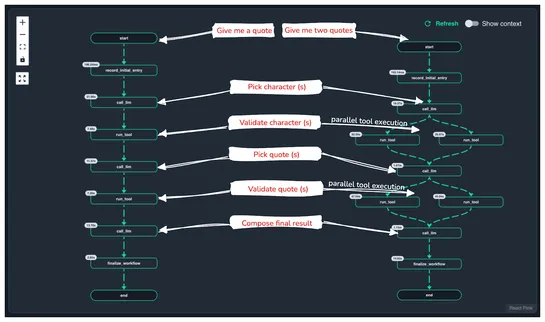
Dapr droppedDurable Agents- a mashup of classic workflows and LLM-driven agents that can actually get things done and survive rough edges. They track reasoning steps, tool calls, and chat states like a champ. If things crash, no problem: Dapr Workflows and Diagrid Catalyst bring it all back... read more  

From Deterministic to Agentic: Creating Durable AI Workflows with Dapr
Link
@kaptain shared a link, 2 months, 2 weeks ago
FAUN.dev()

v1.35: Watch Based Route Reconciliation in the Cloud Controller Manager

Kubernetes v1.35 sneaks in an alphafeature gatethat flips the CCM route controller from "check every X minutes" to "watch and react." It now usesinformersto trigger syncs when nodes change - plus a light periodic check every 12–24 hours... read more  

Link
@kaptain shared a link, 2 months, 2 weeks ago
FAUN.dev()

v1.35: New level of efficiency with in-place Pod restart

Kubernetes 1.35, as you may know, introducedin-place Pod restarts(alpha). It's a real reset: all containers, init and sidecars included - without killing the Pod or kicking off a reschedule. Think restart without the cloud drama. Big win for workloads with heavy inter-container dependencies or massi.. read more  

Link
@kaptain shared a link, 2 months, 2 weeks ago
FAUN.dev()

1.35: Enhanced Debugging with Versioned z-pages APIs

Kubernetes 1.35 makes a quiet-but-crucial upgrade: z-pages debugging endpoints now returnstructured, machine-readable JSON. That means tools- not just tired humans - can parse control plane state directly. The responses areversioned, backward-compatible, and tucked behind feature flags for now... read more  

Link
@kala shared a link, 2 months, 2 weeks ago
FAUN.dev()

The 2026 Data Engineering Roadmap: Building Data Systems for the Agentic AI Era

Data engineering’s getting flipped.AI agentsandLLMsaren’t just tagging along anymore - they’re the main users now. That means engineers need to buildcontext-aware, machine-readable data systemsthat don’t just store info but actually make sense of it. Think:vector databases,knowledge graphs,semantic .. read more  

The 2026 Data Engineering Roadmap: Building Data Systems for the Agentic AI Era
Link
@kala shared a link, 2 months, 2 weeks ago
FAUN.dev()

2025: The year in LLMs

2025 was the year LLMs stopped just answering questions and started building things.Reasoning modelslike OpenAI’s o-series and Claude Code took over tool-driven workflows. Asynchronous coding agentsbroke out. These models didn’t just write code - they ran it, debugged it, then did it again. That loo.. read more  

2025: The year in LLMs
Link
@kala shared a link, 2 months, 2 weeks ago
FAUN.dev()

Streamlining Security Investigations with Agents

Slack broke down how it's threading AI into its product without torching user trust.Slack AIleans hard ontenant-specific data isolationandzero data retention- no leftover crumbs from LLM interactions. Instead of piping user data through someone else’s APIs, Slack runs LLMs onits own infrawhere it ca.. read more  

Streamlining Security Investigations with Agents
Link
@kala shared a link, 2 months, 2 weeks ago
FAUN.dev()

Meet the ‘Mad Max’-Loving CEO Challenging Nvidia With a Renegade Chip

June Paik spurned a takeover offer from Meta Platforms last year. Now his South Korean company, FuriosaAI, has an AI chip entering mass production... read more  

Link
@kala shared a link, 2 months, 2 weeks ago
FAUN.dev()

My LLM coding workflow going into 2026

Anthropic saysClaude Code writes about 90% of its own code now. Why? Because devs are getting smart with AI. They're slicing problems into tight, testable chunks and running structured workflows that keep LLMs on a short leash. It's not just prompts anymore. Think context packaging, multi-agent setu.. read more  

My LLM coding workflow going into 2026
GPT-5.4 is OpenAI’s latest frontier AI model designed to perform complex professional and technical work more reliably. It combines advances in reasoning, coding, tool use, and long-context understanding into a single system capable of handling multi-step workflows across software environments. The model builds on earlier GPT-5 releases while integrating the strong coding capabilities previously introduced with GPT-5.3-Codex.

One of the defining features of GPT-5.4 is its ability to operate as part of agent-style workflows. The model can interact with tools, APIs, and external systems to complete tasks that extend beyond simple text generation. It also introduces native computer-use capabilities, allowing AI agents to operate applications using keyboard and mouse commands, screenshots, and browser automation frameworks such as Playwright.

GPT-5.4 supports context windows of up to one million tokens, enabling it to process and reason over very large documents, long conversations, or complex project contexts. This makes it suitable for tasks such as analyzing codebases, generating technical documentation, working with large spreadsheets, or coordinating long-running workflows. The model also introduces a feature called tool search, which allows it to dynamically retrieve tool definitions only when needed. This reduces token usage and makes it more efficient to work with large ecosystems of tools, including environments with dozens of APIs or MCP servers.

In addition to improved reasoning and automation capabilities, GPT-5.4 focuses on real-world productivity tasks. It performs better at generating and editing spreadsheets, presentations, and documents, and it is designed to maintain stronger context across longer reasoning processes. The model also improves factual accuracy and reduces hallucinations compared with previous versions.

GPT-5.4 is available across OpenAI’s ecosystem, including ChatGPT, the OpenAI API, and Codex. A higher-performance variant, GPT-5.4 Pro, is also available for users and developers who require maximum performance for complex tasks such as advanced research, large-scale automation, and demanding engineering workflows. Together, these capabilities position GPT-5.4 as a model aimed not just at conversation, but at executing real work across software systems.