Join us

ContentUpdates and recent posts about GPT..
Link
@kaptain shared a link, 3 months, 1 week ago
FAUN.dev()

It's Not Kubernetes. It Never Was

The complexity in managing Kubernetes clusters is a reflection of the organizational decisions and lack of processes within the teams operating them. The move towards multi-cloud environments without sufficient planning or resources has exacerbated these issues. Platform engineering solutions offer .. read more  

It's Not Kubernetes. It Never Was
Link
@kaptain shared a link, 3 months, 1 week ago
FAUN.dev()

How WebAssembly plugins simplify Kubernetes extensibility

Helm 4runsWebAssembly (Wasm)plugins to executeWASImodules insideOCIcontainers and VMs.Helmtemplates standardize module lifecycle. The Wasm plugin adds instruction-level sandboxing and Kubernetes segmentation.Helm 4preserves portability acrossx86/ARM. Compared withHelm 3plugins, it shows up to a 40% .. read more  

Link
@kaptain shared a link, 3 months, 1 week ago
FAUN.dev()

The great migration: Why every AI platform is converging on Kubernetes

The CNCF survey finds82%of container users runKubernetesin production.66%of GenAI hosts use it for inference. Kubernetes now stitches data processing, distributed training, LLM inference, and autonomous agents viaSpark,Kubeflow,Kueue,KServe, andArmada. GPU sharing and scheduling advanced withMIG, ti.. read more  

The great migration: Why every AI platform is converging on Kubernetes
Link
@kala shared a link, 3 months, 1 week ago
FAUN.dev()

Reasoning models struggle to control their chains of thought, and that’s good

OpenAI's paper unveilsCoT-Control: an open-source suite of 13,000+ tasks fromGPQA, MMLU-Pro, HLE, BFCLthat measuresCoTcontrollability. Evaluations on 13 models show compliance at 0.1%-15.4%. Compliance is tiny. Controllability improves with model size. It drops as reasoning chains lengthen and after.. read more  

Reasoning models struggle to control their chains of thought, and that’s good
Link
@kala shared a link, 3 months, 1 week ago
FAUN.dev()

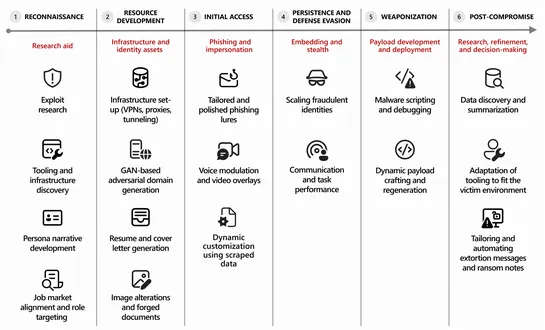
AI as tradecraft: How threat actors operationalize AI

Microsoft observes threat actors operationalizeAIandLLMsacross the cyberattack lifecycle. They accelerate reconnaissance, phishing, malware development, and post‑compromise triage. Actors abusejailbreakingtechniques andGANs. They craft personas, generate look‑alike domains, embed runtime‑adaptive pa.. read more  

AI as tradecraft: How threat actors operationalize AI
Link
@kala shared a link, 3 months, 1 week ago
FAUN.dev()

The L in "LLM" Stands for Lying

The author arguesLLMschurn out fast, generic answers by remixing low-quality source material. They seed brittle, repetitive code viavibe-coding. The remedy: requiresource attributionand auditable inference to separate originals from forgeries and to reshape model training and deployment. Requiringso.. read more  

The L in "LLM" Stands for Lying
Link
@kala shared a link, 3 months, 1 week ago
FAUN.dev()

LLMs are getting better at unmasking people online

Researchers at ETH Zurich show LLMs can stitch anonymous bios to public web data and reidentify users across platforms. Fine-tuned models and agent chains parse unstructured text and automate deanonymization in minutes at penny-level inference costs... read more  

LLMs are getting better at unmasking people online
Link
@kala shared a link, 3 months, 1 week ago
FAUN.dev()

The reason big tech is giving away AI agent frameworks

A catalog of majoragent frameworks: LangGraph, CrewAI, Google ADK, AWS Strands, Microsoft Agent Framework, OpenAI Agents SDK, Mastra, Pydantic AI, Agno. Hyperscalers co-design free SDKs (e.g.,Strands,ADK). They tie those SDKs to metered runtimes -Bedrock,Vertex AI. Revenue shifts to inference and de.. read more  

Link
@devopslinks shared a link, 3 months, 1 week ago
FAUN.dev()

Draw.io MCP for Diagram Generation: Why It’s Worth Using

Draw.io MCPlinks theModel Context Protocoltodraw.io. It ingests structured input (text,CSV,Mermaid) and emitsdraw.io XML, PNG/SVG, or hosted links. Draw.io MCPruns as anMCP Tool Server, CLI, or Copilot skill. It drafts small graphs (<50 nodes) in seconds and stores diagrams inGitfor diffs andCI/CDau.. read more  

Draw.io MCP for Diagram Generation: Why It’s Worth Using
Link
@devopslinks shared a link, 3 months, 1 week ago
FAUN.dev()

How I Dropped Our Production Database and Now Pay 10% More for AWS

Planned migration shifts the static site fromGitHub PagestoAWS S3. DNS moves toAWS.Djangostages on a subdomain before the main domain swaps. ATerraformauto-approve ran with no remote state. It destroyed productionRDS,VPC,ECS, and automated snapshots.AWSfound a hidden snapshot and recovered the DB in.. read more  

How I Dropped Our Production Database and Now Pay 10% More for AWS
GPT (Generative Pre-trained Transformer) is a deep learning model developed by OpenAI that has been pre-trained on massive amounts of text data using unsupervised learning techniques. GPT is designed to generate human-like text in response to prompts, and it is capable of performing a variety of natural language processing tasks, including language translation, summarization, and question-answering. The model is based on the transformer architecture, which allows it to handle long-range dependencies and generate coherent, fluent text. GPT has been used in a wide range of applications, including chatbots, language translation, and content generation.

GPT is a family of language models that have been trained on large amounts of text data using a technique called unsupervised learning. The model is pre-trained on a diverse range of text sources, including books, articles, and web pages, which allows it to capture a broad range of language patterns and styles. Once trained, GPT can be fine-tuned on specific tasks, such as language translation or question-answering, by providing it with task-specific data.

One of the key features of GPT is its ability to generate coherent and fluent text that is indistinguishable from human-generated text. This is achieved by training the model to predict the next word in a sentence given the previous words. GPT also uses a technique called attention, which allows it to focus on relevant parts of the input text when generating a response.

GPT has become increasingly popular in recent years, particularly in the field of natural language processing. The model has been used in a wide range of applications, including chatbots, content generation, and language translation. GPT has also been used to create AI-generated stories, poetry, and even music.