Join us

ContentUpdates and recent posts about k3d..
Link
@varbear shared a link, 1 day, 20 hours ago
FAUN.dev()

How To Make a Fast Dynamic Language Interpreter

Zef's AST-walking interpreter posts a 16.6× speed-up. The gains come from surgical changes:64-bit tagged values,AST node & RMW specialization,symbol hash-consing,inline caches, and a shapedobject model. Developers built it onFil-C++and later ported it toYolo-C++. The Yolo build adds ~4x speed, at th.. read more  
Link
@varbear shared a link, 1 day, 20 hours ago
FAUN.dev()

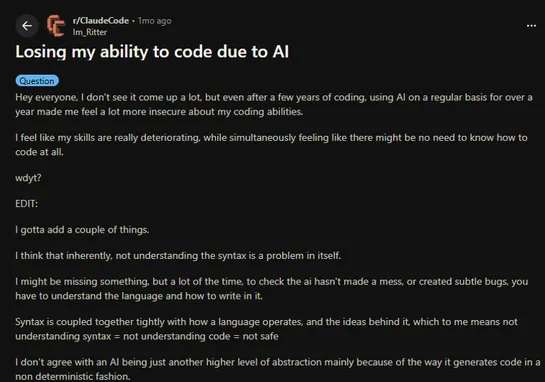
Agentic Coding is a Trap

AI-driven coding agents are the hot new trend, but beware of the trade-offs: increased complexity, skills atrophy, vendor lock-in, and fluctuating costs. Only skilled developers can spot issues in the vast lines of generated code, but paradoxically, AI tools are impacting critical thinking skills ne.. read more  

Agentic Coding is a Trap
Link
@varbear shared a link, 1 day, 20 hours ago
FAUN.dev()

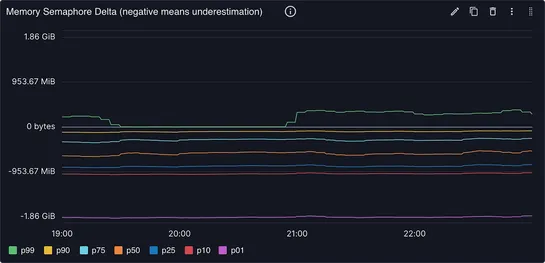
How We Reduced Median Memory Estimation Error by 99%, With the Help of AI

The compaction pipeline at Mixpanel ran into memory estimation issues causing OOMKills. By implementing AI-assisted analysis, they were able to reduce median estimation errorby 99%, leading to a significant improvement in memory estimation accuracy. Through thorough analysis and exploration of alter.. read more  

How We Reduced Median Memory Estimation Error by 99%, With the Help of AI
Link
@varbear shared a link, 1 day, 20 hours ago
FAUN.dev()

When upserts don't update but still write: Debugging Postgres performance at scale

The Datadog team introduced a new upsert query to track inactive hosts, but it unexpectedly increased disk writes and WAL syncs due to row locking. By digging into Postgres's Write-Ahead Logging (WAL) and rewriting the query using a Common Table Expression (CTE), they avoided unnecessary overhead an.. read more  

Link
@kaptain shared a link, 1 day, 20 hours ago
FAUN.dev()

From Ingress NGINX to Higress: migrating 60+ resources in 30 minutes with AI

With the March 2026 retirement ofIngress NGINX, teams face an urgent compliance mandate. They must replace unpatched controllers. EnterHigress. Built onEnvoyandIstio. It unifies LLM protocols, enforces token rate limits, caches prompts, hostsMCP, and usesxDSfor zero-downtime. AnAI agentpaired withhi.. read more  

From Ingress NGINX to Higress: migrating 60+ resources in 30 minutes with AI
Link
@kaptain shared a link, 1 day, 20 hours ago
FAUN.dev()

v1.36: Tiered Memory Protection with Memory QoS

Kubernetes v1.36 rolls out Memory QoS (alpha). Opt-inmemory reservation. Tiered protection by QoS class. Kubelet observability metrics. Kernel-version warnings. It separatesthrottlingfromreservation. A feature gate enables throttling. A kubelet config field controls tieredcgroup v2protection:Guarant.. read more  

Link
@kaptain shared a link, 1 day, 20 hours ago
FAUN.dev()

v1.36: In-Place Vertical Scaling for Pod-Level Resources Graduates to Beta

Kubernetes v1.36 moves In-Place Pod-Level Resources Vertical Scaling to Beta and flips the feature gate on by default. Operators can patch a Pod's aggregate resource to resize running Pods. Often no container restart is needed. Kubelet breaks the Pod-level change into per-container resize events. It.. read more  

Link
@kaptain shared a link, 1 day, 20 hours ago
FAUN.dev()

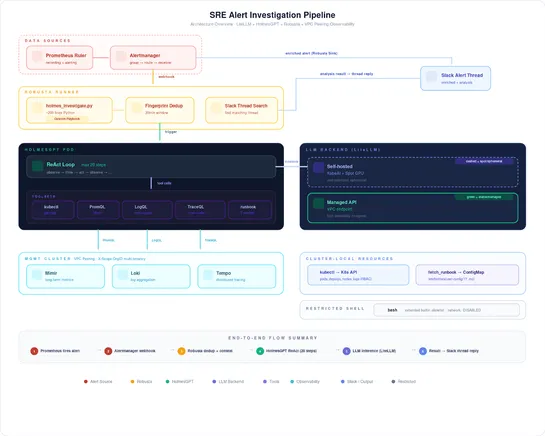
Auto-Diagnosing Kubernetes Alerts with HolmesGPT and CNCF Tools

STCLab built an AI investigation pipeline withHolmesGPT, a 200-linePythonplaybook, andOpenTelemetry. It streamedMimir,Loki, andTempointo Slack threads. Metadata-driven markdownrunbookslimited tools per namespace, cut wasted tool calls from 16 to 2, and let the same model resolve alerts faster... read more  

Auto-Diagnosing Kubernetes Alerts with HolmesGPT and CNCF Tools
Link
@kaptain shared a link, 1 day, 20 hours ago
FAUN.dev()

v1.36: Staleness Mitigation and Observability for Controllers

Kubernetes v1.36 shipsclient-goatomicFIFOprocessing and cache-introspection APIs. Controllers detect stale informer state and skip acting on it. kube-controller-managerenables the capability by default for four high-contention pod controllers. It addsalpha metricsfor skipped syncs and informer resou.. read more  

Link
@kala shared a link, 1 day, 20 hours ago
FAUN.dev()

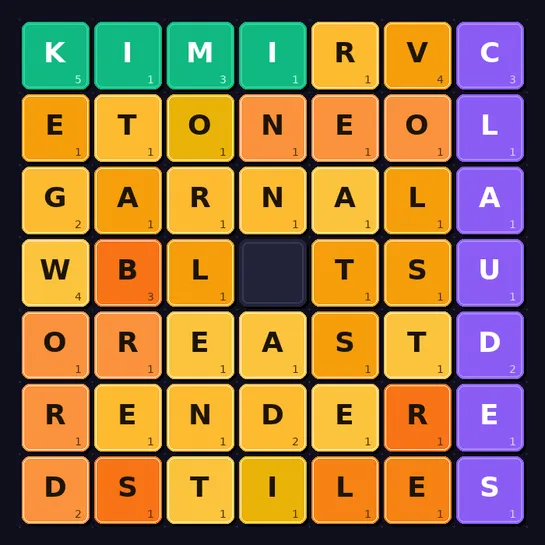
An open-weights Chinese model just beat Claude, GPT-5.5, and Gemini in a programming challenge

The AI Coding Contest Day 12 matched ten models on a sliding‑letter puzzle. Open‑weightsKimi K2.6took first: 22 match points (7‑1‑0).MiMo V2‑Proscored second by blasting claims for intact ≥7‑letter seeds (43 points).GPT‑5.5andClaude Opus 4.7landed third and fifth. Grids ran10×10→30×30. Heavy scrambl.. read more  

An open-weights Chinese model just beat Claude, GPT-5.5, and Gemini in a programming challenge
k3d is an open-source utility designed to simplify running Kubernetes locally by wrapping K3s (Rancher’s lightweight Kubernetes distribution) inside Docker containers. Instead of creating virtual machines, k3d uses Docker as the execution layer, allowing developers to spin up multi-node Kubernetes clusters in seconds using minimal system resources.

k3d is especially popular for local development, CI pipelines, demos, and testing Kubernetes-native applications. It supports advanced setups such as multi-node clusters, load balancers, custom container registries, port mappings, and volume mounts, while remaining easy to tear down and recreate.

Because it uses K3s, k3d inherits a simplified control plane, bundled components, and reduced memory footprint compared to full Kubernetes distributions. This makes it ideal for developers who want a realistic Kubernetes environment without the overhead of tools like Minikube or full VM-based clusters.

k3d integrates cleanly with common Kubernetes workflows and tools such as kubectl, Helm, Skaffold, and Argo CD. It is frequently used to validate manifests, test Helm charts, and simulate production-like environments locally before deploying to cloud or on-prem clusters.