Join us

ContentUpdates and recent posts about Kubernetes..
Link
@kaptain shared a link, 5 months, 3 weeks ago
FAUN.dev()

v1.35: Job Managed By Goes GA

In Kubernetes v1.35,spec.jobControllerManagedByhits GA. That means full handoff of Job reconciliation to external controllers is now official. It unlocks tricks likeMultiKueue, where a single management cluster fires off Jobs to multiple worker clusters, without losing sight of what’s running where... read more  

Link
@kaptain shared a link, 5 months, 3 weeks ago
FAUN.dev()

Troubleshooting Cilium network policies: Four common pitfalls

Cilium’s Day 2 playbook covers the real work: dialing inL7 policy controls, tuningHubble observability, and wringing performance fromBPF. It's how you keep big Kubernetes clusters sane. The focus?Multi-tenant isolation,node-to-node encryption, and scaling cleanly withexternal etcdso the network does.. read more  

Link
@kaptain shared a link, 5 months, 3 weeks ago
FAUN.dev()

93% Faster Next.js in (your) Kubernetes

Next.js brings advanced capabilities to developers out-of-the-box, but scaling it in your own environment can be challenging due to uneven load distribution and high latency. Watt addresses these issues by leveragingSO_REUSEPORTin the Linux kernel, resulting in significantly improved performance met.. read more  

Link
@kaptain shared a link, 5 months, 3 weeks ago
FAUN.dev()

1.35: In-Place Pod Resize Graduates to Stable

In-Place Pod Resizehits GA in Kubernetes 1.35. You can now tweak CPU and memory on live pods without restarts. This is finally production-ready! What’s new since beta? It now handlesmemory limit decreases, doesprioritized resizes, and gives you betterobservabilitywith fresh Kubelet metrics and Pod e.. read more  

Link
@kaptain shared a link, 5 months, 3 weeks ago
FAUN.dev()

Avoiding Zombie Cluster Members When Upgrading to etcd v3.6

etcd v3.5.26 patches a nasty upgrade bug. It now syncsv3storefromv2storeto stop zombie nodes from corrupting clusters during the jump to v3.6. The core issue: Older versions let stale store states bring removed members back from the dead... read more  

Link
@kaptain shared a link, 5 months, 3 weeks ago
FAUN.dev()

Kubernetes OptimizationInPlace Pod Resizing,ZoneAware Routin

Halodoc cut EC2 costs and shaved latency by leaning into two Kubernetes tricks: In-place pod resizing(v1.33) lets them dial pod resources up or down on the fly, especially handy during off-peak hours. Zone-aware routingviatopology-aware hintskeeps inter-service traffic close to home (same AZ), skipp.. read more  

Kubernetes OptimizationInPlace Pod Resizing,ZoneAware Routin
Link
@kala shared a link, 5 months, 3 weeks ago
FAUN.dev()

Chinese AI in 2025, Wrapped

Chinese AI milestones in 2025: Big models from DeepSeek and others, AGI discussions at Alibaba, US-China chip war swings, Beijing's AI Action plan, and more. DeepSeek led the way with an open-source model, setting off a wave of Chinese companies going open-source. China's push for AGI and involvemen.. read more  

Link
@kala shared a link, 5 months, 3 weeks ago
FAUN.dev()

Review of Deep Seek OCR

DeepSeek-OCRflips the OCR script. Instead of feeding full image tokens to the decoder, it leans on an encoder to compress them up front, trimming down input size and GPU strain in one move. That context diet? It opens the door for way bigger windows in LLMs. Why it matters:Shoving compression earlie.. read more  

Link
@kala shared a link, 5 months, 3 weeks ago
FAUN.dev()

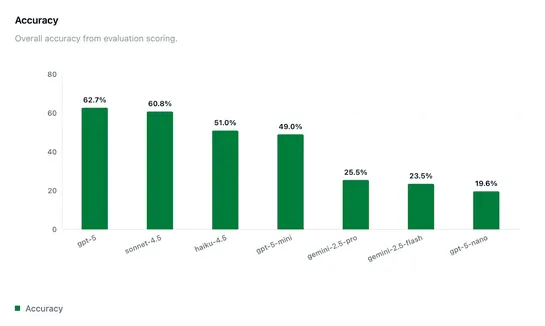
Evaluating AI Agents in Security Operations

Cotool threw frontier LLMs at real-world SecOps tasks using Splunk’s BOTSv3 dataset.GPT-5topped the chart in accuracy (62.7%) and gave the best results per dollar.Claude Haiku-4.5blazed through tasks fastest, just 240 seconds on average, maxing out tool integrations.Gemini-2.5-proflopped on both acc.. read more  

Evaluating AI Agents in Security Operations
Link
@kala shared a link, 5 months, 3 weeks ago
FAUN.dev()

Everything to know about Google Gemini’s most recent AI updates

Google jammed a full no-code AI workshop into Gemini. The browser now bakes inOpal, a drag-and-drop app builder with a shiny newvisual editor. You can chain prompts, preview apps, and feed it text, voice, or images, without touching code. They also dropped theGemini 3 Flash model, built for dual rea.. read more  

Kubernetes, often abbreviated as K8s, is an open-source orchestration platform designed to automate the deployment, scaling, and management of containerized applications. It acts as a "brain" for your infrastructure, ensuring that your containers run exactly where and how they should across a cluster of physical or virtual machines, abstracting away the underlying hardware to treat the entire data center as a single computational resource.

At its core, Kubernetes operates on a declarative model: you define the "desired state" of your application—such as how many replicas should be running or how much CPU they should use - and the system continuously works to maintain that state. If a container crashes or a node fails, Kubernetes automatically detects the discrepancy and restarts or reschedules the workload to ensure zero downtime, providing a self-healing environment that is critical for modern, high-availability systems.

Beyond simple container management, Kubernetes provides a robust ecosystem for networking, storage, and security. It handles service discovery and load balancing internally, allowing containers to communicate seamlessly without hardcoded IP addresses, and orchestrates storage mounting from various providers. By standardizing how applications are deployed and scaled, Kubernetes enables developers to move from local development to global production with consistent and predictable results.