Join us

ContentUpdates and recent posts about Magento 2 Multi Vendor Indian GST Extension..
Link
@faun shared a link, 6 months, 4 weeks ago
FAUN.dev()

Effectively building AI agents on AWS Serverless

AWS just dropped support for buildingserverless agentic AI systems. You’ll need the Strands Agents SDK, Bedrock AgentCore (preview), plus trusty tools like Lambda and ECS. What’s new? Agentic AI flips the script. Instead of dumb prompt-in, response-out bots, you getgoal-driven loopswith memory, too.. read more  
Effectively building AI agents on AWS Serverless
Link
@faun shared a link, 6 months, 4 weeks ago
FAUN.dev()

How to prepare for the Bitnami Changes coming soon

The Bitnami team has delayed the deletion of the Bitnami public catalog until September 29th. They will conduct a series of brownouts to prepare users for the upcoming changes, with the affected applications list being published on the day of each brownout. Users are advised to switch to Bitnami Sec.. read more  

Link
@faun shared a link, 6 months, 4 weeks ago
FAUN.dev()

Observability in Go: What Real Engineers Are Saying in 2025

Go observability still feels like pulling teeth. Manual instrumentation? Tedious. Span coverage? Spotty. Telemetry volume? Totally out of hand. Even with OpenTelemetry gaining traction, Go lags behind Java and Python when it comes to auto-instrumentation and clean context propagation. Devs are hunt.. read more  

Observability in Go: What Real Engineers Are Saying in 2025
Link
@faun shared a link, 6 months, 4 weeks ago
FAUN.dev()

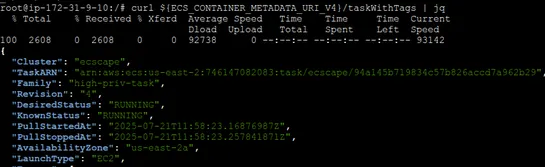
ECScape: Understanding IAM Privilege Boundaries in Amazon ECS

A new ECS security mess—ECScape—lets low-privileged tasks on EC2 act like the ECS agent. That’s bad. Real bad. Why? Because it opens the door to stealing IAM credentials from other ECS tasks sharing the same host. Here’s the trick: The attacker hits the instance metadata service (IMDS) and fakes a .. read more  

ECScape: Understanding IAM Privilege Boundaries in Amazon ECS
Link
@faun shared a link, 6 months, 4 weeks ago
FAUN.dev()

Availability Models: Because “Highly Available” Isn’t Saying Much

Antithesis and Jepsen want to kill hand-wavy "high availability" talk. Instead, they push for clearavailability models—majority,total,sticky, etc.—that spell out when an operationactuallyworks during failures. It's about precision, not platitudes. Why it matters:This reframes availability from a va.. read more  

Availability Models: Because “Highly Available” Isn’t Saying Much
Link
@faun shared a link, 6 months, 4 weeks ago
FAUN.dev()

Google Develops KFuzzTest For Fuzzing Internal Linux Kernel Functions

Google droppedKFuzzTest, a lean fuzzing tool built to hit Linux kernel internals—way past just syscalls. It brings a clean API, docs, and sample targets to get fuzzing fast. Why it matters:KFuzzTest marks a shift. Kernel fuzzing’s no longer just about hammering syscalls—it’s going deeper into the g.. read more  

Link
@faun shared a link, 6 months, 4 weeks ago
FAUN.dev()

v1.34: User preferences (kuberc) are available for testing in kubectl 1.34

Kubernetes v1.34 pusheskubectlinto the future with a betauser preferencessystem. Drop a.kubercfile in place, and you can bake in default flags, toggle features likeinteractive deleteorServer-Side Apply, and wire up custom aliases—including pre- and post-args... read more  

Link
@faun shared a link, 6 months, 4 weeks ago
FAUN.dev()

v1.34: Of Wind & Will (O' WaW)

Kubernetes v1.34 drops with58 updates, and23 just hit stable. Highlights: Dynamic Resource Allocation (DRA), per-Pod resource limits, and secure image pulls using Pod-specific ServiceAccount tokens. Scalability gets a lift from streaming list responses. Security tightens with finer anonymous auth r.. read more  

v1.34: Of Wind & Will (O' WaW)
Link
@faun shared a link, 6 months, 4 weeks ago
FAUN.dev()

kube-bench Tutorial: Features, Use Cases, How It Works

kube-benchjust leveled up. Aqua Security’s CIS compliance scanner now snaps into CI/CD, runs pre-deploy checks, and helps dig through forensics after incidents. It plays nice with managed K8s—EKS, AKS, GKE—and handles custom YAML test suites if you’re going off the beaten path. Reports land in stru.. read more  

kube-bench Tutorial: Features, Use Cases, How It Works
Link
@faun shared a link, 6 months, 4 weeks ago
FAUN.dev()

An introduction to platform engineering

Platform engineering is stepping in where DevOps didn’t quite land. Think fewer duct-taped pipelines, more thoughtful systems. The fix? Internal Developer Platforms (IDPs), usually riding on Kubernetes, built to tame the sprawl. Gartner says 80% of big engineering orgs will run platform teams by 20.. read more  

An introduction to platform engineering
On the 1st of July 2017, the Indian government introduced the Goods and Services Tax (GST) to the general public. This tax replaced pre-existing taxes with a destination-based, multi-stage, indirect tax system. The GST applies to all eCommerce and Magento stores within India. The World Bank has stated that the GST is one of the most complex tax systems worldwide due to its intricate nature.

As the GST is bifurcated into multiple tax slabs, it has become more difficult to implement such a complex taxing system in Magento 2. Managing a multi-vendor marketplace entails dealing with numerous vendors who sell various products on your platform. 

This necessitates the computation of GST tax rates based on the product and its category, which can be intricate due to varying tax brackets. An automated system is needed to collect and accurately compute vendor tax rates.

The Magento 2 Multi-vendor Indian GST Extension, also called the Magento Multi-vendor GST Module by MageComp, confidently calculates GST for products sold through your Magento stores by vendors. The module fully complies with the Indian government's GST standards and prominently displays the vendor's GST number and summary in all Magento order documents.

Why choose MageComp’s Magento 2 Multi Vendor Indian GST Extension?

Allows admins to enable/disable the module for global, category, and product-specific configuration.
Orders that are placed with the GST module showcase a detailed bifurcation of tax rates in the order view, credit memos, invoices, new order emails and PDFs.
The GST module displays a detailed SGST and CGST tax bifurcation in the order details.
The module automatically calculates IGST, CGST and SGST based on the products added to the cart.

Benefits of Multi Vendor Indian GST for Admins

Allows admins to mention their GSTIN, CIN and PAN number in all order details.
Admins can import the product-specific GST via a CSV file.
Admins have the option to include or exclude GST tax rates from the product prices.
Admins can easily set their business origins and apply IGST (interstate Magento GST)
The module allows the admin to upload an image and a digital signature to display in invoice PDF.
Admins have the option to generate detailed GST reports based on orders and products.

Benefits for Vendors

Vendors are allowed to add their GST number to all invoices and other documents.
Vendors can set a GST rate from the backend grid while creating a product.
Vendors can also set a minimum order price to apply GST rates.

Benefits for Customers

Customers can enter the buyer’s GST number to signup.
Customers can update their buyer’s GST number any time they want from their account grid.