Join us

ContentUpdates and recent posts about Magento 2 Multi Vendor Indian GST Extension..
Link
@faun shared a link, 6 months, 4 weeks ago
FAUN.dev()

Evolving Kubernetes for generative AI inference

Google Cloud, ByteDance, and Red Hat are wiring AI smarts straight intoKubernetes. Think: faster inference benchmarks, smarter LLM-aware routing, and on-the-fly resource juggling—all built to handle GenAI heat. Their new push,llm-d, bakesvLLMdeep into Kubernetes. That unlocks disaggregated serving .. read more  
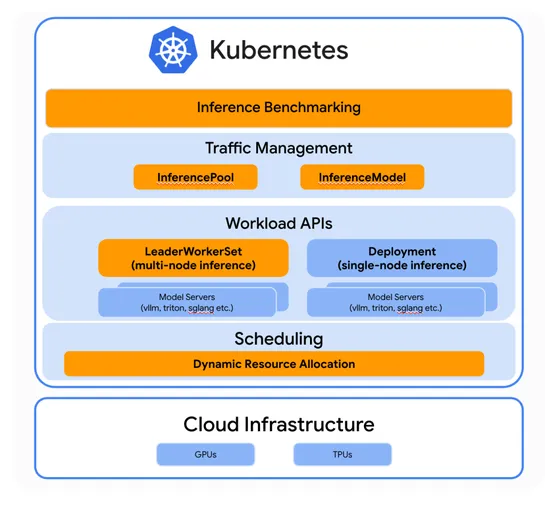
Evolving Kubernetes for generative AI inference
Link
@faun shared a link, 6 months, 4 weeks ago
FAUN.dev()

CNCF Incubates OpenYurt for Kubernetes at the Edge

OpenYurt just leveled up—now officially an incubating project under the CNCF. It pushes Kubernetes out past the data center, into the messy edges of the network, without breaking upstream compatibility. No forks, no duct tape. The maintainer roster’s growing too. Folks fromVMware,Microsoft, andInte.. read more  

CNCF Incubates OpenYurt for Kubernetes at the Edge
Link
@faun shared a link, 6 months, 4 weeks ago
FAUN.dev()

Kubernetes v1.34 brings networking refinements for cloud-native infrastructure

Kubernetes 1.34 comes packed withnetworking upgradesbuilt for scale. Less overhead. Fewer headaches. Easier to run big clusters without sweating packet flows. This triannual release keeps pushing the envelope for both cloud-native setups and the on-prem diehards... read more  

Link
@faun shared a link, 6 months, 4 weeks ago
FAUN.dev()

The architecture of AI is different from all of the computing that came before it

AI is breaking open source out of its old habits. Compute-heavy models now demand GPU-first stacks, leaner infrastructure, and fresh rules for how we build and scale. Jonathan Bryce points out: scalability and reliability still matter—but AI’s deployment needs throw the old architecture playbook ou.. read more  

The architecture of AI is different from all of the computing that came before it
Link
@faun shared a link, 6 months, 4 weeks ago
FAUN.dev()

From Novice to Pro: Mastering Lightweight Linux for Your Kubernetes Project

Alpine, Flatcar, Fedora CoreOS, Talos, and Ubuntu Core are carving out strong niches as Kubernetes-first base OSes. Each leans into immutability, container-native design, and just enough system overhead to get out of the way. That lean profile isn’t just a flex—it means lower resource drag and a de.. read more  

Link
@faun shared a link, 6 months, 4 weeks ago
FAUN.dev()

Battle for Resources or the SSA Path to Kubernetes Diplomacy

A full-stack engineer and systems architect with hands-on time incloudandIoT, building real-world tools for theoil and gas sector. Think connected rigs, smart pipelines, and infrastructure that doesn’t flinch at scale. Market signal:Industrial tech’s going deep. Cloud and IoT aren’t side projects a.. read more  

Link
@faun shared a link, 6 months, 4 weeks ago
FAUN.dev()

Kubernetes in an AI-Native World: Can It Stay Relevant?

At KubeCon + CloudNativeCon Hyderabad 2025, CNCF leads made it clear:cloud-native infraisn’t just supporting AI—it’s becoming its backbone. The conversation’s moved on from“Can Kubernetes run AI?”to“How does it evolve for AI-first everything?”.. read more  

Kubernetes in an AI-Native World: Can It Stay Relevant?
Story
@laura_garcia shared a post, 7 months ago
Software Developer, RELIANOID

💡 What is a VIP Load Balancer?

AVIP (Virtual IP)load balancer distributes traffic across multiple servers using a single IP. It ensures: ✅ Scalability ✅ High availability ✅ Session persistence ✅ Smart traffic routing 🚀RELIANOIDtakes VIP load balancing to the next level with: 🔒 SSL offloading 📊 Dynamic health monitoring ⚖️ Advance..

Knowledge base VIP LOAD BALANCER
Link
@anjali shared a link, 7 months ago
Customer Marketing Manager, Last9

A Practical Guide to Python Application Performance Monitoring(APM)

Monitor, debug, and optimize Python apps in production with APM—track transactions, DB queries, errors, and external calls.

python_apm
On the 1st of July 2017, the Indian government introduced the Goods and Services Tax (GST) to the general public. This tax replaced pre-existing taxes with a destination-based, multi-stage, indirect tax system. The GST applies to all eCommerce and Magento stores within India. The World Bank has stated that the GST is one of the most complex tax systems worldwide due to its intricate nature.

As the GST is bifurcated into multiple tax slabs, it has become more difficult to implement such a complex taxing system in Magento 2. Managing a multi-vendor marketplace entails dealing with numerous vendors who sell various products on your platform. 

This necessitates the computation of GST tax rates based on the product and its category, which can be intricate due to varying tax brackets. An automated system is needed to collect and accurately compute vendor tax rates.

The Magento 2 Multi-vendor Indian GST Extension, also called the Magento Multi-vendor GST Module by MageComp, confidently calculates GST for products sold through your Magento stores by vendors. The module fully complies with the Indian government's GST standards and prominently displays the vendor's GST number and summary in all Magento order documents.

Why choose MageComp’s Magento 2 Multi Vendor Indian GST Extension?

Allows admins to enable/disable the module for global, category, and product-specific configuration.
Orders that are placed with the GST module showcase a detailed bifurcation of tax rates in the order view, credit memos, invoices, new order emails and PDFs.
The GST module displays a detailed SGST and CGST tax bifurcation in the order details.
The module automatically calculates IGST, CGST and SGST based on the products added to the cart.

Benefits of Multi Vendor Indian GST for Admins

Allows admins to mention their GSTIN, CIN and PAN number in all order details.
Admins can import the product-specific GST via a CSV file.
Admins have the option to include or exclude GST tax rates from the product prices.
Admins can easily set their business origins and apply IGST (interstate Magento GST)
The module allows the admin to upload an image and a digital signature to display in invoice PDF.
Admins have the option to generate detailed GST reports based on orders and products.

Benefits for Vendors

Vendors are allowed to add their GST number to all invoices and other documents.
Vendors can set a GST rate from the backend grid while creating a product.
Vendors can also set a minimum order price to apply GST rates.

Benefits for Customers

Customers can enter the buyer’s GST number to signup.
Customers can update their buyer’s GST number any time they want from their account grid.