Join us

ContentUpdates and recent posts about Magento 2 Multi Vendor Indian GST Extension..
Link
@kaptain shared a link, 1 month, 1 week ago
FAUN.dev()

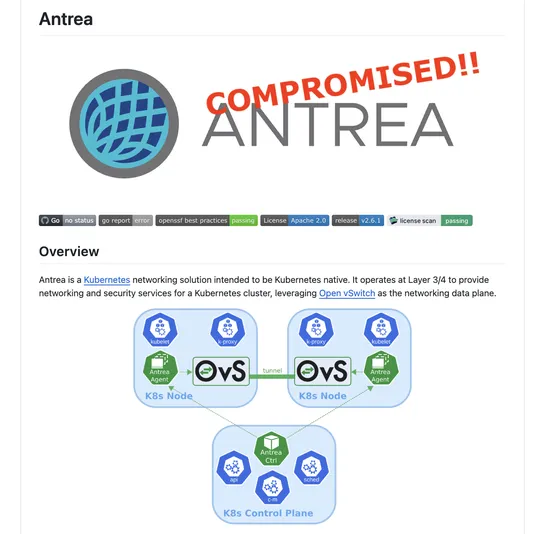
CNCF Project Antrea Compromised in Daring GitHub Attack

A throwaway GitHub account compromised CNCF projectAntrea's Jenkins infrastructure on May 2 by opening a malicious PR and firing/test-*slash-commands that detonated the workflow against PR-fork code with credentials in scope. The same operator ran parallel campaigns against at least seven other proj.. read more  
CNCF Project Antrea Compromised in Daring GitHub Attack
Link
@kaptain shared a link, 1 month, 1 week ago
FAUN.dev()

How Cloud Native Infrastructure Powers AI on Kubernetes

A vendor piece from Mirantis arguing that GPU multi-tenancy on Kubernetes is widely misrepresented, with most platforms shipping namespace-based isolation while production GPU clouds require hardware-enforced separation through MIG partitioning, cluster-per-tenant architecture, and DPU-based network.. read more  

How Cloud Native Infrastructure Powers AI on Kubernetes
Link
@kaptain shared a link, 1 month, 1 week ago
FAUN.dev()

v1.36: Moving Volume Group Snapshots to GA

Volume group snapshots reachedGAin Kubernetesv1.36, with the API promoted togroupsnapshot.storage.k8s.io/v1. The feature lets aVolumeGroupSnapshotobject take crash-consistent snapshots across multiple PVCs selected by label, removing the need to quiesce applications that span separate data and log v.. read more  

Link
@kaptain shared a link, 1 month, 1 week ago
FAUN.dev()

v1.36: Declarative Validation Graduates to GA

Declarative validation graduated toGAin Kubernetesv1.36, replacing handwritten Go validation with+k8s:marker tags on field definitions... read more  

Link
@kaptain shared a link, 1 month, 1 week ago
FAUN.dev()

v1.36: Server-Side Sharded List and Watch

Alpha inv1.36, server-side sharded list and watch adds ashardSelectorfield toListOptionsso the API server uses an FNV-1a hash onmetadata.uidormetadata.namespaceto send each controller replica only its slice of the resource collection. This eliminates the cost of every replica deserializing the full .. read more  

Link
@kala shared a link, 1 month, 1 week ago
FAUN.dev()

Orchestrating AI Code Review at scale

Cloudflare engineers built an AI code review platform on OpenCode. They split GitLab integration, model providers, prompts, and policy into separate plugins. A coordinator assigns up to seven domain reviewers across security, performance, code quality, documentation, release checks, and AGENTS.md co.. read more  

Orchestrating AI Code Review at scale
Link
@kala shared a link, 1 month, 1 week ago
FAUN.dev()

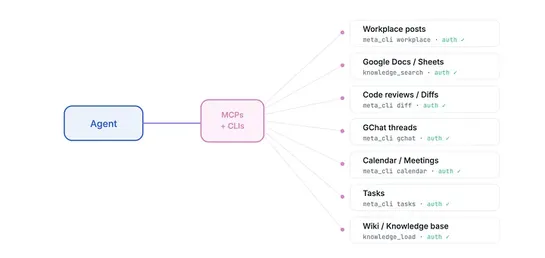
How We Built an AI Second Brain for 60K Knowledge Workers

Meta built an AI agent system internally called the AI Second Brain that now has over 63,000 installs and ~10,000 daily active users across engineering, PM, design, legal, finance, comms, and sales, growing from zero in roughly three months after a non-technical PM's adoption post. The architecture .. read more  

How We Built an AI Second Brain for 60K Knowledge Workers
Link
@kala shared a link, 1 month, 1 week ago
FAUN.dev()

Democratizing Machine Learning at Netflix: Building the Model Lifecycle Graph

Netflix's Saish Sali, Nipun Kumar, and Sura Elamurugu describe the Metadata Service (MDS), a graph layer built to connect siloed ML tooling (model registry, pipeline orchestrator, experimentation platform, feature store, dataset platform, identity) across personalization, studio, payments, and ads. .. read more  

Link
@kala shared a link, 1 month, 1 week ago
FAUN.dev()

The AWS MCP Server is now generally available

AWS now offers AWS MCP Server as a managed remote MCP server in US East (N. Virginia) and Europe (Frankfurt). MCP-compatible clients can use existing IAM credentials to access more than 15,000 AWS API operations. For GA, AWS added IAM context keys, documentation retrieval without authentication, low.. read more  

The AWS MCP Server is now generally available
Link
@kala shared a link, 1 month, 1 week ago
FAUN.dev()

Running local models on an M4 with 24GB memory

Local LLMs work best as supervised coding assistants. The writer ran Qwen 3.5 9B (Q4) in LM Studio on a 24GB MacBook Pro and got about 40 tokens per second, with thinking mode, tool use, and a 128K context window. The author saw mixed results: Qwen helped with simple Elixir linter edits, then failed.. read more  

Running local models on an M4 with 24GB memory
On the 1st of July 2017, the Indian government introduced the Goods and Services Tax (GST) to the general public. This tax replaced pre-existing taxes with a destination-based, multi-stage, indirect tax system. The GST applies to all eCommerce and Magento stores within India. The World Bank has stated that the GST is one of the most complex tax systems worldwide due to its intricate nature.

As the GST is bifurcated into multiple tax slabs, it has become more difficult to implement such a complex taxing system in Magento 2. Managing a multi-vendor marketplace entails dealing with numerous vendors who sell various products on your platform. 

This necessitates the computation of GST tax rates based on the product and its category, which can be intricate due to varying tax brackets. An automated system is needed to collect and accurately compute vendor tax rates.

The Magento 2 Multi-vendor Indian GST Extension, also called the Magento Multi-vendor GST Module by MageComp, confidently calculates GST for products sold through your Magento stores by vendors. The module fully complies with the Indian government's GST standards and prominently displays the vendor's GST number and summary in all Magento order documents.

Why choose MageComp’s Magento 2 Multi Vendor Indian GST Extension?

Allows admins to enable/disable the module for global, category, and product-specific configuration.
Orders that are placed with the GST module showcase a detailed bifurcation of tax rates in the order view, credit memos, invoices, new order emails and PDFs.
The GST module displays a detailed SGST and CGST tax bifurcation in the order details.
The module automatically calculates IGST, CGST and SGST based on the products added to the cart.

Benefits of Multi Vendor Indian GST for Admins

Allows admins to mention their GSTIN, CIN and PAN number in all order details.
Admins can import the product-specific GST via a CSV file.
Admins have the option to include or exclude GST tax rates from the product prices.
Admins can easily set their business origins and apply IGST (interstate Magento GST)
The module allows the admin to upload an image and a digital signature to display in invoice PDF.
Admins have the option to generate detailed GST reports based on orders and products.

Benefits for Vendors

Vendors are allowed to add their GST number to all invoices and other documents.
Vendors can set a GST rate from the backend grid while creating a product.
Vendors can also set a minimum order price to apply GST rates.

Benefits for Customers

Customers can enter the buyer’s GST number to signup.
Customers can update their buyer’s GST number any time they want from their account grid.