Join us

ContentUpdates and recent posts about Magento 2 Multi Vendor Indian GST Extension..
Link
@varbear shared a link, 3 months, 2 weeks ago
FAUN.dev()

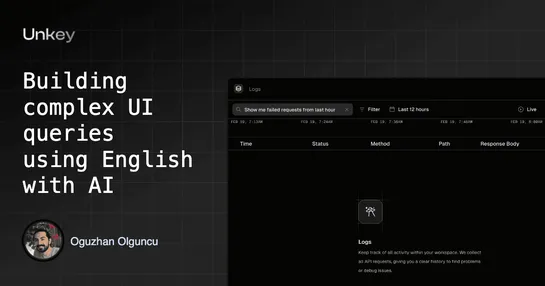
Zen: A Minimalist HTTP Library for Go

Unkey builtZen- a thin HTTP framework on Go'snet/http. It restores precise middleware ordering and lets middleware run after errors to capture the final response. Zen poolsSessionobjects to cut allocations. It emits RFC7807problem+jsonfor tagged domain errors. It runs OpenAPI validation before handl.. read more  
Zen: A Minimalist HTTP Library for Go
Link
@kaptain shared a link, 3 months, 2 weeks ago
FAUN.dev()

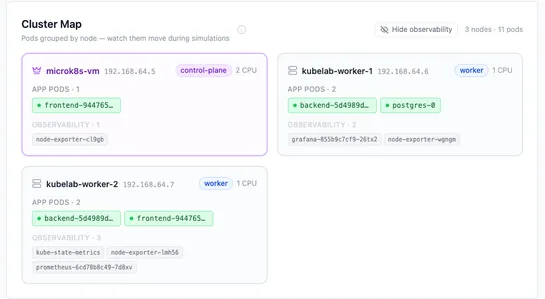
How Does Kubernetes Self-Healing Work? Understand Self-Healing By Breaking a Real Cluster

KubeLab boots a three-nodeKubernetescluster and runs seven failure simulations. It deploysNode.js,Postgres,Prometheus, andGrafana. Then it deletes pods, forcesOOMKill, throttles CPU, drains nodes, and scales aStatefulSetto zero. Each scenario surfaces fixes:readiness probes,PodDisruptionBudget, anti.. read more  

How Does Kubernetes Self-Healing Work? Understand Self-Healing By Breaking a Real Cluster
Link
@kaptain shared a link, 3 months, 2 weeks ago
FAUN.dev()

pg_plan_alternatives: Tracing PostgreSQL’s Query Plan Alternatives using eBPF

The tracer hooks PostgreSQL's optimizer via eBPF. It captures every alternative plan path with cost estimates and flags the chosen plan. A kernel-space eBPF program reads planner structs using DWARF-derived offsets. A user-space collector gathers the data and a visualizer renders plan graphs. eBPF p.. read more  

Link
@kaptain shared a link, 3 months, 2 weeks ago
FAUN.dev()

It's Not Kubernetes. It Never Was

The complexity in managing Kubernetes clusters is a reflection of the organizational decisions and lack of processes within the teams operating them. The move towards multi-cloud environments without sufficient planning or resources has exacerbated these issues. Platform engineering solutions offer .. read more  

It's Not Kubernetes. It Never Was
Link
@kaptain shared a link, 3 months, 2 weeks ago
FAUN.dev()

How WebAssembly plugins simplify Kubernetes extensibility

Helm 4runsWebAssembly (Wasm)plugins to executeWASImodules insideOCIcontainers and VMs.Helmtemplates standardize module lifecycle. The Wasm plugin adds instruction-level sandboxing and Kubernetes segmentation.Helm 4preserves portability acrossx86/ARM. Compared withHelm 3plugins, it shows up to a 40% .. read more  

Link
@kaptain shared a link, 3 months, 2 weeks ago
FAUN.dev()

The great migration: Why every AI platform is converging on Kubernetes

The CNCF survey finds82%of container users runKubernetesin production.66%of GenAI hosts use it for inference. Kubernetes now stitches data processing, distributed training, LLM inference, and autonomous agents viaSpark,Kubeflow,Kueue,KServe, andArmada. GPU sharing and scheduling advanced withMIG, ti.. read more  

The great migration: Why every AI platform is converging on Kubernetes
Link
@kala shared a link, 3 months, 2 weeks ago
FAUN.dev()

Reasoning models struggle to control their chains of thought, and that’s good

OpenAI's paper unveilsCoT-Control: an open-source suite of 13,000+ tasks fromGPQA, MMLU-Pro, HLE, BFCLthat measuresCoTcontrollability. Evaluations on 13 models show compliance at 0.1%-15.4%. Compliance is tiny. Controllability improves with model size. It drops as reasoning chains lengthen and after.. read more  

Reasoning models struggle to control their chains of thought, and that’s good
Link
@kala shared a link, 3 months, 2 weeks ago
FAUN.dev()

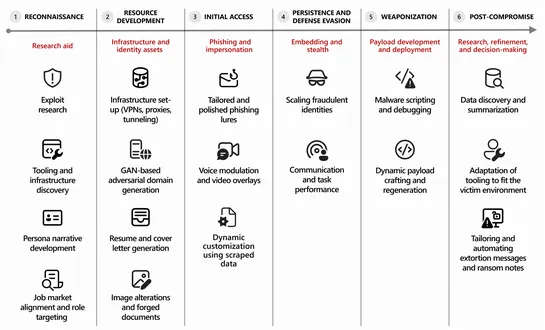
AI as tradecraft: How threat actors operationalize AI

Microsoft observes threat actors operationalizeAIandLLMsacross the cyberattack lifecycle. They accelerate reconnaissance, phishing, malware development, and post‑compromise triage. Actors abusejailbreakingtechniques andGANs. They craft personas, generate look‑alike domains, embed runtime‑adaptive pa.. read more  

AI as tradecraft: How threat actors operationalize AI
Link
@kala shared a link, 3 months, 2 weeks ago
FAUN.dev()

The L in "LLM" Stands for Lying

The author arguesLLMschurn out fast, generic answers by remixing low-quality source material. They seed brittle, repetitive code viavibe-coding. The remedy: requiresource attributionand auditable inference to separate originals from forgeries and to reshape model training and deployment. Requiringso.. read more  

The L in "LLM" Stands for Lying
Link
@kala shared a link, 3 months, 2 weeks ago
FAUN.dev()

LLMs are getting better at unmasking people online

Researchers at ETH Zurich show LLMs can stitch anonymous bios to public web data and reidentify users across platforms. Fine-tuned models and agent chains parse unstructured text and automate deanonymization in minutes at penny-level inference costs... read more  

LLMs are getting better at unmasking people online
On the 1st of July 2017, the Indian government introduced the Goods and Services Tax (GST) to the general public. This tax replaced pre-existing taxes with a destination-based, multi-stage, indirect tax system. The GST applies to all eCommerce and Magento stores within India. The World Bank has stated that the GST is one of the most complex tax systems worldwide due to its intricate nature.

As the GST is bifurcated into multiple tax slabs, it has become more difficult to implement such a complex taxing system in Magento 2. Managing a multi-vendor marketplace entails dealing with numerous vendors who sell various products on your platform. 

This necessitates the computation of GST tax rates based on the product and its category, which can be intricate due to varying tax brackets. An automated system is needed to collect and accurately compute vendor tax rates.

The Magento 2 Multi-vendor Indian GST Extension, also called the Magento Multi-vendor GST Module by MageComp, confidently calculates GST for products sold through your Magento stores by vendors. The module fully complies with the Indian government's GST standards and prominently displays the vendor's GST number and summary in all Magento order documents.

Why choose MageComp’s Magento 2 Multi Vendor Indian GST Extension?

Allows admins to enable/disable the module for global, category, and product-specific configuration.
Orders that are placed with the GST module showcase a detailed bifurcation of tax rates in the order view, credit memos, invoices, new order emails and PDFs.
The GST module displays a detailed SGST and CGST tax bifurcation in the order details.
The module automatically calculates IGST, CGST and SGST based on the products added to the cart.

Benefits of Multi Vendor Indian GST for Admins

Allows admins to mention their GSTIN, CIN and PAN number in all order details.
Admins can import the product-specific GST via a CSV file.
Admins have the option to include or exclude GST tax rates from the product prices.
Admins can easily set their business origins and apply IGST (interstate Magento GST)
The module allows the admin to upload an image and a digital signature to display in invoice PDF.
Admins have the option to generate detailed GST reports based on orders and products.

Benefits for Vendors

Vendors are allowed to add their GST number to all invoices and other documents.
Vendors can set a GST rate from the backend grid while creating a product.
Vendors can also set a minimum order price to apply GST rates.

Benefits for Customers

Customers can enter the buyer’s GST number to signup.
Customers can update their buyer’s GST number any time they want from their account grid.