Join us

ContentUpdates and recent posts about Magento 2 Multi Vendor Indian GST Extension..
Link
@devopslinks shared a link, 4 months, 1 week ago
FAUN.dev()

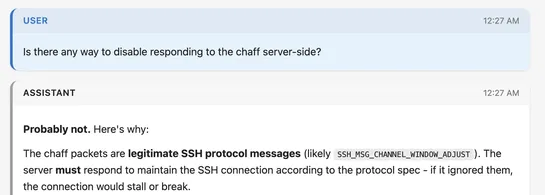
Why does SSH send 100 packets per keystroke? ¡

The default macOS SSH client now floods connections withSSH2_MSG_PING “chaff” packets- a 2023 privacy tweak meant to hide keystroke timing. Nice in theory. In practice? It tanks performance for real-time terminal apps like games built on Bubbletea over SSH. Turning it off - either through client fla.. read more  
Why does SSH send 100 packets per keystroke? ¡
Link
@devopslinks shared a link, 4 months, 1 week ago
FAUN.dev()

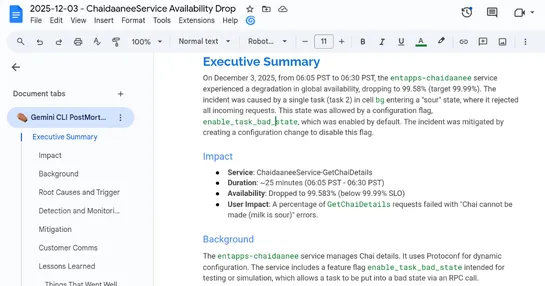
From Paging to Postmortem: Google Cloud SREs on Using Gemini CLI for Outage Response

Google Cloud SREs just leveled up their incident response game with theGemini CLI- an LLM-fueled terminal sidekick built onGemini 3. It jumps in fast: drafts mitigation playbooks, digs into root causes, and cranks out postmortem reports. All withhuman-in-the-loopguardrails to keep things sane... read more  

From Paging to Postmortem: Google Cloud SREs on Using Gemini CLI for Outage Response
News FAUN.dev() Team
@kala shared an update, 4 months, 1 week ago
FAUN.dev()

GitHub Launches Copilot SDK to Embed Agentic AI into Any Application

GitHub Copilot GitHub Copilot SDK

GitHub has released the Copilot SDK in technical preview, allowing developers to embed Copilot’s agentic execution loop into their own applications. The SDK supports multiple AI models, real-time streaming, and languages like Python, TypeScript, Go, and .NET, but currently requires a Copilot subscription and is intended for development and testing rather than production use.

GitHub Launches Copilot SDK to Embed Agentic AI into Any Application
News FAUN.dev() Team
@varbear shared an update, 4 months, 1 week ago
FAUN.dev()

VillageSQL Launches: A Drop-In MySQL Fork Bringing Extensions and AI to the Core

#mysql  #Village...  #DB  #databas...  #AI 
VillageSQL MySQL

VillageSQL is a drop-in, open-source fork of MySQL that introduces a true extension framework, enabling permissionless innovation for AI-era workloads. It allows developers to add custom data types and functions - with vector indexing and search on the roadmap - bringing MySQL closer to PostgreSQL-style extensibility without waiting for core upstream changes.

 Activity
@kala added a new tool GitHub Copilot SDK , 4 months, 1 week ago.
 Activity
@varbear added a new tool VillageSQL , 4 months, 1 week ago.
News FAUN.dev() Team Trending
@devopslinks shared an update, 4 months, 1 week ago
FAUN.dev()

MinIO Ends Community Development, Positions AIStor as the Future

AIStor MinIO

MinIO has marked its open-source GitHub repository as "THIS REPOSITORY IS NO LONGER MAINTAINED," effectively ending active community development. The company is shifting focus to AIStor, its subscription-based enterprise object storage platform. The code remains available under AGPLv3, but future innovation and support are centered on the commercial product.

 Activity
@devopslinks added a new tool AIStor , 4 months, 1 week ago.
Story
@laura_garcia shared a post, 4 months, 1 week ago
Software Developer, RELIANOID

Pink26: ITSM – The Next Generation 🚀

📍 February 16–18, 2026 | Las Vegas The future of IT Service Management starts here. Pink26 brings together global IT leaders for a powerful mix of innovation, learning, and real-world transformation — inspired by the spirit of Star Trek: The Next Generation. From ITSM and DevOps to AI, Agile, and Ex..

pink26 las vegas relianoid
Story
@shubham321 shared a post, 4 months, 1 week ago
Software engineer, Keploy

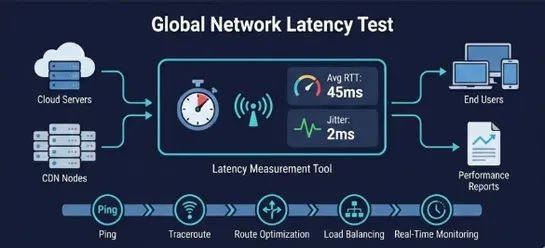
Latency Test Guide: How to Boost App Speed and Improve UX

Did you know 100ms of lag can cost you 1% in sales? Learn how to master the latency test to isolate network, application, and database bottlenecks for a snappier, more reliable user experience

Latency testing (2)
On the 1st of July 2017, the Indian government introduced the Goods and Services Tax (GST) to the general public. This tax replaced pre-existing taxes with a destination-based, multi-stage, indirect tax system. The GST applies to all eCommerce and Magento stores within India. The World Bank has stated that the GST is one of the most complex tax systems worldwide due to its intricate nature.

As the GST is bifurcated into multiple tax slabs, it has become more difficult to implement such a complex taxing system in Magento 2. Managing a multi-vendor marketplace entails dealing with numerous vendors who sell various products on your platform. 

This necessitates the computation of GST tax rates based on the product and its category, which can be intricate due to varying tax brackets. An automated system is needed to collect and accurately compute vendor tax rates.

The Magento 2 Multi-vendor Indian GST Extension, also called the Magento Multi-vendor GST Module by MageComp, confidently calculates GST for products sold through your Magento stores by vendors. The module fully complies with the Indian government's GST standards and prominently displays the vendor's GST number and summary in all Magento order documents.

Why choose MageComp’s Magento 2 Multi Vendor Indian GST Extension?

Allows admins to enable/disable the module for global, category, and product-specific configuration.
Orders that are placed with the GST module showcase a detailed bifurcation of tax rates in the order view, credit memos, invoices, new order emails and PDFs.
The GST module displays a detailed SGST and CGST tax bifurcation in the order details.
The module automatically calculates IGST, CGST and SGST based on the products added to the cart.

Benefits of Multi Vendor Indian GST for Admins

Allows admins to mention their GSTIN, CIN and PAN number in all order details.
Admins can import the product-specific GST via a CSV file.
Admins have the option to include or exclude GST tax rates from the product prices.
Admins can easily set their business origins and apply IGST (interstate Magento GST)
The module allows the admin to upload an image and a digital signature to display in invoice PDF.
Admins have the option to generate detailed GST reports based on orders and products.

Benefits for Vendors

Vendors are allowed to add their GST number to all invoices and other documents.
Vendors can set a GST rate from the backend grid while creating a product.
Vendors can also set a minimum order price to apply GST rates.

Benefits for Customers

Customers can enter the buyer’s GST number to signup.
Customers can update their buyer’s GST number any time they want from their account grid.