Join us

ContentUpdates and recent posts about Slurm..
Link
@kala shared a link, 2 weeks, 4 days ago
FAUN.dev()

Critical Claude Code vulnerability: Deny rules silently bypassed because security checks cost too many tokens

Clause Code security bypass: Anthropic's performance fix silently disabled deny rules for 500K+ developers when more than 50 subcommands were used in a command, impacting permission validation and security policy enforcement. The vulnerability stemmed from a tradeoff between security and performance.. read more  

Link
@kala shared a link, 2 weeks, 4 days ago
FAUN.dev()

China has ‘nearly erased’ America’s lead in AI

Stanford HAI's 2026 AI Index shows China cut the U.S. lead inArenascores. In March 2026,Claude Opus 4.6ledDola‑Seed 2.0by 2.7%. A 2.7% margin is a photo finish. China outpaces the U.S. inpublicationcitations (20.6% vs 12.6% in 2024) and inindustrial robots(~295,000 vs 34,200). It also holds surplusc.. read more  

China has ‘nearly erased’ America’s lead in AI
Link
@kala shared a link, 2 weeks, 4 days ago
FAUN.dev()

I Measured Claude 4.7's New Tokenizer. Here's What It Costs You.

Anthropic's Claude Opus 4.7 migration guide states the new tokenizer utilizes "roughly 1.0 to 1.35x as many tokens" compared to 4.6. Actual measurements show a higher ratio on technical docs and real CLAUDE.md files. The cost of the new tokenizer was measured using real content and synthetic samples.. read more  

I Measured Claude 4.7's New Tokenizer. Here's What It Costs You.
Link
@devopslinks shared a link, 2 weeks, 4 days ago
FAUN.dev()

Reducing our monorepo size to improve developer velocity

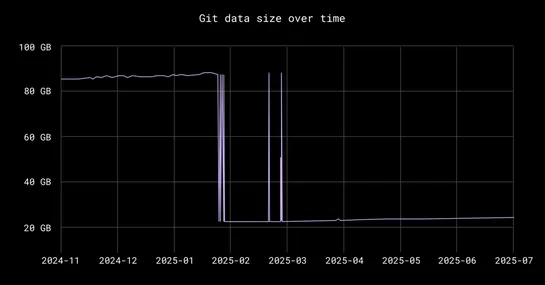
Dropbox cut itsmonorepofrom 87GB to 20GB. It ran a GitHub‑approved server‑sidegit repack, tuned bywindow/depth. Clone times dropped to under 15 minutes. Engineers traced growth to Git’s 16‑char path heuristic. That heuristic mispairedi18nfiles. They tested--path-walklocally, then ran phased replica .. read more  

Reducing our monorepo size to improve developer velocity
Link
@devopslinks shared a link, 2 weeks, 4 days ago
FAUN.dev()

Figma's next-generation data caching platform

Figma rearchitected their storage systems to support scalability, including horizontally sharding their Postgres stack and building FigCache, a stateless proxy service for Redis. FigCache decouples connection scalability from Redis, centralizes traffic routing, enhances security, and provides end-to.. read more  

Figma's next-generation data caching platform
Link
@devopslinks shared a link, 2 weeks, 4 days ago
FAUN.dev()

Don’t trust, verify

Daniel Stenberg, creator of curl, argues that software security should be built on verification rather than trust, outlining the many ways a widely used project like curl could be compromised - from malicious insiders and breached credentials to hacked distribution sites and CI tool exploits. To cou.. read more  

Don’t trust, verify
Link
@devopslinks shared a link, 2 weeks, 4 days ago
FAUN.dev()

Shell Tricks That Actually Make Life Easier (And Save Your Sanity)

This post provides a collection of lesser-known terminal tricks that can improve productivity and efficiency when working in various POSIX shells. The tricks cover a range of functions, from efficient text manipulation to file operations and script writing. By incorporating these tips into daily wor.. read more  

Shell Tricks That Actually Make Life Easier (And Save Your Sanity)
Story
@laura_garcia shared a post, 2 weeks, 6 days ago
Software Developer, RELIANOID

how to migrate ADC services from Array Networks APV Series to RELIANOID—step by step.

Migrating from legacy ADC platforms doesn’t have to be complex. In our latest Knowledge Base article, we walk you through how to migrate ADC services from Array Networks APV Series to RELIANOID—step by step. 🔍 What you’ll find inside: - Clear terminology mapping between both platforms - Practical mi..

Knowledge base migrate ADC services from ARRAY NETWORKS APV SERIES to RELIANOID
Story
@laura_garcia shared a post, 3 weeks ago
Software Developer, RELIANOID

DevOpsCon Amsterdam 2026

- 𝗗𝗲𝘃𝗢𝗽𝘀𝗖𝗼𝗻 𝗔𝗺𝘀𝘁𝗲𝗿𝗱𝗮𝗺 𝟮𝟬𝟮𝟲 𝗶𝘀 𝗷𝘂𝘀𝘁 𝗮𝗿𝗼𝘂𝗻𝗱 𝘁𝗵𝗲 𝗰𝗼𝗿𝗻𝗲𝗿! - Amsterdam, Netherlands April 20–24, 2026 Simplify complexity, amplify agility, and accelerate innovation. Join DevOpsCon Amsterdam 2026 — one of the leading conferences for professionals working with CI/CD, Kubernetes, Platform Engineering, ..

devopscon amsterdam april 26
Story WrapPixel Team
@sanjayjoshi shared a post, 3 weeks, 1 day ago

10+ Shadcn Table Components, Blocks & Tools

A curated list of Shadcn table components and blocks you can use in React and Next.js projects to build clean, flexible, and production-ready data tables faster.

Thumbnail Shadcn Table
Slurm Workload Manager is an open-source, fault-tolerant, and highly scalable cluster management and scheduling system widely used in high-performance computing (HPC). Designed to operate without kernel modifications, Slurm coordinates thousands of compute nodes by allocating resources, launching and monitoring jobs, and managing contention through its flexible scheduling queue.

At its core, Slurm uses a centralized controller (slurmctld) to track cluster state and assign work, while lightweight daemons (slurmd) on each node execute tasks and communicate hierarchically for fault tolerance. Optional components like slurmdbd and slurmrestd extend Slurm with accounting and REST APIs. A rich set of commands—such as srun, squeue, scancel, and sinfo—gives users and administrators full visibility and control.

Slurm’s modular plugin architecture supports nearly every aspect of cluster operation, including authentication, MPI integration, container runtimes, resource limits, energy accounting, topology-aware scheduling, preemption, and GPU management via Generic Resources (GRES). Nodes are organized into partitions, enabling sophisticated policies for job size, priority, fairness, oversubscription, reservation, and resource exclusivity.

Widely adopted across academia, research labs, and enterprise HPC environments, Slurm serves as the backbone for many of the world’s top supercomputers, offering a battle-tested, flexible, and highly configurable framework for large-scale distributed computing.