Join us

ContentUpdates and recent posts about Slurm..
 Activity
@adrian_schmidt started using tool Amazon EC2 , 4 days, 8 hours ago.
 Activity
@adrian_schmidt started using tool Amazon Cloudfront , 4 days, 8 hours ago.
 Activity
@adrian_schmidt started using tool Amazon ALB , 4 days, 8 hours ago.
Story
@laura_garcia shared a post, 4 days, 9 hours ago
Software Developer, RELIANOID

𝗕𝗲𝘁𝘁 𝗕𝗿𝗮𝘀𝗶𝗹 𝟮𝟬𝟮𝟲

📍 São Paulo, Brazil 📅 May 5–8, 2026 𝗥𝗘𝗟𝗜𝗔𝗡𝗢𝗜𝗗 is heading to 𝗕𝗲𝘁𝘁 𝗕𝗿𝗮𝘀𝗶𝗹 𝟮𝟬𝟮𝟲 — 𝘵𝘩𝘦 𝘭𝘢𝘳𝘨𝘦𝘴𝘵 𝘌𝘥𝘛𝘦𝘤𝘩 𝘦𝘷𝘦𝘯𝘵 𝘪𝘯 𝘓𝘢𝘵𝘪𝘯 𝘈𝘮𝘦𝘳𝘪𝘤𝘢. 🚀 46,000+ professionals 💡 270+ companies 🌍 One shared goal: transforming education Let’s talk about secure, scalable, and high-performance digital learning. 👉 See you at Expo Cen..

bett_brazil_sao_paulo_2026_relianoid
Link
@koukibadr shared a link, 4 days, 10 hours ago
Mobile Developer, Nventive

LiveData vs StateFlow

LiveData and StateFlow both stream data reactively, but differ in two key ways:

Initialization — LiveData needs no initial value; StateFlow requires one.

Lifecycle — LiveData is lifecycle-aware by default; StateFlow is not, so you need to wrap it in repeatOnLifecycle to avoid memory leaks.

Code templating
Story
@pramod_kumar_0820 shared a post, 4 days, 14 hours ago
Software Engineer, Teknospire

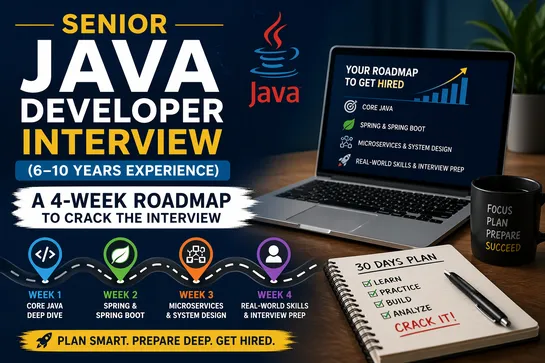
How To Crack Senior Java Interviews (6–10 YOE) In 4 Weeks

Javadoc Searchspring

A practical 4-week roadmap to crack Senior Java Developer interviews (6–10 YOE), covering Core Java, Spring Boot internals, Microservices, System Design, and real-world interview strategies.

Senior Java Interviews (6–10 YOE) In 4 Weeks
 Activity
@smh started using tool TypeScript , 4 days, 15 hours ago.
 Activity
@smh started using tool Terraform , 4 days, 15 hours ago.
 Activity
@smh started using tool Python , 4 days, 15 hours ago.
 Activity
@smh started using tool OpenTelemetry , 4 days, 15 hours ago.
Slurm Workload Manager is an open-source, fault-tolerant, and highly scalable cluster management and scheduling system widely used in high-performance computing (HPC). Designed to operate without kernel modifications, Slurm coordinates thousands of compute nodes by allocating resources, launching and monitoring jobs, and managing contention through its flexible scheduling queue.

At its core, Slurm uses a centralized controller (slurmctld) to track cluster state and assign work, while lightweight daemons (slurmd) on each node execute tasks and communicate hierarchically for fault tolerance. Optional components like slurmdbd and slurmrestd extend Slurm with accounting and REST APIs. A rich set of commands—such as srun, squeue, scancel, and sinfo—gives users and administrators full visibility and control.

Slurm’s modular plugin architecture supports nearly every aspect of cluster operation, including authentication, MPI integration, container runtimes, resource limits, energy accounting, topology-aware scheduling, preemption, and GPU management via Generic Resources (GRES). Nodes are organized into partitions, enabling sophisticated policies for job size, priority, fairness, oversubscription, reservation, and resource exclusivity.

Widely adopted across academia, research labs, and enterprise HPC environments, Slurm serves as the backbone for many of the world’s top supercomputers, offering a battle-tested, flexible, and highly configurable framework for large-scale distributed computing.