Join us

ContentUpdates and recent posts about AWX..
Link
@kala shared a link, 6 months ago
FAUN.dev()

Evaluating AI Agents in Security Operations

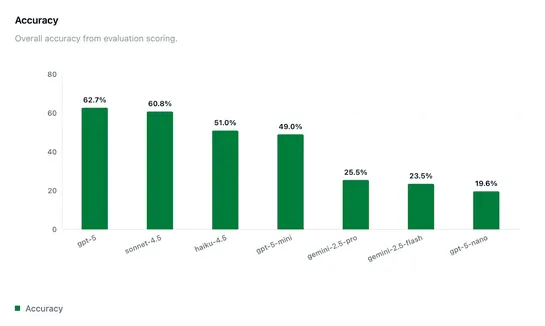
Cotool threw frontier LLMs at real-world SecOps tasks using Splunk’s BOTSv3 dataset.GPT-5topped the chart in accuracy (62.7%) and gave the best results per dollar.Claude Haiku-4.5blazed through tasks fastest, just 240 seconds on average, maxing out tool integrations.Gemini-2.5-proflopped on both acc.. read more  
Evaluating AI Agents in Security Operations
Link
@kala shared a link, 6 months ago
FAUN.dev()

AI agents are starting to eat SaaS

AI coding agents are eating the lunch of low-complexity SaaS. Teams with a bit of dev muscle are skipping subscription logins and spinning up dashboards, pipelines, even decks, using Claude, Gemini, whoever’s fastest that day. Build vs. buy? Tilting back toward build. The kicker: build now takes min.. read more  

AI agents are starting to eat SaaS
Link
@kala shared a link, 6 months ago
FAUN.dev()

Everything to know about Google Gemini’s most recent AI updates

Google jammed a full no-code AI workshop into Gemini. The browser now bakes inOpal, a drag-and-drop app builder with a shiny newvisual editor. You can chain prompts, preview apps, and feed it text, voice, or images, without touching code. They also dropped theGemini 3 Flash model, built for dual rea.. read more  

Link
@devopslinks shared a link, 6 months ago
FAUN.dev()

From Static Rate Limiting to Adaptive Traffic Management in Airbnb’s Key-Value Store

Airbnb just rewired Mussel, its key-value store, with a smarter, layered QoS system. Out go the rigid QPS caps. In comeresource-aware rate control,criticality-based load shedding, andreal-time hot-key mitigation. Dispatchers now speak the language of backend cost -rows, bytes, latency - not just raw.. read more  

From Static Rate Limiting to Adaptive Traffic Management in Airbnb’s Key-Value Store
Link
@devopslinks shared a link, 6 months ago
FAUN.dev()

Agent-Driven SRE Investigations: A Practical Deep Dive into Multi-Agent Incident Response

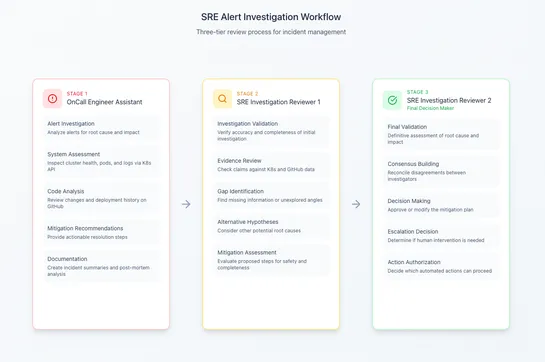
A sandboxed setup dropped multiple Claude-powered agents into Docker containers to run a full incident response drill. Each agent played a role: probing Kubernetes clusters, sniffing out root causes, and shipping remediation PRs straight to GitHub. Out of 7 test incidents, they nailed the diagnoses .. read more  

Agent-Driven SRE Investigations: A Practical Deep Dive into Multi-Agent Incident Response
Link
@devopslinks shared a link, 6 months ago
FAUN.dev()

async dns

A developer went digging for safer async DNS incurlafterpthread_cancelstarted breaking things. Threadless, callback-free options took the spotlight.OpenBSD’sasrquickly stood out, clean event loop integration, no threads, no drama. Beat outc-areson portability and design clarity... read more  

Link
@devopslinks shared a link, 6 months ago
FAUN.dev()

How We Saved 70% of CPU and 60% of Memory in Refinery’s Go Code, No Rust Required.

Refinery 3.0 cuts CPU by 70% and slashes RAM by 60%. The trick: selective field extraction from serialized spans. No full deserialization. Fewer heap allocations. Way less waste. It also recycles buffers, handles metrics smarter, and is gearing up to parallelize its core decision loop... read more  

How We Saved 70% of CPU and 60% of Memory in Refinery’s Go Code, No Rust Required.
News FAUN.dev() Team
@kaptain shared an update, 6 months ago
FAUN.dev()

Docker Brings Production-Grade Hardened Images to Developers at No Cost

Docker

Docker has launched Docker Hardened Images, a secure and minimal set of production-ready images. These images are now freely available to developers.

Docker Brings Production-Grade Hardened Images to Developers at No Cost
Link
@anjali shared a link, 6 months ago
Customer Marketing Manager, Last9

OTel Updates: OpenTelemetry Deprecates Zipkin Exporters

OpenTelemetry deprecates Zipkin exporters in favor of native OTLP support. Migration paths and timeline through December 2026.

depreciating_zipkin
News FAUN.dev() Team
@kaptain shared an update, 6 months ago
FAUN.dev()

Argo CD 3.2.2 Improves Secret Management, Retry Safety, and Auth Checks

Kubernetes Argo CD

ArgoCD v3.2.2 has been released, featuring a new addition, two enhancements, and a bug fix. This update aims to improve the overall functionality and reliability of the platform.

Argo CD 3.2.2 Improves Secret Management, Retry Safety, and Auth Checks
AWX is the open source, community supported upstream project for Red Hat Ansible Automation Platform, formerly known as Ansible Tower. It gives teams a web based interface, a full REST API, and a distributed task engine on top of Ansible, turning command line playbook runs into a managed, auditable automation service.

The project began at AnsibleWorks as the commercial Ansible Tower product, and after Red Hat acquired Ansible, it open sourced the codebase as AWX in September 2017, positioning it as the development ground where new features land before they are hardened into the supported Automation Platform controller. With AWX, you organize automation around projects (synced from Git or other source control), inventories (static or dynamically pulled from cloud providers), credentials (stored encrypted and injected at runtime), and job templates that tie a playbook to its inventory and credentials. On top of that, it adds role based access control, a visual dashboard, job scheduling, workflow chaining, webhooks, and real time job output, so multiple teams can run, track, and delegate automation without sharing SSH keys or sitting at a terminal.

Modern AWX runs on Kubernetes or OpenShift through the AWX Operator, which manages installation, upgrades, and scaling declaratively, reflecting its shift from a single host application to a cloud native, container based platform. Because it is the upstream of a paid product, AWX moves fast and ships frequently, which makes it ideal for labs, learning, and self managed deployments, though teams needing formal support and long term stability typically run the downstream Automation Platform instead.