Join us

ContentUpdates and recent posts about Pulumi..
Story
@laura_garcia shared a post, 5 months, 3 weeks ago
Software Developer, RELIANOID

🔐🌱 Cybersecurity and industrial sustainability: a moment to reflect as the year comes to an end

We shared this article a few months ago, but year-end is the perfect time to revisit it and reflect on where the industry is heading in the year ahead. Cybersecurity and sustainability can no longer be treated as separate disciplines. They share a common goal: ensuring ethical, resilient, and respon..

Story FAUN.dev() Team
@eon01 shared a post, 5 months, 4 weeks ago
Founder, FAUN.dev

Enshittification is not a bug

Docker Helm Kubernetes

Bitnami charts are still high quality, but their public image distribution is going away. Instead of rewriting everything, many teams can keep the charts and switch the underlying images (for example, to Docker Hardened Images) to minimize disruption and maintain security.

Bitnami vs Docker Hardened Images
Story
@laura_garcia shared a post, 6 months ago
Software Developer, RELIANOID

🚀 Deploy RELIANOID CE v7 on AWS with Terraform

Quickly deploy RELIANOID Community Edition v7 on AWS using the official Terraform module. ✔️ VPC, Subnet & Security Group ✔️ EC2 with RELIANOID AMI ✔️ SSH & Web GUI ready ✔️ Easy cleanup with terraform destroy ⚠️ AMI is region-specific (default: us-east-1) 🔐 Always secure your SSH private key #Terra..

Story
@viktoriiagolovtseva shared a post, 6 months ago

How To Create a Jira Test Case Template To Boost Efficiency

Many agile teams prefer Jira for managing test cases. Even though it’s not a dedicated tool, it provides a straightforward way to organize the testing process, track progress, and share results with stakeholders. Additionally, it enhances collaboration between QA and development teams.

Using test case templates in Jira allows you to manage this process even more efficiently. These templates save time, promote standardization, and provide a structured foundation for test execution. In this short tutorial, I will show you how to create a Jira test case template and use it with automation to simplify your testing process.

Zrzut ekranu 2025-12-23 155342
Story
@laura_garcia shared a post, 6 months ago
Software Developer, RELIANOID

🔐 RELIANOID & NIST Cybersecurity Framework Alignment

At RELIANOID, security is built into both our Load Balancer and our internal operations. We align our product and organizational practices with the NIST Cybersecurity Framework (CSF) across its five core functions: Identify, Protect, Detect, Respond, and Recover. ✔️ Consistent security controls acro..

NIST Cybersecurity Framework RELIANOID compliance
Link
@varbear shared a link, 6 months ago
FAUN.dev()

Goodbye Microservices

Twilio Segment collapsed 140+ destination-specific microservices into asingle monolith, one repo, one set of dependencies, one test harness. They leveled out version sprawl and builtTraffic Recorder, a homegrown yakbak-based HTTP playback tool. That killed off hours-long test runs, dropping them to.. read more  

Link
@varbear shared a link, 6 months ago
FAUN.dev()

Why I Didn’t Sign the Resonant Computing Manifesto: The Foundations Need Work

A sharp critique of theResonant Computing Manifestopushes it past vague ideals. It calls for real governance scaffolding, not just poetic prose. Without that? The manifesto risks becoming just another glossy PDF for entrenched players to wave around while changing nothing. Under the hood:What’s real.. read more  

Why I Didn’t Sign the Resonant Computing Manifesto: The Foundations Need Work
Link
@varbear shared a link, 6 months ago
FAUN.dev()

Rust unit testing: file writing

To test file writes without hitting the disk, the author swaps in a closure that takes a file handle. That handle’s a test double, so after the code runs, you can crack it open and inspect what got written... read more  

Link
@varbear shared a link, 6 months ago
FAUN.dev()

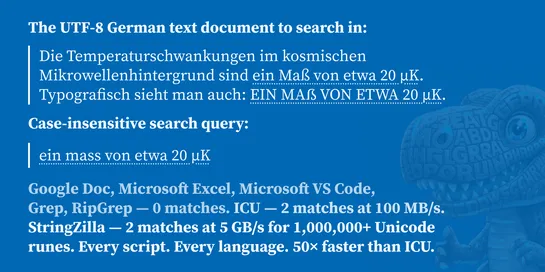
Full Unicode Search at 50× ICU Speed with AVX‑512

StringZilla v4.5drops a major speed bomb on Unicode text processing. Think10× faster tokenization and case folding. Up to150× faster for case-insensitive substring search. It leaves ICU and PCRE2 wheezing in the dust. Under the hood: SIMD all the way, AVX-512 on newer chips, plus script-aware SIMD k.. read more  

Full Unicode Search at 50× ICU Speed with AVX‑512
Link
@varbear shared a link, 6 months ago
FAUN.dev()

pqr.sql: Generate QR Codes with Pure SQL in PostgreSQL

A developer jammed out aQR code generator in pure SQL, just PostgreSQL, no extensions or libraries. One gnarly single-statement query. It even runs faster onPostgreSQL 17than on 16, thanks to engine tweaks... read more  

pqr.sql: Generate QR Codes with Pure SQL in PostgreSQL
Pulumi is an open-source infrastructure-as-code platform that allows you to define, deploy, and manage cloud resources using familiar general-purpose programming languages like Python, JavaScript, Go, and TypeScript.

Pulumi represents a major shift in the Infrastructure-as-Code (IaC) landscape by moving away from proprietary domain-specific languages (DSLs) and static configuration files like YAML or JSON. Instead, it leverages the power of standard programming languages, allowing engineers to use loops, functions, classes, and existing package managers to define their cloud environments. This means you can apply software engineering best practices—such as unit testing, modularity, and CI/CD integration—directly to your infrastructure setups on providers like AWS, Azure, Google Cloud, and Kubernetes.

The platform works by utilizing a "State" mechanism similar to Terraform, where it tracks the current deployment against your desired code. When you run a Pulumi program, it builds a resource graph to determine the most efficient way to provision or update your services. Because it uses real code, it provides superior IDE support, including auto-completion and type-checking, which significantly reduces the syntax errors and "trial-and-error" deployments common with text-based configuration tools.

Furthermore, Pulumi excels in hybrid and multi-cloud environments by providing a unified workflow for both infrastructure and application delivery. It bridges the gap between developers and platform engineers, as both can now speak the same language—literally.