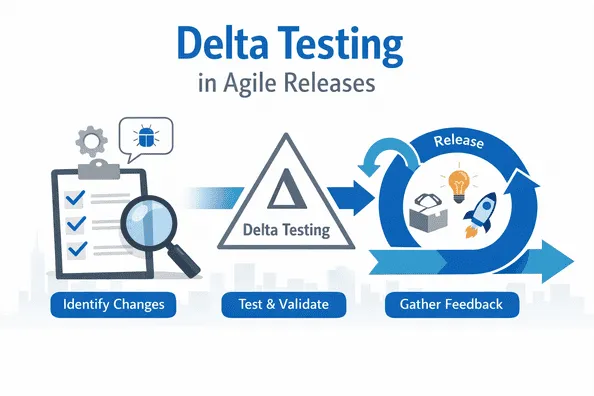
In fast-paced Agile environments, teams release updates frequently, sometimes daily. But as release frequency increases, so does the pressure on testing cycles. Running full regression suites for every minor change can slow delivery, consume resources, and delay feedback. This is where delta testing becomes a practical and strategic solution.
Delta testing focuses only on validating the changes introduced in a new build and their direct impact, instead of retesting the entire application. By narrowing the scope intelligently, teams can maintain confidence without sacrificing speed.
What Is Delta Testing?
Delta testing is a change-based testing approach that validates only the modified parts of an application and the areas potentially affected by those modifications. The term “delta” refers to the difference between two builds, typically the previous stable release and the new version under development.
Instead of executing a complete regression suite, teams identify:
- Newly added features
- Modified functionality
- Bug fixes
- Configuration or environment changes
- Impacted dependencies
Testing efforts are then concentrated on these deltas and their related workflows.
Why Full Regression Isn’t Always Practical
Traditional regression testing ensures that existing functionality remains unaffected after changes. While effective, running a full regression suite in every sprint can lead to:
- Longer feedback cycles
- Increased infrastructure costs
- Delayed deployments
- Redundant test execution
In Agile and CI/CD pipelines, where speed is critical, repeatedly retesting stable modules adds little value. Delta testing addresses this inefficiency by reducing the regression scope without compromising risk control.
How Delta Testing Works in Agile Environments
In Agile releases, changes are incremental. A structured delta testing process typically includes:
1. Change Identification
Analyze commit logs, pull requests, or release notes to identify what has changed.
2. Impact Analysis
Perform change impact analysis to determine which modules, APIs, or workflows might be indirectly affected.
3. Selective Test Mapping
Map identified changes to relevant test cases. This ensures that only necessary automated or manual tests are executed.
4. Targeted Execution
Run focused tests for changed components and their dependencies.
5. Risk Review
Assess whether high-risk areas require additional regression coverage.
This workflow ensures that delta testing remains systematic rather than random or incomplete.
Delta Testing vs Regression Testing
Although closely related, delta testing and regression testing serve different purposes.
AspectDelta TestingFull Regression TestingScopeOnly changed and impacted areasEntire applicationSpeedFaster executionSlower executionResource UsageOptimizedHigher infrastructure costBest ForFrequent Agile releasesMajor releases or architectural changes
In practice, many teams combine both strategies, using delta testing for regular sprint deployments and full regression testing for major releases.
Benefits of Delta Testing in CI/CD Pipelines
When integrated into CI/CD pipelines, delta testing offers significant advantages:
Faster Feedback Loops
Developers receive quicker validation on code changes.
Reduced Test Execution Time
Selective testing shortens pipeline duration.
Optimized Infrastructure Costs
Less compute power is needed compared to running full test suites.
Improved Release Velocity
Teams can deploy features more frequently without bottlenecks.
Lower Testing Fatigue
QA teams avoid repetitive testing of stable modules.
For organizations aiming for continuous delivery, delta testing supports both speed and stability.
Real-World Example
Imagine a SaaS application where a team updates only the billing calculation logic. Instead of executing the entire regression suite, delta testing would focus on:
- Billing module test cases
- Payment API integrations
- Invoice generation workflows
- Reporting modules dependent on billing data
By concentrating on these impacted areas, the team validates functionality efficiently while maintaining confidence in system stability.
Risks and Challenges
While delta testing improves efficiency, it requires discipline and accurate impact analysis. Potential risks include:
- Missing indirect dependencies
- Incomplete test mapping
- Over-reliance on automation without proper validation
- Skipping full regression for too long
If change impact analysis is weak, defects can escape into production. Therefore, delta testing should be supported by strong documentation, version tracking, and traceability between requirements and test cases.
Best Practices for Effective Delta Testing
To implement delta testing successfully:
- Maintain clear traceability between features and test cases
- Use automated tools to detect changed files and dependencies
- Categorize tests by module or service
- Periodically run full regression to maintain overall confidence
- Monitor defect trends to validate the effectiveness of selective testing
Combining these practices ensures that delta testing enhances agility rather than introducing risk.
When Should Teams Use Delta Testing?
Delta testing works best when:
- Changes are incremental and well-defined
- Applications follow modular or microservices architecture
- CI/CD pipelines require fast validation
- Teams have reliable automated test coverage
- Release cycles are frequent
It is less suitable when major architectural overhauls or core system rewrites occur, where full regression is safer.
Conclusion
In Agile and DevOps environments, testing strategies must evolve to match development speed. Delta testing provides a focused, change-driven approach that allows teams to validate updates without retesting everything. By combining intelligent impact analysis with selective test execution, organizations can accelerate releases while maintaining software quality.
When implemented thoughtfully, delta testing becomes a powerful ally in modern software delivery, balancing speed, efficiency, and reliability.