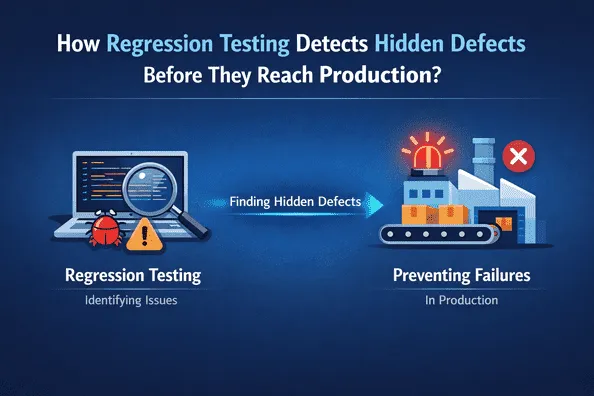
In modern software development, even small changes can introduce unexpected issues. New features, bug fixes, or refactoring can inadvertently break existing functionality. Detecting these hidden defects before they reach production is critical for maintaining software stability, minimizing downtime, and ensuring a smooth user experience. Regression testing plays a central role in this process.
By systematically re-running previously executed test cases and validating system behavior, regression testing identifies defects that might otherwise go unnoticed. This proactive approach allows teams to maintain quality while continuing to innovate rapidly.
What Is Regression Testing?
Regression testing is the practice of retesting existing functionality after any code change. Its primary goals are:
- Ensuring previously working features continue to operate correctly
- Identifying unintended side effects of new code
- Maintaining system reliability across releases
Rather than focusing solely on new features, regression testing keeps the application stable as it evolves.
How Hidden Defects Occur
Hidden defects often arise from subtle or indirect changes in the system. Common sources include:
- Code refactoring that unintentionally affects shared modules
- Updates to APIs or third-party libraries
- Changes in configuration or environment
- Unhandled edge cases in workflows
- Interactions between new features and existing functionality
Without proper regression validation, these issues may not be detected during initial development, surfacing later as production incidents.
How Regression Testing Detects Hidden Defects
1. Revalidating Critical Workflows
Regression tests cover the most important workflows in an application. By executing these tests after each change, teams can quickly detect unexpected failures. For example, an e-commerce checkout flow might be validated end-to-end after updates to the payment module. Any hidden defect introduced during the update is immediately flagged.
2. Catching Integration and API Issues
Many defects are introduced at the interface between components or services. Regression testing, particularly when combined with regression testing tools, validates these interactions automatically. This ensures that changes in one module do not break dependent modules or external integrations.
3. Edge Case and Negative Scenario Validation
Hidden defects often appear only under specific conditions, such as unusual input values or rare workflows. Regression testing ensures that both typical and edge-case scenarios are validated, reducing the likelihood of overlooked bugs.
4. Early Detection Through CI/CD Integration
When regression tests are integrated into a CI/CD pipeline, every code change triggers automated validation. Failures are caught immediately, allowing developers to address defects before they reach production. This rapid feedback loop prevents minor issues from escalating into major problems.
5. Preventing Regression in Refactored Code
Refactoring improves code quality and maintainability but can inadvertently introduce defects. Regression testing verifies that the refactored code preserves expected behavior, catching hidden issues that manual inspection might miss.
Benefits of Using Regression Testing
- Reduced Production Incidents: Early defect detection prevents disruptions in live environments.
- Improved Code Confidence: Developers can deploy changes knowing core functionality remains intact.
- Faster Debugging: Detecting defects early reduces the time and effort required to fix them.
- Lower Technical Debt: Continuous validation prevents accumulation of hidden issues over time.
Applying Regression Testing in Complex Systems
In large applications or distributed systems, detecting hidden defects can be challenging due to multiple interdependent components. Teams can apply regression testing strategically by:
- Segmenting Test Suites: Divide regression tests into functional areas (e.g., user workflows, APIs, background jobs). This allows targeted testing and faster detection of defects in specific areas.
- Prioritizing High-Risk Modules: Focus on critical modules like payment processing, authentication, or data processing, where failures have the highest impact.
- Using Baseline Comparisons: Capture expected outputs or API responses and compare them with the current test run to detect subtle deviations.
- Monitoring Trends: Track recurring failures or frequently failing tests to identify unstable parts of the system that need refactoring or deeper investigation.
- Incorporating Regression in Staging: Run regression tests in a staging environment that mirrors production to catch defects that may not appear in isolated development environments.
This approach ensures that regression testing is not just a checkbox activity but a strategic safety mechanism, especially in complex, evolving systems. Teams can detect subtle issues early, maintain system reliability, and support faster, safer releases.
Best Practices for Effective Regression Testing
- Prioritize critical workflows and high-risk modules
- Include negative tests and edge cases in automated test suites
- Integrate regression tests into CI/CD pipelines for rapid feedback
- Update test cases regularly to align with evolving requirements
- Balance manual and automated regression testing to optimize coverage
Conclusion
Regression testing is essential for detecting hidden defects before they reach production. By validating both core and edge-case workflows, monitoring integrations, and leveraging automated regression testing tools teams can ensure system stability, reduce technical debt, and deliver high-quality software consistently.
Detecting hidden defects proactively is not just about preventing downtime; it’s about enabling teams to innovate confidently, maintain reliability, and keep user trust intact.