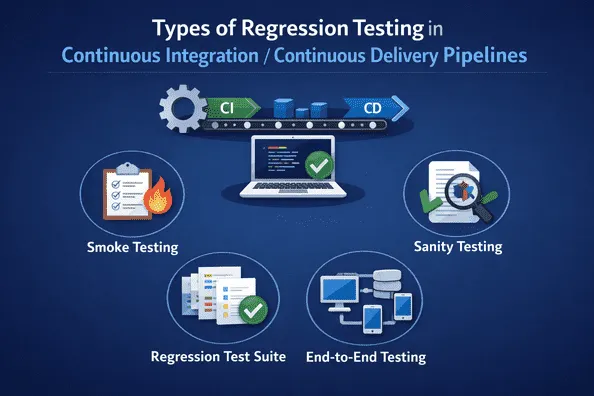
Continuous Integration and Continuous Delivery (CI/CD) pipelines have transformed modern software development. Faster release cycles, frequent deployments, and complex microservice architectures make it crucial for teams to ensure that new code does not break existing functionality. Regression testing is central to this effort, but not all regression testing is the same. Understanding the different types of regression testing and how they fit into CI/CD pipelines helps teams maintain software reliability without slowing down delivery.
This article explores the key types of regression testing, their analytical applications, integration in CI/CD, and strategies for optimizing automated pipelines.
Why Regression Testing Matters in CI/CD?
In CI/CD environments, code changes are frequent and rapid. Without effective regression testing, minor updates can introduce defects, affecting production stability. Teams face challenges such as:
- Detecting defects early
- Ensuring integration points remain stable
- Maintaining coverage without increasing execution time
- Supporting high-frequency releases
Regression testing mitigates these risks by validating that previously functioning features continue to work as expected after new changes are introduced.
Key Types of Regression Testing
1. Retest-All Regression
This type involves executing the entire test suite against the updated code. While comprehensive, retesting everything is time-consuming and may not be practical in fast CI/CD cycles. Analytical teams often use it selectively for major releases or high-risk changes.
Pros:
- Maximum coverage
- Ensures no existing functionality breaks
Cons:
- Long execution times
- Requires significant computational resources
2. Selective Regression
Selective regression focuses only on test cases that relate to modified components. Automation is critical to identify impacted areas and execute relevant tests in CI/CD pipelines efficiently.
Pros:
- Faster than retest-all
- Optimized resource usage
Cons:
- Requires proper mapping of code changes to test cases
- Risk of missing indirect impacts
3. Prioritized Regression
Here, test cases are prioritized based on risk, business impact, or frequency of use. Critical functionality is tested first, followed by less impactful areas. In high-frequency CI/CD pipelines, prioritized regression balances speed and coverage.
Pros:
- Reduces test execution time
- Focuses on high-value scenarios
Cons:
- Lower-priority tests may be delayed
- Requires continuous risk assessment
4. Partial Regression
Partial regression testing targets newly added features while verifying that they do not affect existing components. This type is particularly useful in agile sprints where features are integrated incrementally.
Pros:
- Supports iterative development
- Efficient for small updates
Cons:
- May miss interactions with unrelated modules
5. Unit Regression
Unit regression ensures that individual functions or modules work correctly after code changes. Automated unit tests integrated into CI pipelines provide immediate feedback and prevent small defects from propagating upstream.
Pros:
- Fast and precise
- Early detection of defects
Cons:
- Limited scope
- Requires high test coverage to be effective
6. Integration Regression
Integration regression validates the interactions between modules or services. It is essential in microservice architectures where multiple services communicate via APIs. Incorporating this type of regression into CI/CD helps detect failures before deployment.
Pros:
- Detects interface and dependency issues
- Supports API-first and contract-driven workflows
Cons:
- Test setup can be complex
- Requires realistic test data and environment simulations
7. Functional Regression (Black Box Testing)
Functional regression validates system behavior against functional requirements, often using black box testing methods. Testers focus on input-output validation without considering internal code structures.
Pros:
- Validates business-critical functionality
- Ensures user-facing features remain reliable
Cons:
- May miss internal logic defects
- Relies on accurate functional specifications
Integrating Regression Testing Types in CI/CD
Automation Strategy
CI/CD pipelines rely on automation to execute regression tests efficiently. Strategies include:
- Parallel Execution: Running independent regression tests concurrently to reduce cycle time.
- Trigger-Based Execution: Automatically triggering relevant regression suites on code commits, merges, or pull requests.
- Versioned Test Suites: Maintaining test suites per application version to manage compatibility and avoid false failures.
Automation ensures that types of regression testing complement each other without creating bottlenecks.
Risk-Based Test Selection
High-frequency deployments cannot afford full regression on every commit. Risk-based selection focuses testing on areas most likely to break. Teams often combine selective and prioritized regression to achieve both speed and reliability.
Monitoring and Feedback
Regression test results feed back into CI/CD dashboards, highlighting:
- Failed tests and impacted components
- Flaky tests that need attention
- Test coverage gaps
This analytical approach allows teams to continuously refine their testing strategy.
Challenges and Mitigation
Test Maintenance Overhead
As applications evolve, regression suites can become outdated or brittle. Mitigation strategies include:
- Modular test design
- Regular review of test relevance
- Using test automation tools for maintenance
Flaky Tests
Tests that fail intermittently reduce confidence in results. Teams must:
- Isolate test dependencies
- Use stable test data
- Monitor and fix flaky test trends
Scaling Across Microservices
Distributed architectures require coordinated regression strategies. Automated integration and contract validation tests reduce the risk of missed failures.
Measuring the Impact of Regression Testing
Effective regression testing in CI/CD pipelines can be measured using:
- Reduced defect escape rates
- Shorter release cycles
- Fewer production rollbacks
- Increased test coverage of high-risk components
- Early feedback for developers
Analytical evaluation ensures that regression testing contributes measurable value rather than just consuming resources.
Best Practices for CI/CD Regression Testing
- Align Regression Type with Change Impact: Choose retest-all, selective, or prioritized strategies based on the nature of code changes.
- Integrate Early and Often: Run regression tests as part of CI/CD workflows to catch defects as early as possible.
- Leverage Automation Tools: Use tools that support dynamic test selection, parallel execution, and versioned suites.
- Combine Regression Types: Use unit, integration, and functional regression in complementary ways to maximize coverage.
- Monitor Metrics: Track test reliability, coverage, and execution time to continuously optimize the pipeline.
Conclusion
Regression testing is not one-size-fits-all. Each type serves a specific purpose in CI/CD pipelines, from unit-level verification to full-system validation. Understanding the analytical role of different regression testing types helps teams reduce bottlenecks, prevent defects, and maintain high release confidence.
By strategically combining selective, prioritized, integration, and functional regression, and leveraging test automation tools, engineering teams can ensure that fast-paced releases do not compromise software quality. In modern DevOps practices, mastering the types of regression testing is essential for sustainable, reliable delivery.