Join us

ContentUpdates from Xygeni...
Link
@varbear shared a link, 1 month ago
FAUN.dev()

Slop Creep: The Great Enshittification of Software

The argument is that coding agents accelerate codebase decay by removing the natural speed limit on bad architectural decisions, compressing months of compounding mistakes into days. The defense is to invest ten times more in the planning phase, with concrete code snippets for the data models and ab.. read more  

Link
@kaptain shared a link, 1 month ago
FAUN.dev()

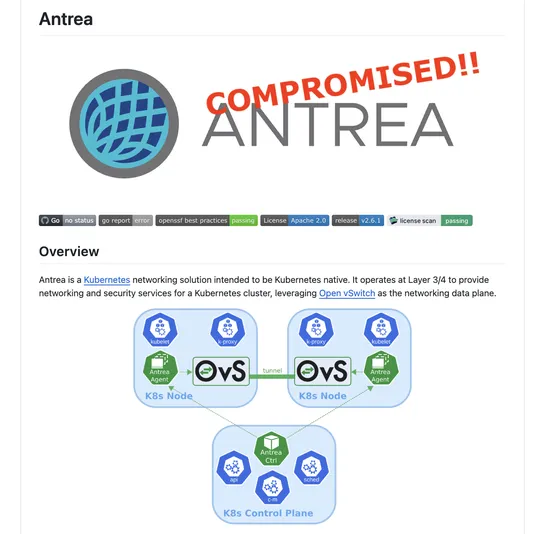
CNCF Project Antrea Compromised in Daring GitHub Attack

A throwaway GitHub account compromised CNCF projectAntrea's Jenkins infrastructure on May 2 by opening a malicious PR and firing/test-*slash-commands that detonated the workflow against PR-fork code with credentials in scope. The same operator ran parallel campaigns against at least seven other proj.. read more  

CNCF Project Antrea Compromised in Daring GitHub Attack
Link
@kaptain shared a link, 1 month ago
FAUN.dev()

v1.36: Moving Volume Group Snapshots to GA

Volume group snapshots reachedGAin Kubernetesv1.36, with the API promoted togroupsnapshot.storage.k8s.io/v1. The feature lets aVolumeGroupSnapshotobject take crash-consistent snapshots across multiple PVCs selected by label, removing the need to quiesce applications that span separate data and log v.. read more  

Link
@kaptain shared a link, 1 month ago
FAUN.dev()

How Cloud Native Infrastructure Powers AI on Kubernetes

A vendor piece from Mirantis arguing that GPU multi-tenancy on Kubernetes is widely misrepresented, with most platforms shipping namespace-based isolation while production GPU clouds require hardware-enforced separation through MIG partitioning, cluster-per-tenant architecture, and DPU-based network.. read more  

How Cloud Native Infrastructure Powers AI on Kubernetes
Link
@kaptain shared a link, 1 month ago
FAUN.dev()

v1.36: Declarative Validation Graduates to GA

Declarative validation graduated toGAin Kubernetesv1.36, replacing handwritten Go validation with+k8s:marker tags on field definitions... read more  

Link
@kaptain shared a link, 1 month ago
FAUN.dev()

v1.36: Server-Side Sharded List and Watch

Alpha inv1.36, server-side sharded list and watch adds ashardSelectorfield toListOptionsso the API server uses an FNV-1a hash onmetadata.uidormetadata.namespaceto send each controller replica only its slice of the resource collection. This eliminates the cost of every replica deserializing the full .. read more  

Link
@kala shared a link, 1 month ago
FAUN.dev()

Orchestrating AI Code Review at scale

Cloudflare engineers built an AI code review platform on OpenCode. They split GitLab integration, model providers, prompts, and policy into separate plugins. A coordinator assigns up to seven domain reviewers across security, performance, code quality, documentation, release checks, and AGENTS.md co.. read more  

Orchestrating AI Code Review at scale
Link
@kala shared a link, 1 month ago
FAUN.dev()

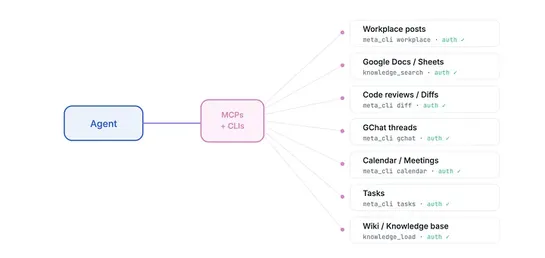
How We Built an AI Second Brain for 60K Knowledge Workers

Meta built an AI agent system internally called the AI Second Brain that now has over 63,000 installs and ~10,000 daily active users across engineering, PM, design, legal, finance, comms, and sales, growing from zero in roughly three months after a non-technical PM's adoption post. The architecture .. read more  

How We Built an AI Second Brain for 60K Knowledge Workers
Link
@kala shared a link, 1 month ago
FAUN.dev()

Democratizing Machine Learning at Netflix: Building the Model Lifecycle Graph

Netflix's Saish Sali, Nipun Kumar, and Sura Elamurugu describe the Metadata Service (MDS), a graph layer built to connect siloed ML tooling (model registry, pipeline orchestrator, experimentation platform, feature store, dataset platform, identity) across personalization, studio, payments, and ads. .. read more  

Link
@kala shared a link, 1 month ago
FAUN.dev()

The AWS MCP Server is now generally available

AWS now offers AWS MCP Server as a managed remote MCP server in US East (N. Virginia) and Europe (Frankfurt). MCP-compatible clients can use existing IAM credentials to access more than 15,000 AWS API operations. For GA, AWS added IAM context keys, documentation retrieval without authentication, low.. read more  

The AWS MCP Server is now generally available
Xygeni is an AI-powered Application Security (AppSec) and Software Supply Chain Security platform designed for modern AI-first development environments. It helps organizations secure the entire software development lifecycle (SDLC) (from code and dependencies to CI/CD pipelines, cloud infrastructure, and runtime applications) through a unified, developer-friendly platform.

Built to address the growing complexity of AI-assisted development, Xygeni combines SAST, SCA, DAST, IaC Security, Secrets Detection, CI/CD Security, Malware Defense, Build Security, and ASPM into a single platform with real-time visibility and risk-based prioritization.

Xygeni goes beyond traditional AppSec tooling by focusing on exploitability, remediation risk, and automation. Its AI-powered capabilities help teams detect vulnerabilities, malicious packages, secrets leakage, and supply chain attacks while automatically recommending or applying secure fixes directly inside IDEs, pull requests, and AI-assisted workflows.

The platform also provides advanced governance and visibility for modern AI-driven development practices, including copilots, agents, plugins, and autonomous workflows. Through Xygeni DevAI and CoreAI, security teams can enforce guardrails, automate remediation, analyze business impact, and reduce operational overhead without slowing developer productivity.

With integrated malware detection, runtime-aware prioritization, SBOM generation, artifact attestation, anomaly detection, and CI/CD protection, Xygeni enables organizations to proactively secure software delivery from code to cloud while maintaining compliance with evolving security frameworks and software supply chain standards.