Join us

ContentUpdates and recent posts about Argo CD..
Link
@kaptain shared a link, 1 month, 2 weeks ago
FAUN.dev()

When Kubernetes restarts your pod - And when it doesn’t

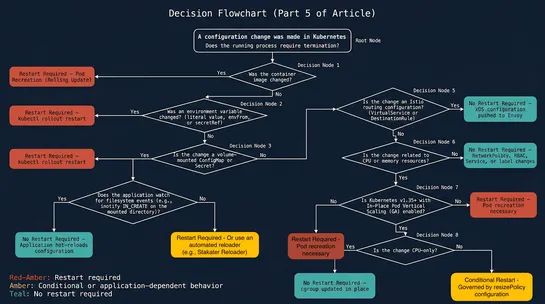
Production internals guide verified against Kubernetes 1.35 GA. Engineers need to understand terminology differences to avoid flawed runbooks and bad on-call decisions. Kubelet watches the pod spec, not other resources like ConfigMaps or Secrets, to explain the majority of config update investigatio.. read more  
When Kubernetes restarts your pod - And when it doesn’t
Link
@kaptain shared a link, 1 month, 2 weeks ago
FAUN.dev()

How GitHub uses eBPF to improve deployment safety

GitHub hosts its own source code on github.com, creating a circular dependency. To mitigate this, GitHub maintains mirrors of its code and built assets. By using eBPF, GitHub can selectively monitor and block calls that create circular dependencies in their deployment system... read more  

How GitHub uses eBPF to improve deployment safety
Link
@kala shared a link, 1 month, 2 weeks ago
FAUN.dev()

Scaling MCP adoption: Our reference architecture for simpler, safer and cheaper enterprise deployments of MCP

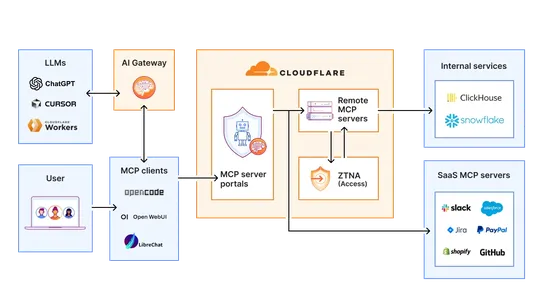
Cloudflare centralized MCP servers in a monorepo. It added governed templates, Cloudflare Access auth, audit logs, and DLP behind an MCP server portal. It launched Code Mode to collapse many tool schemas into two portal tools. Token use fell ~94%. Cloudflare Gateway now finds shadow MCP servers... read more  

Scaling MCP adoption: Our reference architecture for simpler, safer and cheaper enterprise deployments of MCP
Link
@kala shared a link, 1 month, 2 weeks ago
FAUN.dev()

Critical Claude Code vulnerability: Deny rules silently bypassed because security checks cost too many tokens

Clause Code security bypass: Anthropic's performance fix silently disabled deny rules for 500K+ developers when more than 50 subcommands were used in a command, impacting permission validation and security policy enforcement. The vulnerability stemmed from a tradeoff between security and performance.. read more  

Link
@kala shared a link, 1 month, 2 weeks ago
FAUN.dev()

China has ‘nearly erased’ America’s lead in AI

Stanford HAI's 2026 AI Index shows China cut the U.S. lead inArenascores. In March 2026,Claude Opus 4.6ledDola‑Seed 2.0by 2.7%. A 2.7% margin is a photo finish. China outpaces the U.S. inpublicationcitations (20.6% vs 12.6% in 2024) and inindustrial robots(~295,000 vs 34,200). It also holds surplusc.. read more  

China has ‘nearly erased’ America’s lead in AI
Link
@kala shared a link, 1 month, 2 weeks ago
FAUN.dev()

I Measured Claude 4.7's New Tokenizer. Here's What It Costs You.

Anthropic's Claude Opus 4.7 migration guide states the new tokenizer utilizes "roughly 1.0 to 1.35x as many tokens" compared to 4.6. Actual measurements show a higher ratio on technical docs and real CLAUDE.md files. The cost of the new tokenizer was measured using real content and synthetic samples.. read more  

I Measured Claude 4.7's New Tokenizer. Here's What It Costs You.
Link
@kala shared a link, 1 month, 2 weeks ago
FAUN.dev()

Anthropic releases Claude Opus 4.7, narrowly retaking lead for most powerful generally available LLM

Anthropic has unveiled Claude Opus 4.7, a powerful large language model that outperforms key rivals like GPT-5.4 and Google's Gemini 3.1 Pro in benchmarks such as agentic coding and financial analysis. Opus 4.7 leads the market on the GDPVal-AA knowledge work evaluation with an Elo score of 1753 and.. read more  

Link
@devopslinks shared a link, 1 month, 2 weeks ago
FAUN.dev()

Shell Tricks That Actually Make Life Easier (And Save Your Sanity)

This post provides a collection of lesser-known terminal tricks that can improve productivity and efficiency when working in various POSIX shells. The tricks cover a range of functions, from efficient text manipulation to file operations and script writing. By incorporating these tips into daily wor.. read more  

Shell Tricks That Actually Make Life Easier (And Save Your Sanity)
Link
@devopslinks shared a link, 1 month, 2 weeks ago
FAUN.dev()

Figma's next-generation data caching platform

Figma rearchitected their storage systems to support scalability, including horizontally sharding their Postgres stack and building FigCache, a stateless proxy service for Redis. FigCache decouples connection scalability from Redis, centralizes traffic routing, enhances security, and provides end-to.. read more  

Figma's next-generation data caching platform
Link
@devopslinks shared a link, 1 month, 2 weeks ago
FAUN.dev()

Reducing our monorepo size to improve developer velocity

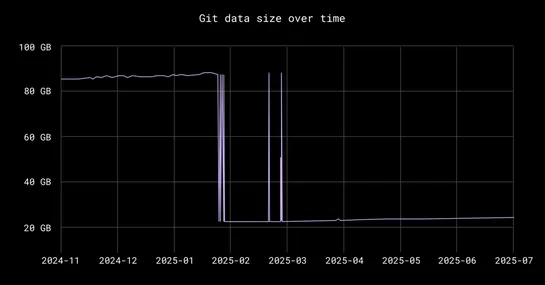
Dropbox cut itsmonorepofrom 87GB to 20GB. It ran a GitHub‑approved server‑sidegit repack, tuned bywindow/depth. Clone times dropped to under 15 minutes. Engineers traced growth to Git’s 16‑char path heuristic. That heuristic mispairedi18nfiles. They tested--path-walklocally, then ran phased replica .. read more  

Reducing our monorepo size to improve developer velocity
At its core, Argo CD treats Git as the single source of truth for application definitions. You declare the desired state of your Kubernetes applications in Git (manifests, Helm charts, Kustomize overlays), and Argo CD continuously compares that desired state with what is actually running in the cluster. When drift is detected, it can alert you or automatically reconcile the cluster back to the Git-defined state.

Argo CD runs inside Kubernetes and provides:

- Declarative application management
- Automated or manual sync from Git to cluster
- Continuous drift detection and health assessment
- Rollbacks by reverting Git commits
- Fine-grained RBAC and multi-cluster support

It integrates natively with common Kubernetes configuration formats:

- Plain YAML
- Helm
- Kustomize
- Jsonnet

Operationally, Argo CD exposes both a web UI and CLI, making it easy to visualize application state, deployment history, diffs, and sync status. It is commonly used in platform engineering and SRE teams to standardize deployments, reduce configuration drift, and enforce auditability.

Argo CD is part of the Argo Project, which is hosted by the Cloud Native Computing Foundation (CNCF), and is widely adopted in production Kubernetes environments ranging from startups to large enterprises.