Join us

ContentUpdates and recent posts about GPT-5.4..
Link
@varbear shared a link, 1 week ago
FAUN.dev()

Python 3.3: The Version That Quietly Rewired Everything

Python 3.3 introduced three key features that have had a lasting impact on Python development. Firstly, yield from simplified the composition of generators by allowing easy delegation between them. Secondly, venv standardized virtual environments in Python, improving isolation and reproducibility of.. read more  
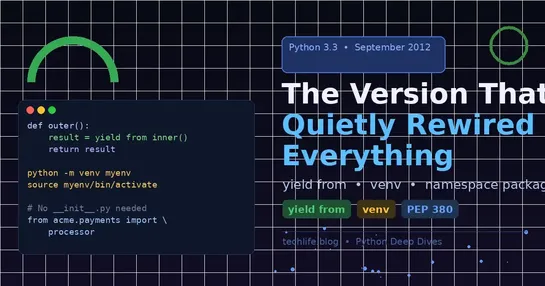
Python 3.3: The Version That Quietly Rewired Everything
Link
@varbear shared a link, 1 week ago
FAUN.dev()

Email address obfuscation: What works in 2026?

The article catalogs obfuscation methods:HTML entities,SVG in an object,display:none, JavaScript decoders, custom encodings, andAES‑256. It coversmailtoobfuscation, redirects (302/301,.htaccess), interaction-gated reveals, accessibility caveats, and ahoneypot-based spam-statistics system... read more  

Link
@kaptain shared a link, 1 week ago
FAUN.dev()

Duolingo's Kubernetes Leap

Duolingo made a bold leap migrating 500+ services to Kubernetes, embracing Argo CD for blue-green deployments and leveraging GitOps for flexibility and control. This shift to a cellular architecture enabled them to isolate environments and manage developer trust while navigating AWS rate limits. Exc.. read more  

Link
@kaptain shared a link, 1 week ago
FAUN.dev()

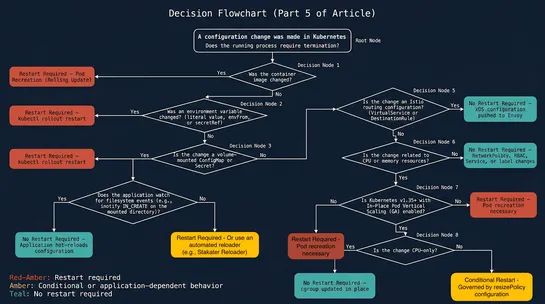
When Kubernetes restarts your pod - And when it doesn’t

Production internals guide verified against Kubernetes 1.35 GA. Engineers need to understand terminology differences to avoid flawed runbooks and bad on-call decisions. Kubelet watches the pod spec, not other resources like ConfigMaps or Secrets, to explain the majority of config update investigatio.. read more  

When Kubernetes restarts your pod - And when it doesn’t
Link
@kaptain shared a link, 1 week ago
FAUN.dev()

How GitHub uses eBPF to improve deployment safety

GitHub hosts its own source code on github.com, creating a circular dependency. To mitigate this, GitHub maintains mirrors of its code and built assets. By using eBPF, GitHub can selectively monitor and block calls that create circular dependencies in their deployment system... read more  

How GitHub uses eBPF to improve deployment safety
Link
@kaptain shared a link, 1 week ago
FAUN.dev()

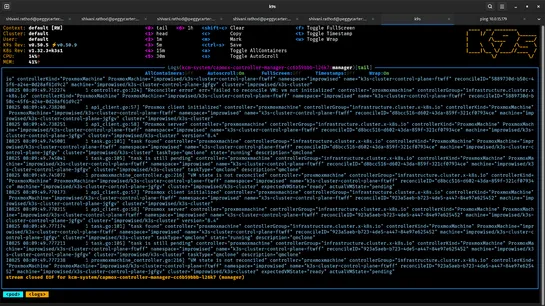
K3s on On-Prem Infrastructures the GitOps Way: Writing a Custom k0rdent Template from Scratch

Kubernetes, now 12 years old, has evolved into the universal operating system for modern infrastructure, running on various platforms like Proxmox. Using k0rdent, Proxmox, and K3s, users can provision and manage Kubernetes clusters on-premise in a declarative, repeatable, and clean manner. This appr.. read more  

K3s on On-Prem Infrastructures the GitOps Way: Writing a Custom k0rdent Template from Scratch
Link
@kaptain shared a link, 1 week ago
FAUN.dev()

Kubernetes Monitoring Helm chart v4: Biggest update ever!

The Kubernetes Monitoring Helm chart version 4.0 is designed to solve real pain points that users have hit as their monitoring setups have grown. Destinations are now defined as a map instead of a list, making it easier to manage configurations for multiple clusters. Collectors are defined by the us.. read more  

Kubernetes Monitoring Helm chart v4: Biggest update ever!
Link
@kala shared a link, 1 week ago
FAUN.dev()

I Measured Claude 4.7's New Tokenizer. Here's What It Costs You.

Anthropic's Claude Opus 4.7 migration guide states the new tokenizer utilizes "roughly 1.0 to 1.35x as many tokens" compared to 4.6. Actual measurements show a higher ratio on technical docs and real CLAUDE.md files. The cost of the new tokenizer was measured using real content and synthetic samples.. read more  

I Measured Claude 4.7's New Tokenizer. Here's What It Costs You.
Link
@kala shared a link, 1 week ago
FAUN.dev()

Anthropic releases Claude Opus 4.7, narrowly retaking lead for most powerful generally available LLM

Anthropic has unveiled Claude Opus 4.7, a powerful large language model that outperforms key rivals like GPT-5.4 and Google's Gemini 3.1 Pro in benchmarks such as agentic coding and financial analysis. Opus 4.7 leads the market on the GDPVal-AA knowledge work evaluation with an Elo score of 1753 and.. read more  

Link
@kala shared a link, 1 week ago
FAUN.dev()

China has ‘nearly erased’ America’s lead in AI

Stanford HAI's 2026 AI Index shows China cut the U.S. lead inArenascores. In March 2026,Claude Opus 4.6ledDola‑Seed 2.0by 2.7%. A 2.7% margin is a photo finish. China outpaces the U.S. inpublicationcitations (20.6% vs 12.6% in 2024) and inindustrial robots(~295,000 vs 34,200). It also holds surplusc.. read more  

China has ‘nearly erased’ America’s lead in AI
GPT-5.4 is OpenAI’s latest frontier AI model designed to perform complex professional and technical work more reliably. It combines advances in reasoning, coding, tool use, and long-context understanding into a single system capable of handling multi-step workflows across software environments. The model builds on earlier GPT-5 releases while integrating the strong coding capabilities previously introduced with GPT-5.3-Codex.

One of the defining features of GPT-5.4 is its ability to operate as part of agent-style workflows. The model can interact with tools, APIs, and external systems to complete tasks that extend beyond simple text generation. It also introduces native computer-use capabilities, allowing AI agents to operate applications using keyboard and mouse commands, screenshots, and browser automation frameworks such as Playwright.

GPT-5.4 supports context windows of up to one million tokens, enabling it to process and reason over very large documents, long conversations, or complex project contexts. This makes it suitable for tasks such as analyzing codebases, generating technical documentation, working with large spreadsheets, or coordinating long-running workflows. The model also introduces a feature called tool search, which allows it to dynamically retrieve tool definitions only when needed. This reduces token usage and makes it more efficient to work with large ecosystems of tools, including environments with dozens of APIs or MCP servers.

In addition to improved reasoning and automation capabilities, GPT-5.4 focuses on real-world productivity tasks. It performs better at generating and editing spreadsheets, presentations, and documents, and it is designed to maintain stronger context across longer reasoning processes. The model also improves factual accuracy and reduces hallucinations compared with previous versions.

GPT-5.4 is available across OpenAI’s ecosystem, including ChatGPT, the OpenAI API, and Codex. A higher-performance variant, GPT-5.4 Pro, is also available for users and developers who require maximum performance for complex tasks such as advanced research, large-scale automation, and demanding engineering workflows. Together, these capabilities position GPT-5.4 as a model aimed not just at conversation, but at executing real work across software systems.