Join us

ContentUpdates and recent posts about Sigstore..
Link
@varbear shared a link, 1 month, 1 week ago
FAUN.dev()

Adventures in 30 Years in Engineering Productivity

Carlos Arguelles collects a decade of writing on engineering productivity at Microsoft, Amazon, and Google, covering monorepo versus microrepo CI/CD philosophies, hermetic test environments, ML-based bug deduplication, code coverage debates, and the AI-driven shift toward autonomous validation of ge.. read more  
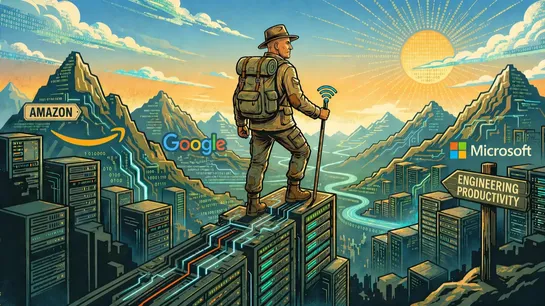
Adventures in 30 Years in Engineering Productivity
Link
@varbear shared a link, 1 month, 1 week ago
FAUN.dev()

I Deleted My Clever Code and the Database Got Better

A first-person walkthrough of rewriting an embedded key-value store after a friend spotted that the lock-free ring buffer was writing to a slot before claiming ownership, with the rebuilt single-mutex version 76 lines smaller, more correct, and explicit about every tradeoff (fsync on every write, no.. read more  

Link
@varbear shared a link, 1 month, 1 week ago
FAUN.dev()

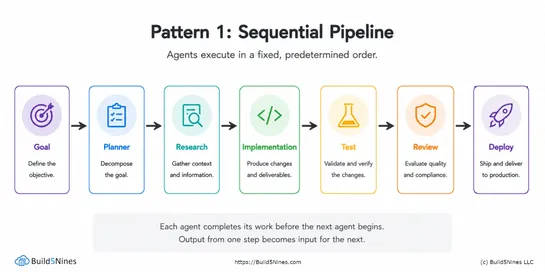
6 Multi-Agent Orchestration Design Patterns Every Developer Should Know

Chris Pietschmann walks through six multi-agent orchestration patterns (sequential pipeline, fan-out/fan-in, hierarchical delegation, consensus, event-driven, iterative refinement) and the state management primitives that let them compose... read more  

6 Multi-Agent Orchestration Design Patterns Every Developer Should Know
Link
@varbear shared a link, 1 month, 1 week ago
FAUN.dev()

Slop Creep: The Great Enshittification of Software

The argument is that coding agents accelerate codebase decay by removing the natural speed limit on bad architectural decisions, compressing months of compounding mistakes into days. The defense is to invest ten times more in the planning phase, with concrete code snippets for the data models and ab.. read more  

Link
@kaptain shared a link, 1 month, 1 week ago
FAUN.dev()

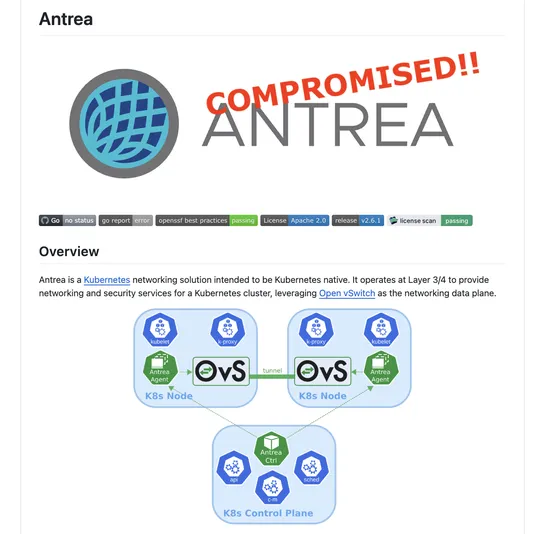
CNCF Project Antrea Compromised in Daring GitHub Attack

A throwaway GitHub account compromised CNCF projectAntrea's Jenkins infrastructure on May 2 by opening a malicious PR and firing/test-*slash-commands that detonated the workflow against PR-fork code with credentials in scope. The same operator ran parallel campaigns against at least seven other proj.. read more  

CNCF Project Antrea Compromised in Daring GitHub Attack
Link
@kaptain shared a link, 1 month, 1 week ago
FAUN.dev()

How Cloud Native Infrastructure Powers AI on Kubernetes

A vendor piece from Mirantis arguing that GPU multi-tenancy on Kubernetes is widely misrepresented, with most platforms shipping namespace-based isolation while production GPU clouds require hardware-enforced separation through MIG partitioning, cluster-per-tenant architecture, and DPU-based network.. read more  

How Cloud Native Infrastructure Powers AI on Kubernetes
Link
@kaptain shared a link, 1 month, 1 week ago
FAUN.dev()

v1.36: Moving Volume Group Snapshots to GA

Volume group snapshots reachedGAin Kubernetesv1.36, with the API promoted togroupsnapshot.storage.k8s.io/v1. The feature lets aVolumeGroupSnapshotobject take crash-consistent snapshots across multiple PVCs selected by label, removing the need to quiesce applications that span separate data and log v.. read more  

Link
@kaptain shared a link, 1 month, 1 week ago
FAUN.dev()

v1.36: Declarative Validation Graduates to GA

Declarative validation graduated toGAin Kubernetesv1.36, replacing handwritten Go validation with+k8s:marker tags on field definitions... read more  

Link
@kaptain shared a link, 1 month, 1 week ago
FAUN.dev()

v1.36: Server-Side Sharded List and Watch

Alpha inv1.36, server-side sharded list and watch adds ashardSelectorfield toListOptionsso the API server uses an FNV-1a hash onmetadata.uidormetadata.namespaceto send each controller replica only its slice of the resource collection. This eliminates the cost of every replica deserializing the full .. read more  

Link
@kala shared a link, 1 month, 1 week ago
FAUN.dev()

Orchestrating AI Code Review at scale

Cloudflare engineers built an AI code review platform on OpenCode. They split GitLab integration, model providers, prompts, and policy into separate plugins. A coordinator assigns up to seven domain reviewers across security, performance, code quality, documentation, release checks, and AGENTS.md co.. read more  

Orchestrating AI Code Review at scale
Sigstore is an open source initiative designed to make software artifact signing and verification simple, automatic, and widely accessible. Its primary goal is to improve software supply chain security by enabling developers and organizations to cryptographically prove the origin and integrity of the software they build and distribute.

At its core, sigstore removes many of the traditional barriers associated with code signing. Instead of managing long-lived private keys manually, sigstore supports keyless signing, where identities are issued dynamically using OpenID Connect (OIDC) providers such as GitHub Actions, Google, or Microsoft. This dramatically lowers operational complexity and reduces the risk of key compromise.

The sigstore ecosystem is composed of several key components:

- Cosign: A tool for signing, verifying, and storing signatures for container images and other artifacts. Signatures are stored alongside artifacts in OCI registries, rather than embedded in them.

- Fulcio: A certificate authority that issues short-lived X.509 certificates based on OIDC identities, enabling keyless signing.

- Rekor: A transparency log that records signing events in an append-only, tamper-evident ledger. This provides public auditability and detection of suspicious or malicious signing activity.

Together, these components allow anyone to verify who built an artifact, when it was built, and whether it has been tampered with, using publicly verifiable cryptographic proofs. This aligns closely with modern supply chain security practices such as SLSA (Supply-chain Levels for Software Artifacts).

sigstore is widely adopted in the cloud-native ecosystem and integrates with tools like Kubernetes, container registries, CI/CD pipelines, and package managers. It is commonly used to sign container images, Helm charts, binaries, and SBOMs, and is increasingly becoming a baseline security requirement for production software delivery.

The project is governed by the OpenSSF (Open Source Security Foundation) and supported by major industry players.