TL;DR
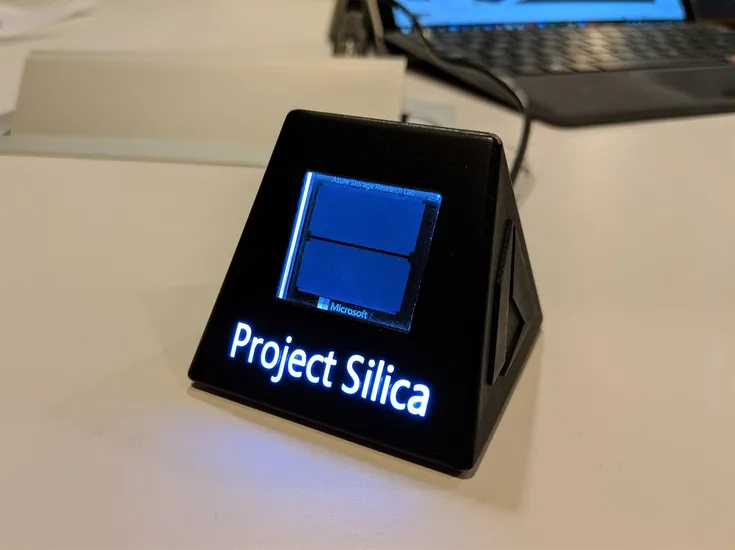
Microsoft's Project Silica encodes data in borosilicate glass using femtosecond lasers, offering long-term storage for up to 10,000 years. This method overcomes traditional storage limitations and is cost-effective, though write speed remains a challenge. The research phase is complete, but no product release has been announced.
Key Points
Highlight key points with color coding based on sentiment (positive, neutral, negative).Microsoft published the Project Silica breakthrough in Nature on February 18, 2026 - one of the most prestigious scientific journals in the world.
The technology now works with ordinary borosilicate glass - the same material in your kitchen cookware - removing the two biggest commercialization blockers: cost and supply.
Phase voxels require only a single femtosecond laser pulse per voxel, making the hardware simpler, cheaper, and easier to manufacture than the original birefringent method.
A 2mm-thin borosilicate plate stores 2.02 TB across 258 layers, with a density of 0.678 Gbit/mm³ and write throughput of 65.9 Mbit/s using four parallel beams.
Accelerated aging tests confirm data integrity for at least 10,000 years at room temperature - no climate control, no power, no ongoing cost.
Write speed remains the critical bottleneck - filling a 2 TB plate takes roughly 70 hours, compared to LTO-10 tape at 400 MB/s uncompressed.
Microsoft has not chosen between birefringent and phase voxels for a future commercial product - the core architectural decision remains open.
The research phase is now complete. Microsoft announced no product, no price, and no shipping timeline.
The only remaining technical challenge is the femtosecond laser itself - not the glass, not the encoding method, per Project Silica's director Richard Black.
Potential applications include AI training datasets, medical records, scientific archives, and cultural heritage preservation - all write-once, read-rarely workloads.
The Problem With How We Store Everything
Every byte of human knowledge stored today is on borrowed time. According to Microsoft Research, magnetic tapes and hard drives degrade within decades - making them far from ideal for preserving information for future generations. And as Semafor notes, with the rise of AI and the explosion of data it depends on, current methods are simply unsustainable.
Microsoft's answer is glass. Not exotic glass - the same borosilicate material in your kitchen cookware and oven door.
What Just Happened
On February 18, 2026, Microsoft Research published a breakthrough paper in Nature on Project Silica, its decade-long effort to encode data in glass using femtosecond lasers. The headline advance, per Microsoft Research's blog: the technology now works with ordinary borosilicate glass - not just expensive, hard-to-source fused silica - directly addressing the two biggest barriers to commercialization: cost and availability of storage media.
According to Windows Central, the project was founded in 2019. This is its first major public update in half a decade, and it lands in Nature - the most prestigious scientific journal in the world.
How It Works
The system encodes data as microscopic 3D structures called voxels - think pixels, but buried inside a solid piece of glass using a femtosecond laser. This generation introduces two distinct methods:
Birefringent voxels - the original method - work by changing how glass interacts with polarized light. They deliver higher storage density but require expensive, high-purity fused silica.
Phase voxels - the new invention - are the real breakthrough. According to Tom's Hardware, phase voxels modify the local refractive index of the glass, creating phase shifts in transmitted light. Critically, each phase voxel requires only a single femtosecond laser pulse - simpler, faster, and compatible with borosilicate glass.
As Gizmodo explains, the remaining technical challenges now lie mostly with the femtosecond lasers themselves - not the glass, not the encoding method. According to Richard Black, Project Silica's director at Microsoft Research Cambridge: "One of the things that we've done with our research is effectively we have removed all of the scientific challenges - now, it's only about the laser."
The Numbers
According to Tom's Hardware, the borosilicate system achieves:
- 2.02 TB per 120mm × 120mm × 2mm glass plate, across 258 layers
- 0.678 Gbit/mm³ storage density
- 18.4 Mbit/s write throughput per beam
- 65.9 Mbit/s with four parallel beams, without inducing thermal damage
- Writing with 16 or more beams is projected to reach 263.6 Mbit/s
The fused silica method, by comparison, stores 4.84 TB per plate at higher density - but requires glass available from only a few specialized manufacturers worldwide.
Reading hardware has also been simplified. Per Microsoft Research, the reader now requires only one camera, not three or four - reducing both cost and physical footprint.
Why Glass Lasts
According to Gizmodo, Peter Kazansky, an optical physicist at the University of Southampton who was not involved in the research, framed the stakes plainly: "Our current records are kept on fragile magnetic platters that are constantly decaying; this research ensures our digital heritage becomes permanent."
Glass is resistant to water, heat, dust, and magnetic interference. Microsoft validated longevity using accelerated aging tests - simulating millennia of decay at elevated temperatures. Per Blocks & Files, the researchers concluded: "We demonstrate that Silica is a viable storage system by fully recovering user data using FEC, and show through accelerated aging experiments that our modifications last more than 10,000 years at room temperature."
Richard Black puts the economics simply, via Gizmodo: "You can write the data into the glass, and then once it's done, then it's done - there's no ongoing cost."
What It's Good For - and What It Isn't
According to New Atlas, the potential applications include medical, industrial, and scientific data, archiving the web, AI training datasets, and media libraries from publishers of film, music, and literature.
But write speed remains the critical constraint. As Blocks & Files points out, even at 65.9 Mbit/s with four beams, filling a 2 TB borosilicate plate would take roughly 70 hours. For context, LTO-10 tape writes at 400 MB/s uncompressed - nearly 50× faster. Project Silica is strictly a write-once, read-rarely medium. It is not a replacement for tape in active archival workflows - not yet.
Microsoft has also not made a choice on which voxel type to productize. Per Blocks & Files, the researchers stated explicitly: "A key system choice for a future Silica system is whether to use birefringent or phase voxels." They make no recommendation - leaving the core architectural decision open.
The Bottom Line
According to Microsoft Research, the research phase is now complete. The blog post announcing the Nature paper says so directly - without announcing a product, a price, or a shipping timeline.
What Project Silica has delivered is a proof of concept that is now scientifically credible and materially practical. The move to borosilicate glass removes the supply-chain and cost barriers that blocked the previous generation. Phase voxels simplify the hardware stack to the point where, per Gizmodo, Kazansky called it a "pragmatic engineering choice" with "a clear path toward industrial throughput."
Whether that path leads to a datacenter near you - or stays a research milestone - is a question Microsoft has not yet answered.
Key Numbers
Present key numerics and statistics in a minimalist format.Potential lifespan of data stored in glass.
Storage capacity per borosilicate glass plate (phase voxels).
Storage capacity per fused silica glass plate (birefringent voxels).
Glass plate thickness.
Number of storage layers in a borosilicate plate.
Number of storage layers in a fused silica plate.
Storage density (phase voxels, borosilicate).
Storage density (birefringent voxels, fused silica).
Write throughput per single beam.
Write throughput with four parallel beams.
Projected write throughput with 16 beams.
Estimated time to fill a 2 TB borosilicate plate at current speed.
LTO-10 tape write speed (uncompressed) for comparison.
Number of cameras required by the new reader (down from 3-4).
Year Project Silica was founded.
Nature publication date.
Stakeholder Relationships
An interactive diagram mapping entities directly or indirectly involved in this news. Drag nodes to rearrange them and see relationship details.People
Key entities and stakeholders, categorized for clarity: people, organizations, tools, events, regulatory bodies, and industries.Leads Project Silica at Microsoft Research Cambridge. Stated that all scientific challenges have been solved and the only remaining obstacle is the femtosecond laser itself.
External expert not involved in the research. Called the phase voxel approach a 'pragmatic engineering choice' with a 'clear path toward industrial throughput', and warned that current magnetic storage leaves our digital heritage at risk.
Organizations
Key entities and stakeholders, categorized for clarity: people, organizations, tools, events, regulatory bodies, and industries.Microsoft's research division behind Project Silica, based in Cambridge, UK. Published the Nature paper on February 18, 2026.
Home institution of Peter Kazansky, who provided independent expert commentary on the Project Silica breakthrough.
Partnered with Microsoft to preserve music in glass under Arctic ice for 10,000 years - one of Project Silica's real-world proof-of-concept deployments.
Partnered with Microsoft to store the Superman movie on quartz glass - an early Project Silica proof of concept.
Tools
Key entities and stakeholders, categorized for clarity: people, organizations, tools, events, regulatory bodies, and industries.Fires pulses lasting one quadrillionth of a second to modify the internal structure of glass without cracking or melting it. The only remaining technical bottleneck in the system.
Ordinary glass found in kitchen cookware and oven doors. Now validated as a viable storage medium, replacing expensive fused silica and removing key commercialization barriers.
High-purity glass used in the first generation of Project Silica. Achieves higher density (1.59 Gbit/mm³, 4.84 TB per plate) but is expensive and available from only a few manufacturers.
New encoding method invented for Project Silica that modifies the refractive index of glass. Requires only a single laser pulse per voxel - simpler, faster, and compatible with borosilicate glass.
Original encoding method that changes how glass interacts with polarized light. Delivers higher storage density but requires fused silica and multiple laser pulses per voxel.
Low-density parity-check error correction used to recover data even when optical signal quality degrades during reading.
Machine learning model used to decode data read from phase voxels, mitigating the higher levels of inter-symbol interference that phase voxels introduce.
Current industry-standard archival tape, writing at 400 MB/s uncompressed - roughly 50x faster than Project Silica's current four-beam throughput of 65.9 Mbit/s.
Timeline of Events
Timeline of key events and milestones.Microsoft Research Cambridge initiates Project Silica to explore long-term data storage in glass using femtosecond lasers.
Warner Bros. partners with Microsoft to store the Superman movie on quartz glass - the first major real-world proof of concept for Project Silica.
Microsoft partners with the Global Music Vault to preserve music in glass under Arctic ice for 10,000 years.
Microsoft works with students on a crowdsourced archive of images, sounds, music, and spoken language encoded in glass to represent humanity's diversity for millennia.
Microsoft publishes a broad summary of Project Silica innovations - covering archival systems design, datacenter robotics, erasure coding, and ML-based decoding - in ACM Transactions on Storage.
Microsoft Research publishes the Project Silica breakthrough in Nature (DOI: 10.1038/s41586-025-10042-w), demonstrating borosilicate glass storage, phase voxels, parallel writing, and 10,000-year longevity validation.
Microsoft announces that the research phase of Project Silica is now complete, with no product, price, or commercial timeline announced.
No commercial product has been announced. The key architectural decision between birefringent and phase voxels for a future Silica system remains unresolved. Write speed and laser throughput are the only remaining technical blockers.
Additional Resources
Enjoyed it?
Get weekly updates delivered straight to your inbox, it only takes 3 seconds!Subscribe to our weekly newsletter DevOpsLinks to receive similar updates for free!
Give a Pawfive to this post!
Share with your friends and followers
Start writing about what excites you in tech — connect with developers, grow your voice, and get rewarded.
Join other developers and claim your FAUN.dev() account now!

FAUN.dev()
FAUN.dev() is a developer-first platform built with a simple goal: help engineers stay sharp withou…



DevOpsLinks #DevOps
FAUN.dev()
@devopslinksDeveloper Influence
18
Influence
1
Total Hits
138
Posts
Featured Course(s)


Cloud-Native Microservices With Kubernetes - 2nd Edition
A Comprehensive Guide to Building, Scaling, Deploying, Observing, and Managing Highly-Available Microservices in Kubernetes