TL;DR
Anthropic's new Economic Index report introduces five "economic primitives" to measure how Claude is used: task complexity, user and AI skill level, use case (work, coursework, personal), autonomy, and task success - built from privacy-preserving classification of anonymized Claude.ai and first-party API transcripts from November 2025.
Key Points
Highlight key points with color coding based on sentiment (positive, neutral, negative).Anthropic introduced new metrics called "economic primitives" to measure how AI is used, covering five dimensions such as task complexity, user and AI skill levels, autonomy, use case, and task success.
Claude generally succeeds on the tasks it is given, but success rates decline as task complexity increases, highlighting limits to reliable automation on longer or more difficult tasks.
AI usage shows strong geographic variation and remains highly concentrated in a small set of tasks, with coding-related work accounting for a large share of observed usage.
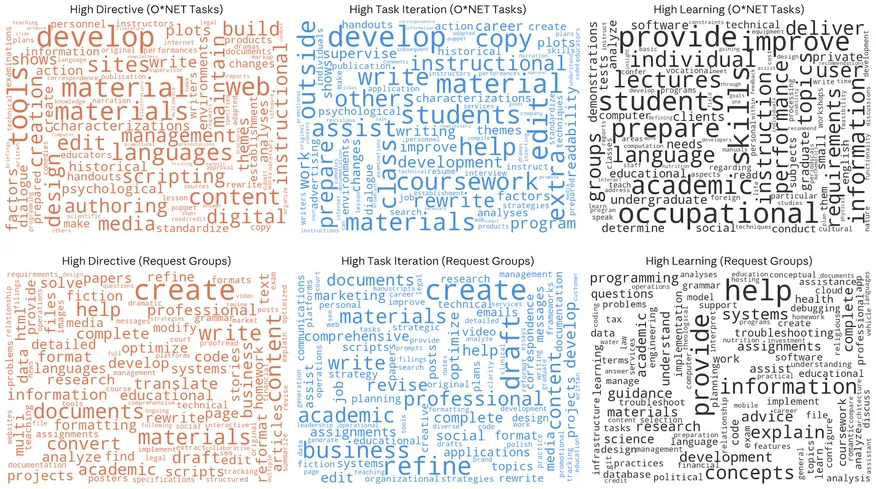
Claude interactions are classified into three primary collaboration modes: Directive (task delegation), Task Iteration (collaborative refinement), and Learning (explanation and instruction).
Recent usage patterns show a shift back toward augmented use of AI on Claude.ai, driven mainly by iterative collaboration rather than pure delegation or learning-focused interactions.
A recent report introduces "economic primitives" as a novel metric for assessing AI usage, with a particular focus on interactions with Claude in November 2025. These primitives evaluate AI's economic impact across five dimensions: task complexity, human and AI skills, use case, AI autonomy, and task success. The report highlights significant geographic variations in AI adoption, noting that coding tasks see the most concentrated usage, yet the global distribution remains uneven. Within the United States, there is a trend towards more balanced usage across states, with faster adoption rates in previously lagging areas.
As Claude's usage expands, it diversifies, especially in wealthier countries where personal use is more prevalent. In contrast, less developed countries primarily use Claude for educational purposes. The report observes that while Claude generally succeeds in most tasks, it struggles with more complex ones, particularly where human completion time increases. Additionally, Claude is used for higher-skill tasks compared to the broader economy, which could lead to skill-biased technical changes, potentially increasing demand for highly skilled workers while displacing those with lower skills.
The report also examines the relationship between AI usage and economic factors, finding that GDP per capita and human education levels are strong predictors of AI adoption, both globally and within the US. Yet, the connection between AI usage and other economic primitives, such as task complexity and AI autonomy, varies between countries and US states. Countries with higher per capita usage tend to use AI more collaboratively, with less decision-making autonomy given to Claude.
The report provides a detailed analysis of how AI is changing the economy, offering insights into the implications of AI adoption for productivity and labor market shifts. The introduction of economic primitives presents a new framework for understanding the diverse ways AI is used and its potential economic impacts.
Key Numbers
Present key numerics and statistics in a minimalist format.Share of Claude.ai conversations accounted for by the top 10 most common tasks (November 2025).
Share of first-party API traffic accounted for by the top 10 most common tasks.
Share of Claude.ai usage represented by the single most common task (modifying software to correct errors).
Share of Claude.ai conversations classified as Computer and Mathematical tasks (November 2025).
Share of first-party API traffic classified as Computer and Mathematical tasks.
Share of Claude.ai conversations classified as Educational Instruction and Library tasks.
Share of first-party API transcripts associated with Office and Administrative Support tasks.
Share of Claude.ai conversations classified as augmentation (collaborative use).
Share of Claude.ai conversations classified as automation (delegated task completion).
Share of first-party API interactions classified as automation.
Overall task success rate estimated for Claude.ai conversations.
Overall task success rate estimated for first-party API usage.
Estimated task success rate for personal life management requests.
Estimated task success rate for software development requests.
Average estimated human-only task duration for Claude.ai conversations.
Average estimated human-only task duration for first-party API usage.
Share of Claude.ai usage classified as work-related.
Share of Claude.ai usage classified as coursework-related.
Share of Claude.ai usage classified as personal use.
Share of total Claude usage accounted for by the top five US states.
Share of the US working-age population represented by the top five usage states.
Estimated time to parity in Claude usage per capita across US states if recent convergence trends persist.
Size of the anonymized Claude.ai conversation sample used for analysis.
Size of the anonymized first-party API transcript sample used for analysis.
Stakeholder Relationships
An interactive diagram mapping entities directly or indirectly involved in this news. Drag nodes to rearrange them and see relationship details.Organizations
Key entities and stakeholders, categorized for clarity: people, organizations, tools, events, regulatory bodies, and industries.Anthropic is responsible for developing the AI model Claude and producing the report on economic primitives for AI usage.
Tools
Key entities and stakeholders, categorized for clarity: people, organizations, tools, events, regulatory bodies, and industries.Claude is an AI model developed by Anthropic, used to assess AI usage through economic primitives.
The Anthropic AI Usage Index measures per-capita Claude usage relative to the working-age population of a country or US state..
Timeline of Events
Timeline of key events and milestones.The top 10 most common tasks accounted for 21% of sampled Claude.ai conversations.
Computer and Mathematical (mostly coding-related) tasks peaked at 40% of Claude.ai conversations.
The top 10 tasks accounted for 23% of Claude.ai conversations. For first-party (1P) API records, the top 10 tasks accounted for 28% of traffic.
Anthropic published the previous Economic Index report, providing the comparison baseline for August and November 2025 usage patterns.
Additional Resources
Enjoyed it?
Get weekly updates delivered straight to your inbox, it only takes 3 seconds!Subscribe to our weekly newsletter Kala to receive similar updates for free!
Give a Pawfive to this post!
Share with your friends and followers
Start writing about what excites you in tech — connect with developers, grow your voice, and get rewarded.
Join other developers and claim your FAUN.dev() account now!

FAUN.dev()
FAUN.dev() is a developer-first platform built with a simple goal: help engineers stay sharp withou…



Kala #GenAI
FAUN.dev()
@kalaDeveloper Influence
20
Influence
1
Total Hits
144
Posts