Join us

ContentUpdates and recent posts about Slurm..
News FAUN.dev() Team
@kala shared an update, 1 month, 3 weeks ago
FAUN.dev()

Anthropic Launches Petri: Open-Source Tool for AI Safety Audits

Anthropic introduces Petri, an open-source tool for automating AI safety audits, revealing risky behaviors in leading language models.

News FAUN.dev() Team
@devopslinks shared an update, 1 month, 3 weeks ago
FAUN.dev()

Qovery Secures $13M Series A to Boost DevOps Automation Platform

Kubernetes

Qovery raises $13M Series A to enhance its DevOps automation platform, addressing the DevOps engineer shortage and supporting regional expansion and AI-driven development.

Story
@laura_garcia shared a post, 1 month, 3 weeks ago
Software Developer, RELIANOID

Japan’s new Active Cyberdefence Law

Japan’s new Active Cyberdefence Law (ACD) is redefining how the nation tackles cyber threats — shifting from a defensive stance to a proactive cybersecurity strategy. Key measures include: ⚙️ Authority to neutralize hostile servers 🤝 Closer public–private collaboration 📢 Mandatory breach reporting A..

Japan's Active Cyberdefence Law
Story
@laura_garcia shared a post, 1 month, 3 weeks ago
Software Developer, RELIANOID

Asia Hits 50% IPv6 Capability — A Global Milestone

- Asia has reached a major internet milestone: 50% of its systems are now IPv6 capable, positioning the region as a global leader in IPv6 user adoption. - Why this matters: - India (78.1%) and China (810M users) are driving this growth. - Historical IPv4 scarcity in Asia helped fuel early IPv6 inves..

Blog Asia reaches 50 percent IPv6 capability
Story
@laura_garcia shared a post, 1 month, 3 weeks ago
Software Developer, RELIANOID

🚀 RELIANOID is heading to it-sa Expo&Congress 2025!

📍 Nuremberg, Germany | October 7–9, 2025 🔒 Europe’s largest IT security event with 900+ exhibitors, expert talks & global networking. We’ll be there to showcase how RELIANOID helps businesses stay ahead of evolving cyber threats. 👉 See you in Nuremberg! Send us a DM to make an appointment. #itSa2025..

itsa nuremberg
Link
@faun shared a link, 1 month, 3 weeks ago
FAUN.dev()

Organize your Slack channels by “How Often”, not “What” - Aggressively Paraphrasing Me

One dev rewired their Slack setup by **engagement frequency**—not subject. Channels got sorted into tiers like “Read Now” and “Read Hourly,” cutting through noise and saving brainpower. It riffs off the **Eisenhower Matrix**, letting priorities shift with projects, not burn people out... read more  

Link
@faun shared a link, 1 month, 3 weeks ago
FAUN.dev()

Privacy for subdomains: the solution

A two-container setup using **acme.sh** gets Let's Encrypt certs running on a Synology NAS—thanks, Docker. No built-in Certbot support? No problem. Cloudflare DNS API token handles auth. Scheduled tasks handle renewal... read more  

Privacy for subdomains: the solution
Link
@faun shared a link, 1 month, 3 weeks ago
FAUN.dev()

Users Only Care About 20% of Your Application

Modern apps burst with features most people never touch. Users stick to their favorite 20%. The rest? Frustration, bloat, ignored edge cases. Tools like **VS Code**, **Slack**, and **Notion** nail it by staying lean at the core and letting users stack what they need. Extensions, plug-ins, integrati.. read more  

Link
@faun shared a link, 1 month, 3 weeks ago
FAUN.dev()

Authentication Explained: When to Use Basic, Bearer, OAuth2, JWT & SSO

Modern apps don’t just check passwords—they rely on **API tokens**, **OAuth**, and **Single Sign-On (SSO)** to know who’s knocking before they open the door... read more  

Link
@faun shared a link, 1 month, 3 weeks ago
FAUN.dev()

Uncommon Uses of Common Python Standard Library Functions

A fresh guide gives old Python friends a second look—turns out, tools like **itertools.groupby**, **zip**, **bisect**, and **heapq** aren’t just standard; they’re slick solutions to real problems. Think run-length encoding, matrix transposes, or fast, sorted inserts without bringing in another depen.. read more  

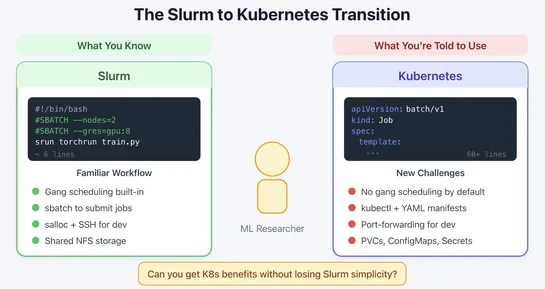
Slurm Workload Manager is an open-source, fault-tolerant, and highly scalable cluster management and scheduling system widely used in high-performance computing (HPC). Designed to operate without kernel modifications, Slurm coordinates thousands of compute nodes by allocating resources, launching and monitoring jobs, and managing contention through its flexible scheduling queue.

At its core, Slurm uses a centralized controller (slurmctld) to track cluster state and assign work, while lightweight daemons (slurmd) on each node execute tasks and communicate hierarchically for fault tolerance. Optional components like slurmdbd and slurmrestd extend Slurm with accounting and REST APIs. A rich set of commands—such as srun, squeue, scancel, and sinfo—gives users and administrators full visibility and control.

Slurm’s modular plugin architecture supports nearly every aspect of cluster operation, including authentication, MPI integration, container runtimes, resource limits, energy accounting, topology-aware scheduling, preemption, and GPU management via Generic Resources (GRES). Nodes are organized into partitions, enabling sophisticated policies for job size, priority, fairness, oversubscription, reservation, and resource exclusivity.

Widely adopted across academia, research labs, and enterprise HPC environments, Slurm serves as the backbone for many of the world’s top supercomputers, offering a battle-tested, flexible, and highly configurable framework for large-scale distributed computing.