TL;DR
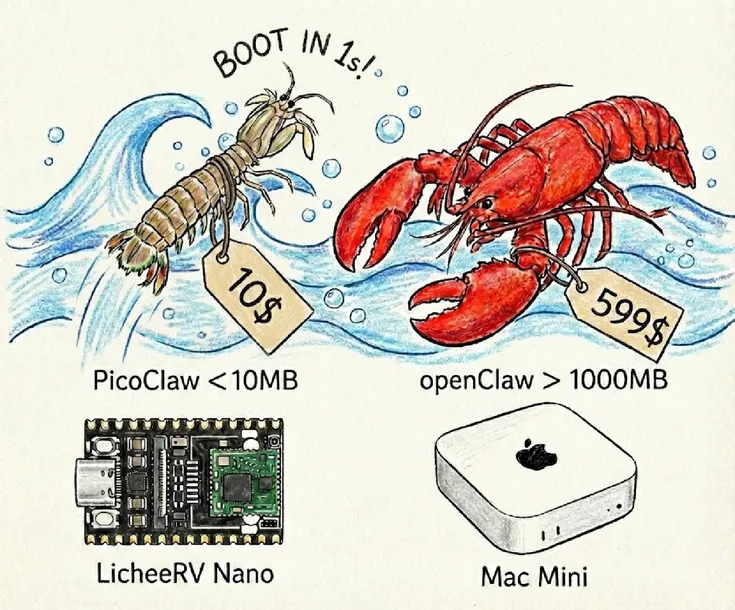
Sipeed has released PicoClaw. The project is an open-source AI assistant written in Go that runs in under 10MB of RAM and boots in about one second. It uses 99% less memory than OpenClaw and was designed for low-cost Linux boards starting around $10, it supports multiple LLM providers, chat platform integrations, and automation workflows.
Key Points
Highlight key points with color coding based on sentiment (positive, neutral, negative).PicoClaw is an AI assistant written in Go that is designed to run on devices costing around $10 and operates with under 10MB of RAM.
PicoClaw runs in a sandboxed environment by default, restricting file and command access to a configured workspace.
PicoClaw supports custom skills and periodic tasks through configuration files and scheduled job mechanisms.
The project reached 5,000 GitHub stars within four days of launch and accepts feature requests through GitHub Discussions.
PicoClaw runs on Linux devices across ARM, x86, and RISC-V architectures.
PicoClaw is a lightweight AI assistant written in Go. It is designed to run on low-cost hardware, including Linux boards priced around $10, with a memory footprint under 10MB. Compared to systems such as OpenClaw, which typically require gigabytes of RAM, PicoClaw reduces memory usage by up to 99%. It supports RISC-V, ARM, and x86 architectures and starts in approximately one second on a 0.6GHz single-core processor.
The project was built through a self-bootstrapping process in which the AI agent generated and refactored most of the codebase under human supervision. According to the maintainers, about 95% of the core system was agent-generated. The result is a single portable binary that runs across supported platforms without external runtime dependencies.
PicoClaw provides assistant capabilities such as task planning, logging, scheduled jobs, web search, automation workflows, and command execution. It supports chat integrations including Telegram and Discord, and can also run directly from the CLI. Configuration is handled through a local JSON file where users define the workspace, model provider, API keys, tool settings, and security boundaries. Supported LLM providers include OpenRouter, Zhipu, Anthropic, OpenAI, Gemini, and others via API keys.
By default, PicoClaw runs in a sandboxed mode. File access and command execution are restricted to a defined workspace directory. Dangerous system commands such as disk formatting, bulk deletion, and shutdown operations are blocked by built-in safety guards. Scheduled tasks are stored locally, and periodic automation is handled through a configurable heartbeat mechanism.
The project is released under the MIT license. The source code is available on GitHub.
Key Numbers
Present key numerics and statistics in a minimalist format.Minimum hardware cost required to run PicoClaw (e.g., entry-level Linux development boards).
Maximum memory footprint of PicoClaw during operation.
Startup time on a low-power single-core processor.
Processor frequency used to benchmark startup time.
Memory reduction compared to OpenClaw.
Estimated hardware cost reduction compared to running OpenClaw on a Mac mini.
Startup speed improvement compared to OpenClaw.
Portion of PicoClaw core system code generated by an AI agent.
Stakeholder Relationships
An interactive diagram mapping entities directly or indirectly involved in this news. Drag nodes to rearrange them and see relationship details.Organizations
Key entities and stakeholders, categorized for clarity: people, organizations, tools, events, regulatory bodies, and industries.Sipeed is the company behind the PicoClaw project.
Tools
Key entities and stakeholders, categorized for clarity: people, organizations, tools, events, regulatory bodies, and industries.PicoClaw is an AI assistant written in Go designed to run on low-cost Linux hardware with under 10MB RAM.
Go is the programming language used to implement PicoClaw.
Timeline of Events
Timeline of key events and milestones.PicoClaw was launched on GitHub.
PicoClaw reached 5000 stars in 4 days. The development team announced the finalization of the Project Roadmap and the setup of a Developer Group to accelerate development.
Additional Resources
Enjoyed it?
Get weekly updates delivered straight to your inbox, it only takes 3 seconds!Subscribe to our weekly newsletter Kala to receive similar updates for free!
Give a Pawfive to this post!
1 Pawfive for this post!

Share with your friends and followers
Start writing about what excites you in tech — connect with developers, grow your voice, and get rewarded.
Join other developers and claim your FAUN.dev() account now!

FAUN.dev()
FAUN.dev() is a developer-first platform built with a simple goal: help engineers stay sharp withou…



Kala #GenAI
FAUN.dev()
@kalaDeveloper Influence
21
Influence
1
Total Hits
149
Posts



Featured Course(s)

Painless Docker - 2nd Edition
A Comprehensive Guide to Mastering Docker and its Ecosystem