Join us

ContentUpdates and recent posts about GPT-5.4..
Link
@kaptain shared a link, 1 month ago
FAUN.dev()

Why Kubernetes is retiring Ingress NGINX

The Kubernetes Steering Committee is pulling the plug onIngress NGINX- official support ends March 2026. No more updates. No security patches. Gone. Why? It's been coasting on fumes. One or two part-time maintainers couldn't keep up. The tech debt piled up. Now it's a security liability. What's next.. read more  
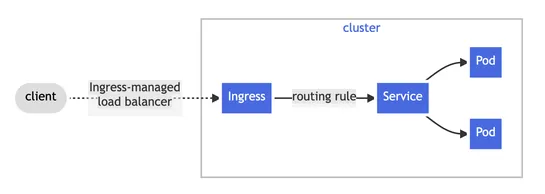
Why Kubernetes is retiring Ingress NGINX
Link
@kaptain shared a link, 1 month ago
FAUN.dev()

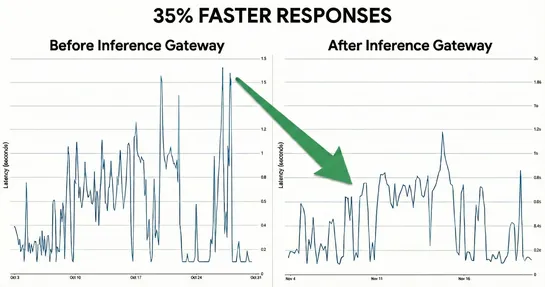
How GKE Inference Gateway improved latency for Vertex AI

Vertex AI now plays nice withGKE Inference Gateway, hooking into the Kubernetes Gateway API to manage serious generative AI workloads. What’s new:load-awareandcontent-aware routing. It pulls from Prometheus metrics and leverages KV cache context to keep latency low and throughput high - exactly what.. read more  

How GKE Inference Gateway improved latency for Vertex AI
Link
@kaptain shared a link, 1 month ago
FAUN.dev()

How Kubernetes Learned to Resize Pods Without Restarting Them

Kubernetes v1.35 introduces in-place Pod resizing, allowing dynamic adjustments to CPU and memory limits without restarting containers. This feature addresses the operational gap of vertical scaling in Kubernetes by maintaining the same Pod UID and workload identity during resizing. With this breakt.. read more  

How Kubernetes Learned to Resize Pods Without Restarting Them
Link
@kaptain shared a link, 1 month ago
FAUN.dev()

Introducing Node Readiness Controller

Kubernetes just dropped theNode Readiness Controller- a smarter way to track node health. It slaps taints on nodes based on custom signals, not just the plain old "Ready" status. The goal? Safer pod scheduling that actually reflects what’s going on under the hood. It's powered by theNodeReadinessRul.. read more  

Link
@kaptain shared a link, 1 month ago
FAUN.dev()

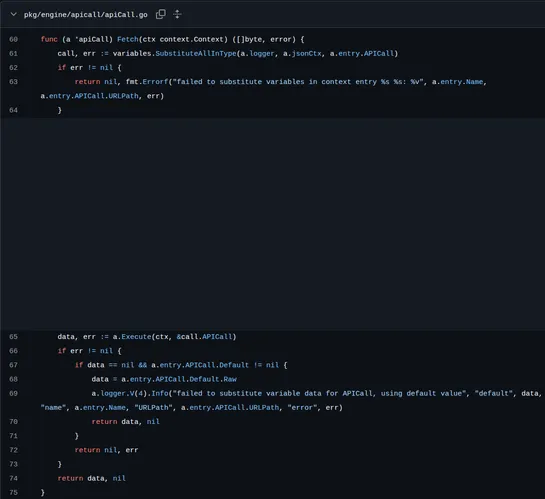
CVE-2026-22039: Kyverno Authorization Bypass

Kyverno - a CNCF policy engine for Kubernetes - just dropped a critical one:CVE-2026-22039. It lets limited-access users jump namespaces by hijacking Kyverno'scluster-wide ServiceAccountthrough crafty use of policy context variable substitution. Think privilege escalation without breaking a sweat. I.. read more  

CVE-2026-22039: Kyverno Authorization Bypass
Link
@kala shared a link, 1 month ago
FAUN.dev()

Self-Optimizing Football Chatbot Guided by Domain Experts on

Generic LLM judges and static prompts fail to capture domain-specific nuance in football defensive analysis. The architecture for self-optimizing agents built on Databricks Agent Framework allows developers to continuously improve AI quality using MLflow and expert feedback. The agent, such as a DC .. read more  

Link
@kala shared a link, 1 month ago
FAUN.dev()

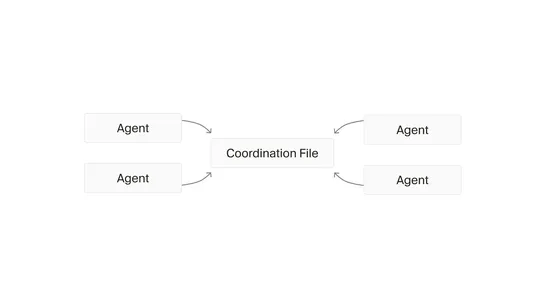
Towards self-driving codebases

OpenAI spun up a swarm of GPT-5.x agents - thousands of them. Over a week-long sprint, they cranked out runnable browser code and shipped it nonstop. The system hit 1,000 commits an hour across 10 million tool calls. The architecture? A planner-worker stack. Hierarchical. Recursive. Lean on agent ch.. read more  

Towards self-driving codebases
Link
@kala shared a link, 1 month ago
FAUN.dev()

Generative Pen-trained Transformer

MeetGPenT, an open-source, wall-mounted polargraph pen plotter with a flair for generative art. It blends custom hardware, Marlin firmware, a Flask web UI running on Raspberry Pi, and Gemini-generated drawing prompts. The stack? Machina + LLM. Prompts go in, JSON drawing commands come out. That driv.. read more  

Link
@kala shared a link, 1 month ago
FAUN.dev()

My AI Adoption Journey

A dev walks through the shift from chatbot coding toagent-based AI workflows, think agents that read files, run code, and double-check their work. Things only clicked once they built outcustom tools and configsto help agents spot and fix their own screwups. That’s the real unlock... read more  

Link
@kala shared a link, 1 month ago
FAUN.dev()

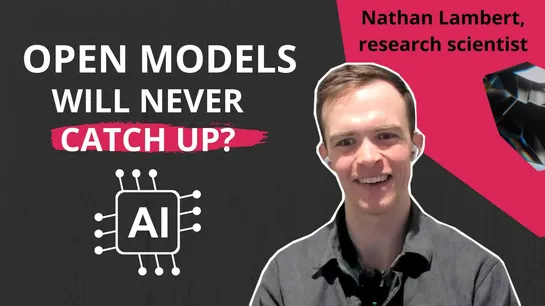
Nathan Lambert: Open Models Will Never Catch Up

Open models will be the engine for the next ten years of AI research, according to Nathan Lambert, a research scientist at AI2. He explains that while open models may not catch up with closed ones due to fewer resources, they are still crucial for innovation. Lambert emphasizes the importance of int.. read more  

Nathan Lambert: Open Models Will Never Catch Up
GPT-5.4 is OpenAI’s latest frontier AI model designed to perform complex professional and technical work more reliably. It combines advances in reasoning, coding, tool use, and long-context understanding into a single system capable of handling multi-step workflows across software environments. The model builds on earlier GPT-5 releases while integrating the strong coding capabilities previously introduced with GPT-5.3-Codex.

One of the defining features of GPT-5.4 is its ability to operate as part of agent-style workflows. The model can interact with tools, APIs, and external systems to complete tasks that extend beyond simple text generation. It also introduces native computer-use capabilities, allowing AI agents to operate applications using keyboard and mouse commands, screenshots, and browser automation frameworks such as Playwright.

GPT-5.4 supports context windows of up to one million tokens, enabling it to process and reason over very large documents, long conversations, or complex project contexts. This makes it suitable for tasks such as analyzing codebases, generating technical documentation, working with large spreadsheets, or coordinating long-running workflows. The model also introduces a feature called tool search, which allows it to dynamically retrieve tool definitions only when needed. This reduces token usage and makes it more efficient to work with large ecosystems of tools, including environments with dozens of APIs or MCP servers.

In addition to improved reasoning and automation capabilities, GPT-5.4 focuses on real-world productivity tasks. It performs better at generating and editing spreadsheets, presentations, and documents, and it is designed to maintain stronger context across longer reasoning processes. The model also improves factual accuracy and reduces hallucinations compared with previous versions.

GPT-5.4 is available across OpenAI’s ecosystem, including ChatGPT, the OpenAI API, and Codex. A higher-performance variant, GPT-5.4 Pro, is also available for users and developers who require maximum performance for complex tasks such as advanced research, large-scale automation, and demanding engineering workflows. Together, these capabilities position GPT-5.4 as a model aimed not just at conversation, but at executing real work across software systems.