


TL;DR
The 2025 Go Developer Survey reveals developers' desire for better best practices, enhanced standard library usage, and modernized tooling. AI-powered development tools are common, yet satisfaction is moderate due to quality concerns. Most respondents are experienced developers in the tech industry, highlighting challenges like ensuring code quality and finding reliable modules.
Key Points
Highlight key points with color coding based on sentiment (positive, neutral, negative).A major challenge for Go developers is identifying and consistently applying idiomatic best practices, along with finding trustworthy third-party modules.
Use of AI-powered development tools is now common among Go developers, but overall satisfaction remains moderate due to concerns about code quality and reliability.
A notable share of developers frequently need to consult documentation for core go commands such as go build, go run, and go mod. This fact highlights some usability gaps in the CLI help system.
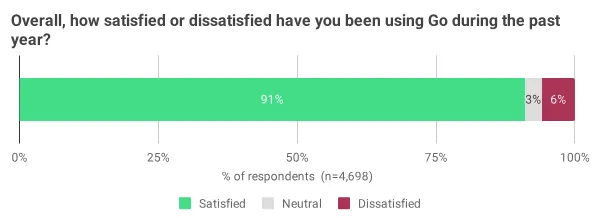
Despite these frictions, overall satisfaction with Go remains very high, with more than 90% of respondents reporting they are satisfied working with the language.
Most respondents are experienced professional developers who primarily use Go for work, develop on macOS or Linux, and deploy mainly to Linux-based environments.
The 2025 Go Developer Survey is out and it offers a clear snapshot of where the Go ecosystem stands today and where friction remains. Developers broadly value Go as a stable, productive platform, but they are asking for more guidance on best practices, better ways to leverage the standard library, and modernized tooling to reduce day-to-day friction.
AI-powered development tools are now widely used among Go developers, particularly for learning, boilerplate generation, unit tests, and autocompletion. However, satisfaction remains moderate. The dominant concern is code quality: AI-generated output often requires careful review, corrections, and contextual adjustments, which limits trust and caps productivity gains. AI is seen as helpful for reducing toil, not as a reliable autonomous coder.
The survey highlights a recurring usability issue with Go's tooling: core command documentation. A significant number of developers report frequently revisiting documentation for fundamental commands such as go build, go run, and go mod. The current help system is functional but not discoverable or ergonomic enough - this is what the data suggests.
Demographically, respondents are overwhelmingly experienced professional developers, many of whom adopted Go after working extensively in other languages. This creates a recurring challenge: when Go's idioms differ sharply from familiar paradigms, developers struggle to both learn and consistently apply "the Go way." This reinforces the call for more official, opinionated guidance and better tooling support to encode idiomatic practices.
Three challenges dominate developer feedback:
- Difficulty identifying and enforcing best practices.
- Missing language features commonly found elsewhere, particularly around error handling, enums, and expressiveness.
- Trouble identifying trustworthy third-party modules, with developers asking for stronger quality signals, maintenance indicators, and usage context.
On the environment side, Go remains firmly rooted in UNIX-like systems, with macOS and Linux dominating development and Linux-based deployments accounting for nearly all production use. Containers remain the default deployment target, while embedded and IoT usage is growing. VS Code and GoLand continue to lead as preferred editors, and AWS alongside company-owned infrastructure remain the most common deployment environments.
More details available in the official blog post.
Key Numbers
Present key numerics and statistics in a minimalist format.Total survey responses collected before data cleaning.
Total survey responses used after data cleaning.
Percentage of respondents who identified as professional developers.
Percentage of respondents using Go for their primary job.
Percentage of respondents using Go for personal or open-source projects.
Percentage of respondents aged between 25 and 45.
Percentage of respondents with at least six years of professional development experience.
Percentage of respondents with more professional development experience than Go-specific experience.
Percentage of respondents working in the technology industry.
Percentage of respondents working in organizations with 2–500 employees.
Percentage of respondents working alone.
Percentage of respondents working at organizations with more than 1,000 employees.
Percentage of respondents who have used Go for less than one year.
Percentage of respondents satisfied working with Go.
Percentage of respondents very satisfied working with Go.
Percentage of respondents reporting difficulty ensuring Go code follows best practices.
Percentage of respondents frustrated by missing language features found in other languages.
Percentage of respondents reporting difficulty finding trustworthy Go modules.
Percentage of respondents using AI-powered development tools daily.
Percentage of respondents not using AI-powered development tools or using them only a few times per month.
Percentage of respondents satisfied with AI-powered development tools.
Percentage of respondents somewhat satisfied with AI-powered development tools.
Percentage of respondents very satisfied with AI-powered development tools.
Percentage of respondents citing non-functional code as the primary problem with AI tools.
Percentage of respondents reporting poor quality even when AI-generated code works.
Percentage of respondents developing Go software on macOS.
Percentage of respondents developing Go software on Linux.
Percentage of respondents deploying Go software to Linux-based systems.
Percentage of respondents deploying Go software to Amazon Web Services (AWS).
Percentage of respondents deploying Go software to company-owned servers.
Percentage of respondents deploying Go software to Google Cloud Platform (GCP).
Percentage of respondents selecting 'Other' cloud providers for deployment.
Share of 'Other' cloud provider responses attributed to Hetzner.
Organizations
Key entities and stakeholders, categorized for clarity: people, organizations, tools, events, regulatory bodies, and industries.Google is a multinational technology company that develops software, cloud services, and programming languages, including stewardship of the Go programming language.
Tools
Key entities and stakeholders, categorized for clarity: people, organizations, tools, events, regulatory bodies, and industries.Go is a statically typed, compiled programming language designed for simplicity, reliability, and efficiency, commonly used for backend services, tooling, and cloud infrastructure.
AI-powered development tools assist programmers with tasks such as code generation, refactoring, documentation lookup, and boilerplate reduction.
Timeline of Events
Timeline of key events and milestones.The 2025 Go Developer Survey was conducted between September 9 and September 30, 2025 to collect data on developer experience, tooling, AI usage, and ecosystem challenges.
The results of the 2025 Go Developer Survey were publicly released by the Go Team.
The Go Team plans to release anonymized raw survey data for community analysis.
The Go Team stated intentions to improve contributor involvement and better understand developer concerns based on survey feedback.
Additional Resources
Enjoyed it?
Get weekly updates delivered straight to your inbox, it only takes 3 seconds!Subscribe to our weekly newsletter VarBear to receive similar updates for free!
Give a Pawfive to this post!
Share with your friends and followers
Start writing about what excites you in tech — connect with developers, grow your voice, and get rewarded.
Join other developers and claim your FAUN.dev() account now!

FAUN.dev()
FAUN.dev() is a developer-first platform built with a simple goal: help engineers stay sharp withou…



VarBear #SoftwareEngineering
FAUN.dev()
@varbearDeveloper Influence
16
Influence
1
Total Hits
121
Posts
Related tools


Featured Course(s)


Painless Docker - 2nd Edition
A Comprehensive Guide to Mastering Docker and its Ecosystem
