Join us

ContentRecent posts and updates..
Link
@koukibadr shared a link, 2 months ago
Mobile Developer, Nventive

LiveData vs StateFlow

LiveData and StateFlow both stream data reactively, but differ in two key ways:

Initialization — LiveData needs no initial value; StateFlow requires one.

Lifecycle — LiveData is lifecycle-aware by default; StateFlow is not, so you need to wrap it in repeatOnLifecycle to avoid memory leaks.

Code templating
Dev Swag
@ByteVibe shared a product

Mesh it - Developer T-Shirt

#developer  #merchandise  #swag 

Write it, cut it, paste it, save it, load it, check it, deploy it then mesh it! Made of 100% cotton, this t-shirt has a slim fit, so it's perfect for all body types. ✅ 100% cotton ✅ Classic fit ✅ Tear...

Mesh it - Developer T-Shirt
Link
@koukibadr shared a link, 2 months ago
Mobile Developer, Nventive

Code Templating

Link
@paunikar-jayesh shared a link, 2 months, 1 week ago
Backend Developer

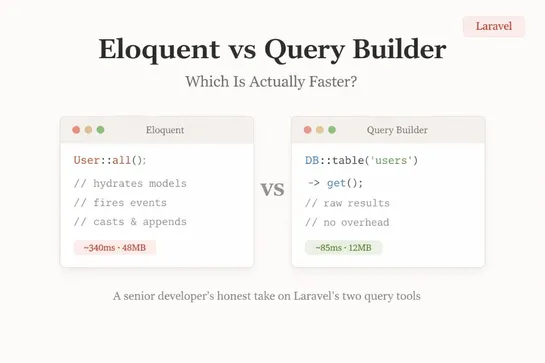
Laravel Eloquent vs Query Builder — Which One Should You Actually Use?

Your query builder vs Eloquent choice isn’t just about syntax — it can make or break your app’s performance.

In this article, I break down what actually happens under the hood when you use Eloquent vs Query Builder, based on real production experience. While both hit the same database, Eloquent adds layers like model hydration, events, and relationships — which feel great for clean code but can become costly at scale.

Through real benchmarks and practical examples, you’ll see why Eloquent can be 4x slower in heavy data scenarios — and why that often doesn’t matter for typical apps. The real problem isn’t Eloquent itself, but how developers misuse it (hello, N+1 queries 👀).

This isn’t a “pick one” debate. The real takeaway: smart developers use both — Eloquent for readability and relationships, Query Builder for performance-critical operations.

If you’ve ever wondered why your Laravel app suddenly slows down in production, this might be the missing piece.

Eloquent-vs-Query-Builder-comparison
Link
@simme shared a link, 2 months, 1 week ago
Senior Engineering Manager, @canonical

Boring code is an organizational tell

Boring code is an organizational symptom, not an aesthetic failure. Co-change patterns in version control reveal team boundaries before any retrospective does; ownership concentration predicts defects better than code complexity metrics. With agents removing the friction that contained clever code accumulation, the incentive structures that produce boring code have never mattered more.

gradients
Link
@hamzmu shared a link, 2 months, 2 weeks ago
Fellow, Rootly

Using Graphify to turn Incident Data into a Knowledge Graph

Karpathy said we should build LLM knowledge bases. 48 hours later made Graphify was made: one command, full semantic knowledge graph.

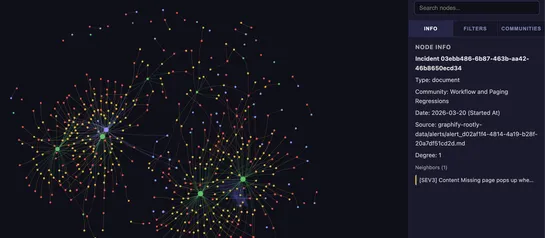
We applied the idea to incident data turning them into a queryable and interactable semantic graph. This lets us see past fixes, predict failures, cluster services, cut alert noise, and reveal team load in seconds.

If you’re using Rootly, here is a small plugin to explore your incident data.

Check it out: github.com/Rootly-AI-Labs/rootly-graphify-importer

Interactive knowledge graph visualization of incident management data showing clustered services, alerts, and responders with connected nodes and relationships in Graphify
Link
@pramod_kumar_0820 shared a link, 3 months ago
Software Engineer, Teknospire

Java 26 Released 🚀: What’s New, What Matters & Why It’s Faster Than Ever

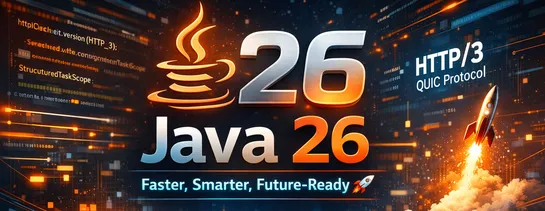
Java 26 (March 2026) is out, and while it’s not a headline-heavy release, it brings meaningful improvements where it counts — performance, networking, and concurrency.

Some notable updates:

🌐 HTTP/3 support (QUIC-based, lower latency, better reliability)

🧵 Structured Concurrency (Preview) for safer multithreading

JVM & GC optimizations improving startup and runtime performance

🧠 Continued evolution of pattern matching

🧪 Vector API (Incubator) for high-performance workloads

This release is less about flashy features and more about incremental improvements that impact real-world systems.

java_26_released_version
Link
@mmaksimovic shared a link, 3 months ago

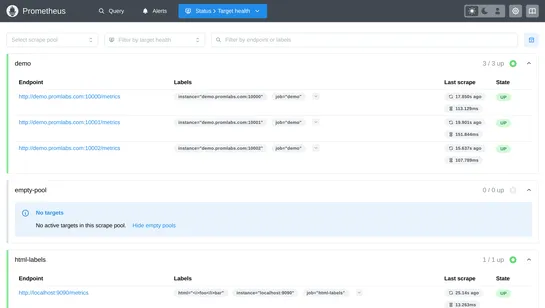
Monitoring Your App Without Running Your Own Prometheus Stack

When to use Prometheus and when to look for other solutions.

Monitoring Your App Without Running Your Own Prometheus Stack
Link
@tellsaqib shared a link, 3 months ago

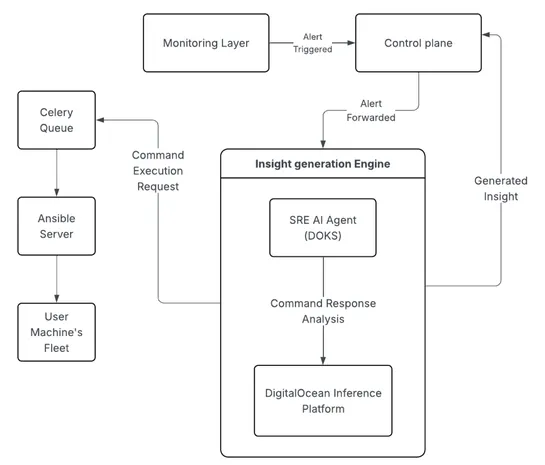
How Cloudways is manages its 90K servers fleet using Agentic SRE

Scaling Autonomous Site Reliability Engineering: Architecture, Orchestration, and Validation for a 90,000+ Server Fleet

How Cloudways is manages its 90K servers fleet using Agentic SRE
Link Xygeni Team
@mashka shared a link, 3 months, 1 week ago
Paid Acquisition and Growth Marketing, xygeni

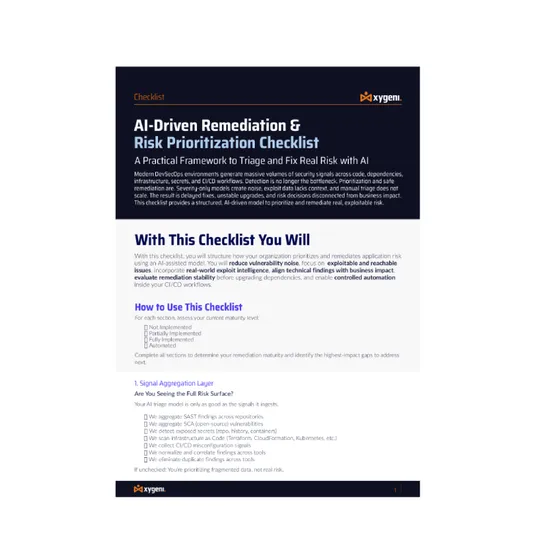
You don’t have a vulnerability problem. You have a prioritization problem.

Most teams today don’t struggle to find vulnerabilities; they struggle to decide what to fix first. With SAST, SCA, secrets, and CI/CD checks all generating signals, the real challenge is prioritization: what’s actually exploitable, what’s reachable, and what can be fixed without breaking things. Instead of relying only on severity, modern teams are shifting toward risk-based remediation, combining exploitability, context, and stability, while reducing noise across tools and automating safe fixes through PRs. If you’re dealing with alert fatigue or slow remediation cycles, this checklist is a practical starting point → https://go.xygeni.io/ai-driven-remediation-risk-prioritization-checklist

Ai-Driven Checklist
Link
@pramod_kumar_0820 shared a link, 3 months, 2 weeks ago
Software Engineer, Teknospire

Why Most Spring Boot Apps Fail in Production (7 Critical Mistakes)

Most Spring Boot applications run perfectly in development.

The APIs respond quickly, tests pass, and everything seems stable.

But once the application reaches production, things can change dramatically — slow responses, memory issues, and unexpected failures start appearing.

In many cases, the problem isn't Spring Boot itself.
It's a set of common mistakes developers unknowingly introduce into their applications.

In this article, we'll explore 7 critical mistakes that cause many Spring Boot apps to fail in production — and how to avoid them.

new